Clear Sky Science · en
Effects of silicon carbide nanoparticles on mechanical and vibrational characteristics of carbon glass epoxy hybrid composites
Stronger, Quieter Materials for Future Transport
Modern airplanes, cars, and trains all rely on layered plastic-and-fiber materials that are strong yet lightweight. This paper explores how adding tiny hard particles, far smaller than a grain of dust, can make such materials not only tougher but also better at handling vibration and blocking noise. The work points toward quieter cabins, safer structures, and more efficient vehicles that use less fuel.
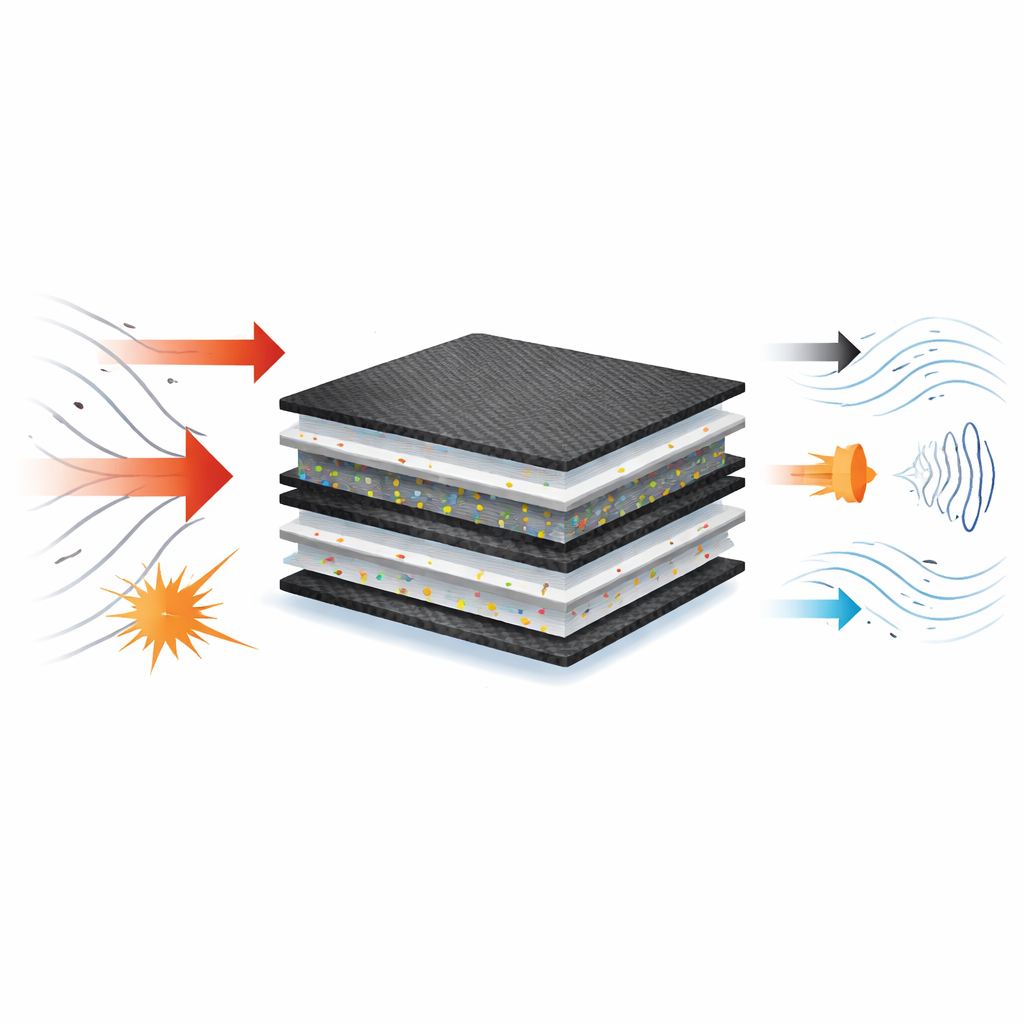
Building a Tough Sandwich of Fibers and Resin
The researchers started with a "sandwich" material made from alternating sheets of carbon fiber and glass fiber, all glued together with an epoxy resin. Carbon fiber brings high strength and stiffness but is expensive, while glass fiber is cheaper and durable, so combining them balances cost and performance. Into the epoxy, the team mixed ultra-small grains of silicon carbide, a very hard ceramic used in abrasives and electronic devices. These grains, called nanoparticles, ranged from 10 to 100 billionths of a meter in size. By changing how much nanoparticle powder they stirred into the resin—0%, 1%, 3%, and 5% by weight—they created a family of nearly identical panels that differed only in nanoparticle content.
Pushing, Bending, and Hitting the Panels
To see how these panels behaved in real-world conditions, the team subjected them to a series of standard tests. They pulled on the strips until they broke to measure tensile strength and stiffness, bent them in three-point bending tests to assess flexural strength, and struck them in a Charpy impact test to measure how much sudden energy they could absorb before fracturing. They also clamped slender strips like miniature diving boards and tapped them, tracking how they vibrated and how quickly the motion died away. Finally, they placed circular samples in a specialized tube and sent sound waves through them, recording how much sound was blocked over a wide range of tones relevant to engines, road noise, and machinery.
Finding the Sweet Spot for Nanoparticles
The results showed a clear “sweet spot” at 3% silicon carbide by weight. Compared with panels that contained no nanoparticles, these optimally filled panels were about one-fifth stronger in both pulling and bending tests, and noticeably stiffer. They also absorbed more energy when struck, meaning they resisted sudden impacts better. Under vibration, the 3% panels had the highest natural frequency and stiffness, indicating they would deflect less under dynamic loads. However, their ability to dissipate vibrational energy (damping) decreased compared with the unfilled material, reflecting a familiar trade-off: stiffer structures usually ring longer. At 5% nanoparticle content, strength and impact resistance actually dropped, even though stiffness rose, signaling that the material had become too brittle.
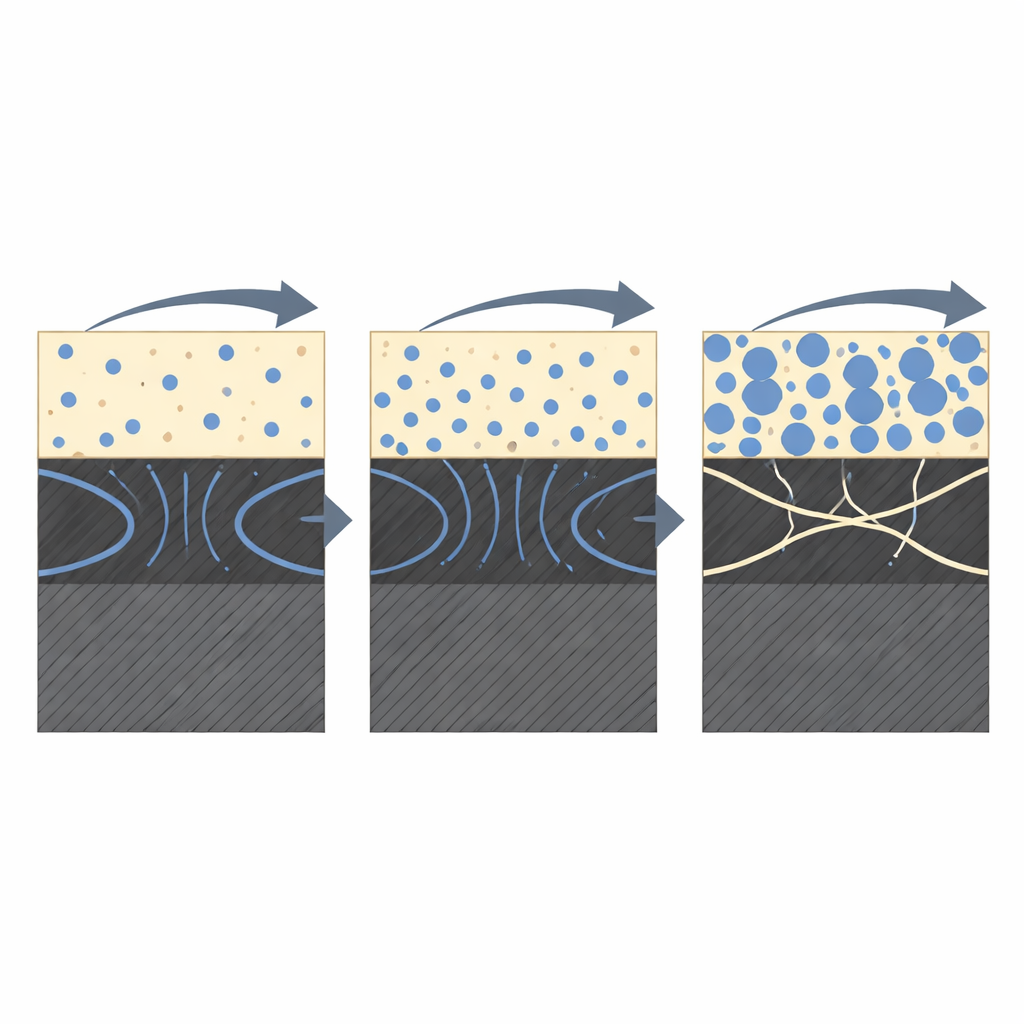
What Happens Inside the Material
Microscope images of broken samples helped explain this behavior. At low nanoparticle levels, the particles begin to anchor the resin more tightly to the fibers, reducing the amount of fiber pull-out and spreading stresses more evenly. At about 3%, the particles are well dispersed, and the resin forms a continuous, well-bonded layer around the fibers with few internal flaws; cracks have a harder time starting and growing, so the material carries more load before breaking. But at 5%, the particles start clumping together into clusters, leaving tiny gaps and weak spots in the resin. These clusters act like built-in cracks, focusing stress and leading to sudden, brittle failure—even though the overall resin layer is stiffer. In sound tests, on the other hand, the highest particle loading (5%) blocked the most noise, because the extra internal interfaces scatter and reflect sound waves more strongly.
What This Means for Everyday Technology
For non-specialists, the key message is that a little bit of the right nano-additive can transform a familiar material. In this case, carefully tuned amounts of silicon carbide nanoparticles turned a standard carbon–glass fiber panel into a stronger, stiffer, more impact-resistant, and acoustically useful material. Too few particles and the gains are modest; too many and the material becomes brittle, even if it blocks sound well. Hitting the “just right” level around 3% offers a balanced combination of strength, stiffness, vibration behavior, and weight that could help engineers design safer, lighter, and quieter structures for aircraft, cars, trains, and other advanced machines.
Citation: Suhas, K.S., Reddy, V.K., Reddy, Y.T. et al. Effects of silicon carbide nanoparticles on mechanical and vibrational characteristics of carbon glass epoxy hybrid composites. Sci Rep 16, 8009 (2026). https://doi.org/10.1038/s41598-026-39559-4
Keywords: nanoparticle-reinforced composites, hybrid fiber laminates, silicon carbide epoxy, vibration and noise control, lightweight structural materials