Clear Sky Science · en
From virtual to real: comparison of field experiments and DEM simulation of twin-disc granular fertiliser broadcaster
Why this research matters for farmers and food
Getting fertiliser in the right place is a quiet cornerstone of modern farming. If granules are spread unevenly, some plants are starved while others are overfed, wasting money and polluting soil and water. This study asks a simple but powerful question: can we trust computer simulations to predict how real fertiliser spreaders behave in the field, so that engineers can improve machines on a screen instead of through slow, costly outdoor trials?
From spinning metal discs to flying grains
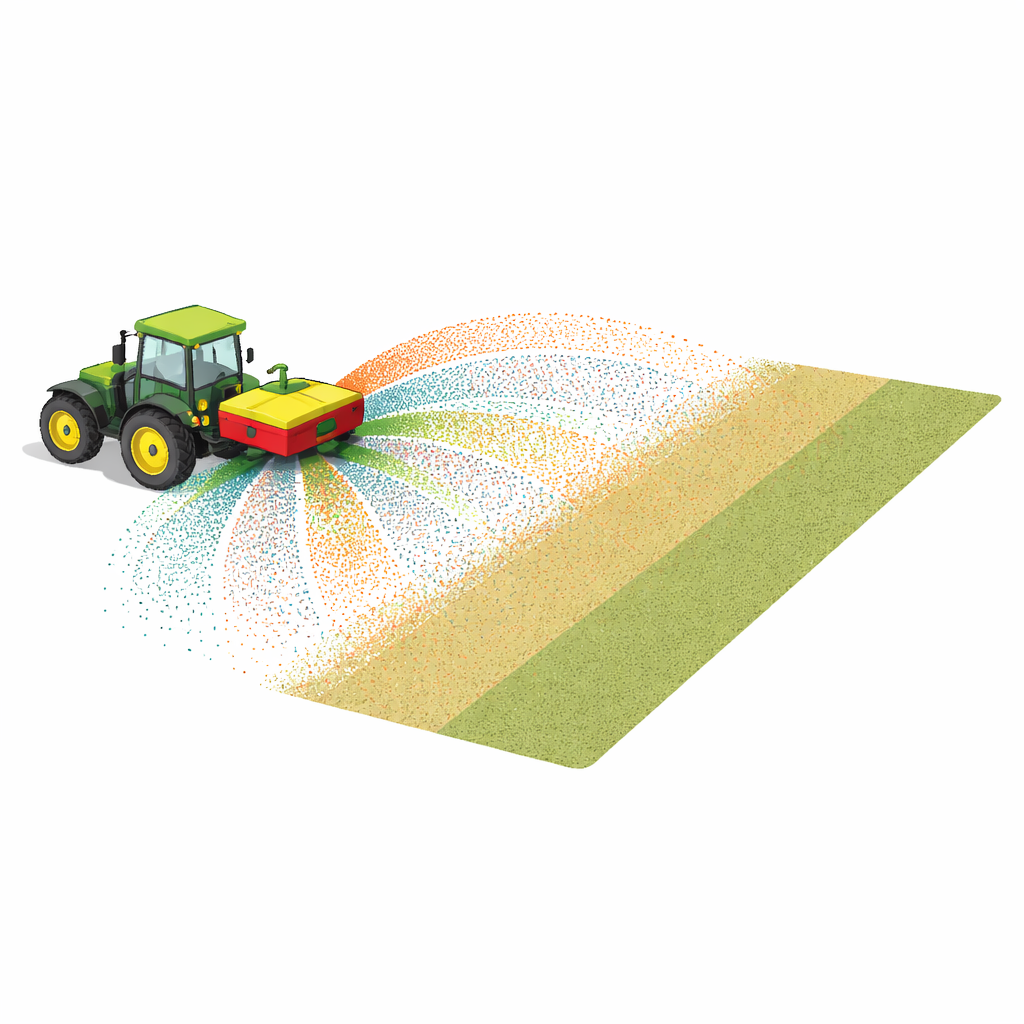
On many farms, a workhorse machine called a twin-disc fertiliser broadcaster flings tiny granules across wide swaths of land. Fertiliser drops from a tank onto two spinning metal discs fitted with short vanes that hurl the particles outward. The key challenge is to create a smooth, even carpet of granules sideways across the tractor’s path, known as transverse distribution. In this study, the researchers focused on a commercial broadcaster with a 1200-liter tank and stainless-steel discs 46 centimeters across, each fitted with three vanes set at a specific angle. They tested the machine at five disc speeds while applying a standard rate of fertiliser under calm outdoor conditions that follow international test guidelines.
Measuring real-world spreading on a test field
To see exactly where the fertiliser landed, the team arranged hundreds of collection bins in a grid pattern across a test area. As the tractor drove past at a steady speed, granules fell into these trays, which were later weighed on a precision scale. This setup allowed the researchers to map how much fertiliser reached every position across a 16-meter working width. Such field trials are demanding: they require good weather, careful setup, and a lot of labour and material. Yet they provide the ground truth needed to judge whether any computer model is realistic.
Building a digital twin of the spreader
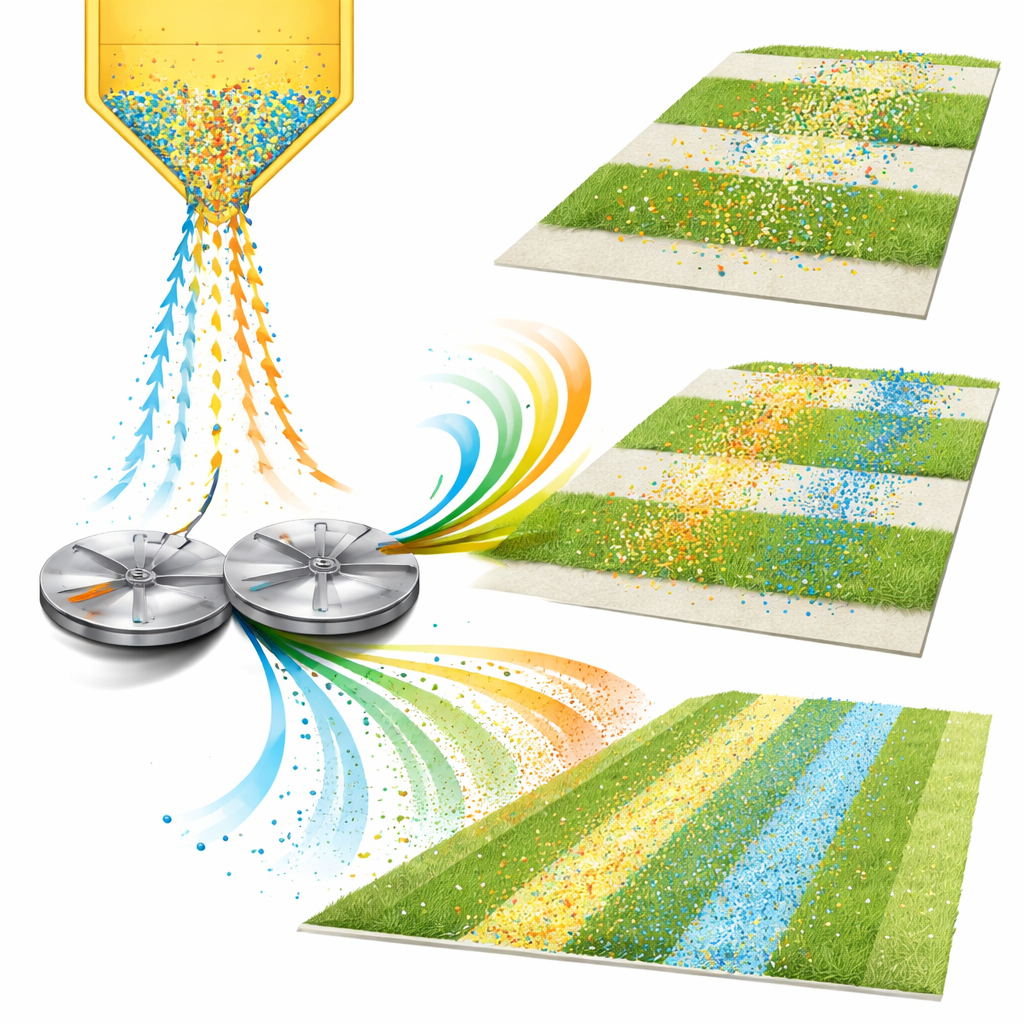
In parallel, the researchers built a detailed 3D model of the same broadcaster in specialised software that uses the Discrete Element Method (DEM). Instead of treating fertiliser as a smooth stream, DEM follows each grain as an individual object that collides, slides, and bounces off other granules and machine surfaces. The team entered fertiliser properties such as particle size distribution, density, and how elastic or sticky the grains are when they hit steel or each other. They also included air drag, tractor speed, disc speed, and air temperature to mimic the field conditions. To fine-tune the most uncertain interaction settings, like how much friction acts between fertiliser and steel, they used a statistical screening approach and then adjusted the most influential parameter until the simulated spread pattern best matched measurements at one representative disc speed.
How close virtual and real spreading can get
Once calibrated, the digital spreader was run at the same five disc speeds used outdoors. The researchers compared the amount of fertiliser in the virtual trays with that in the real bins across the 16-meter width. The differences were small: for three-vaned discs, the average discrepancy in fertiliser quantity across the working width was about 2%, and for individual speeds the gap ranged from almost zero to at most 5.9%. These deviations are lower than or comparable to those reported in earlier studies of similar machines, where simulation–field differences of roughly 9–11% were common. Interestingly, while some earlier work suggested that higher disc speeds increased sideways distribution in a straightforward way, this study found more nuanced effects, underlining the value of a realistic, grain-by-grain model.
What this means for smarter, cleaner farming
The study shows that, when a spreader and fertiliser are carefully described in DEM software, computer simulations can closely reproduce real-world spreading patterns for twin-disc broadcasters. This opens the door to using virtual trials to explore new disc designs, vane angles, fertiliser types, and operating settings with far less time, cost, and dependence on ideal weather. By helping engineers design machines that place nutrients more evenly where crops need them, such simulations can boost fertiliser efficiency and reduce excess run-off into the environment. In the long run, the same approach can be extended to other farm equipment and integrated into precision agriculture systems, supporting more sustainable and data-driven food production.
Citation: Kömekçi, F., Demir, V., Kömekçi, C. et al. From virtual to real: comparison of field experiments and DEM simulation of twin-disc granular fertiliser broadcaster. Sci Rep 16, 8548 (2026). https://doi.org/10.1038/s41598-026-39552-x
Keywords: fertilizer spreading, granular materials, farm machinery, computer simulation, precision agriculture