Clear Sky Science · en
Experimental investigation on spray morphology in dual pitch spiral nozzle
Why big water sprays matter
When a warehouse or industrial plant catches fire, you want a lot of water delivered quickly and spread where it counts. Special nozzles mounted in deluge systems do exactly this, turning pressurized water into wide blankets of spray. Yet, for one common design—the spiral nozzle—engineers have surprisingly little detailed data on how its sprays actually form and change as pressure rises. This study takes a close experimental look at a dual-pitch spiral nozzle to reveal how much water it delivers and how its spray shape evolves, with direct relevance to firefighting, cooling, and other industrial uses. 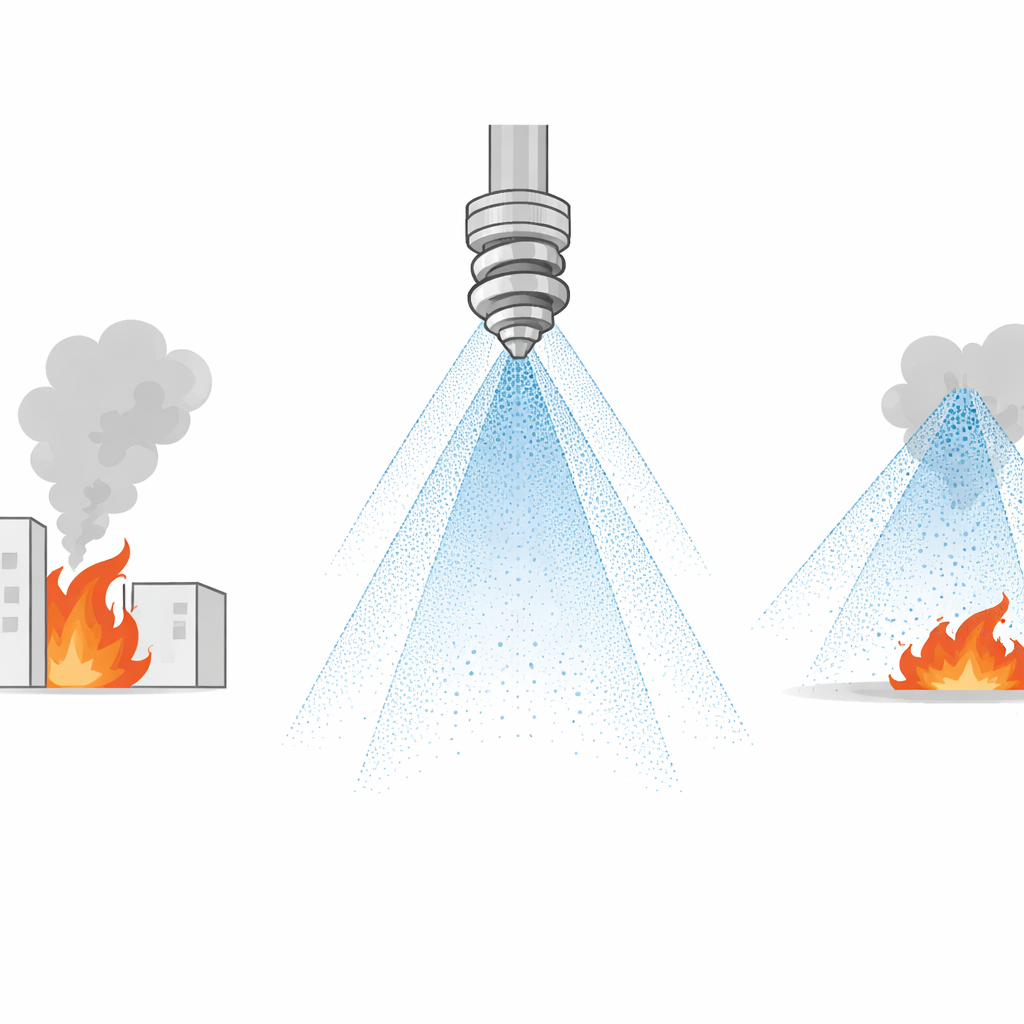
A closer look at a twisted metal tool
Spiral nozzles are compact, one-piece metal fittings whose tip is shaped like a helix. As water rushes past the spiral, it breaks into cones of droplets rather than a simple solid jet. These nozzles can handle very high flow rates—up to thousands of liters per minute—while resisting clogging, which is crucial when using hard or dirty water. They already appear in flue-gas cleaning, spray drying, distillation columns, and especially in deluge fire suppression systems where a flood of water must be released in seconds. Despite this broad use, most earlier studies only measured the outermost visible cone of spray, leaving the inner structures and detailed pressure-flow relationships largely unexplored.
Probing the hidden structure of the spray
The researchers focused on a spiral nozzle with two spiral pitches, meaning it can naturally form multiple sprays at once. Using a carefully controlled test setup, they pumped water through the nozzle at inlet pressures from 0.2 to 3.4 bar and measured how much water came out and how wide each spray cone became. A bright LED backlight and a high-quality digital camera captured the spray shapes against a dark background. The images were then processed with edge-detection techniques to pinpoint the spray boundaries and calculate cone angles for an outer spray (called Spray 1) and an inner spray (Spray 2). Mass flow rate was determined by weighing the collected water over time, with attention paid to measurement uncertainty and repeatability.
Three stages as pressure rises
The nozzle’s behavior fell naturally into three regimes. At very low pressure (around 0.2 bar), the water simply dripped out as large, coarse droplets—hardly a spray at all. Between 0.2 and 1 bar the flow increased slowly and became a continuous jet rather than a mist. Around 1.3 bar the jet entered a transition stage just before true atomization. Once the inlet pressure reached about 1.6 bar, the hallmark pattern appeared: two distinct sprays emerged, an outer cone and a narrower inner cone. As pressure climbed from 1.6 to 3 bar, the total mass flow rate surged by more than a factor of ten. Beyond 3 bar, however, the increase in flow began to level off, signaling that the nozzle was nearing a hydraulic saturation point set by its internal geometry. 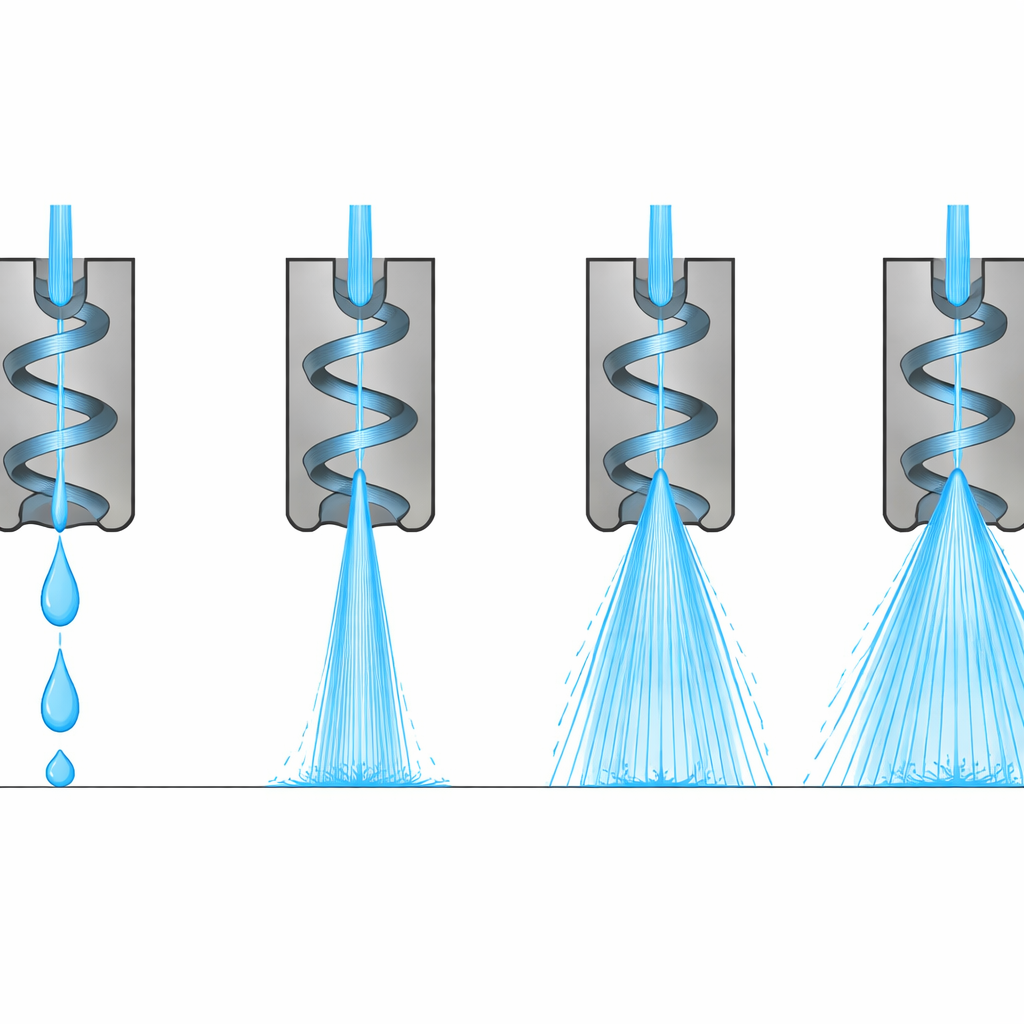
Two sprays, two very different behaviors
The dual-spray structure showed a striking split personality. The outer spray cone, Spray 1, reacted strongly to pressure: its angle grew from about 64 degrees at 1.6 bar to roughly 121 degrees at 3.4 bar, greatly widening the wetted area. In contrast, the inner spray, Spray 2, remained remarkably stable at around 30 degrees over the same pressure range, changing only slightly. At the highest pressures, faint secondary sprays also appeared near the main ones, and the edges of all sprays became more “dusty,” reflecting a cloud of finer droplets that made the boundaries harder to define. Both sprays showed signs of angular saturation above 3 bar, where further pressure increases produced little change, again underscoring the limiting role of the nozzle’s dimensions.
What this means for real-world systems
For non-specialists, the takeaway is straightforward: the way a spiral nozzle spreads water depends strongly on pressure up to a point, but then becomes limited by its shape. At modest pressures, the nozzle barely sprays; at typical operating pressures for fire suppression, it suddenly opens into two distinct cones, with the outer cone widening dramatically as pressure rises, while the inner one stays narrow and steady. Eventually, both flow and cone angles stop responding much to added pressure. These precise measurements give engineers reliable numbers for designing safer fire suppression and cooling systems and serve as a crucial reality check for computer simulations that seek to predict how such nozzles behave under demanding conditions.
Citation: Khani Aminjan, K., Strasser, W., Marami Milani, S. et al. Experimental investigation on spray morphology in dual pitch spiral nozzle. Sci Rep 16, 8577 (2026). https://doi.org/10.1038/s41598-026-39550-z
Keywords: spiral nozzle, spray morphology, fire suppression, atomization, spray cone angle