Clear Sky Science · en
Copper doped hybrid nanosponges functionalized with Aplysina aerophoba extract for enhanced bioactive performance
From Sea Sponge to Germ-Fighting Material
Antibiotic resistance is turning once-routine infections into serious medical threats, pushing scientists to search for new ways to stop harmful microbes. In this study, researchers turned to an unlikely ally: a bright yellow Mediterranean sea sponge called Aplysina aerophoba. By combining a chemical extract from this sponge with copper, they created tiny, porous particles—"nanosponges"—that can strongly inhibit the growth of several disease-causing bacteria in the lab, using a simple and environmentally friendly process.
A Natural Treasure Under the Waves
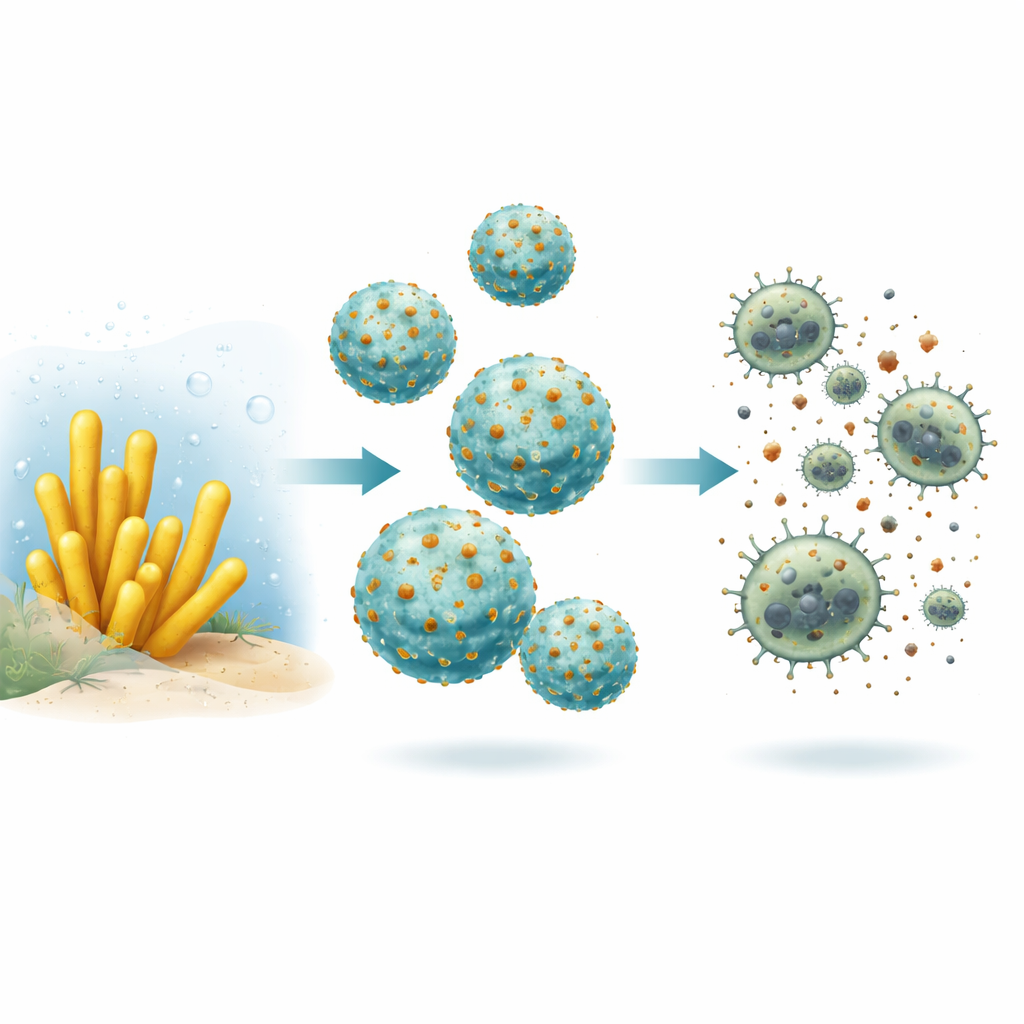
Aplysina aerophoba is a tube-shaped sponge that grows along rocky coasts in the eastern Atlantic and Mediterranean. For years, scientists have known that it is rich in unusual molecules that help the sponge defend itself against predators, invading microbes, and even cancer-like changes in cells. Some of these compounds show promising effects against tumors and in tissue repair. Because the sponge can now be farmed in the sea rather than harvested from the wild, it offers a renewable source of bioactive raw material for new medical technologies.
Building Tiny Copper-Rich Sponges
Instead of using purified proteins or enzymes, the team worked directly with a crude methanol extract of the sponge. They mixed a small amount of this extract into a salt solution that contained copper ions, under mild, water-based conditions similar to body fluids. As the reaction progressed, blue, sponge-like particles formed and settled out. Microscopy revealed that these particles are made of many tiny, petal-like sheets assembled into porous, flower-shaped clusters at the micro- and nanoscale. Further tests showed that copper and other elements from the sponge extract are evenly distributed throughout the structure, and that the material is crystalline, with building blocks only tens of nanometers wide.
Testing Antioxidant Power and Germ Control
The researchers next asked how these nanosponges behave biologically. Using a standard test that measures how well a substance can neutralize unstable, damaging molecules called free radicals, they found that the copper nanosponges themselves showed essentially no antioxidant activity. In contrast, the original sponge extract had a modest ability to quench these radicals, and a well-known vitamin-based antioxidant showed much stronger protection. This suggests that, once bound into the copper-based framework, many of the sponge’s antioxidant molecules are no longer accessible, and that copper may even push the material toward more reactive, rather than protective, behavior.
Beating Back Bacteria in the Lab
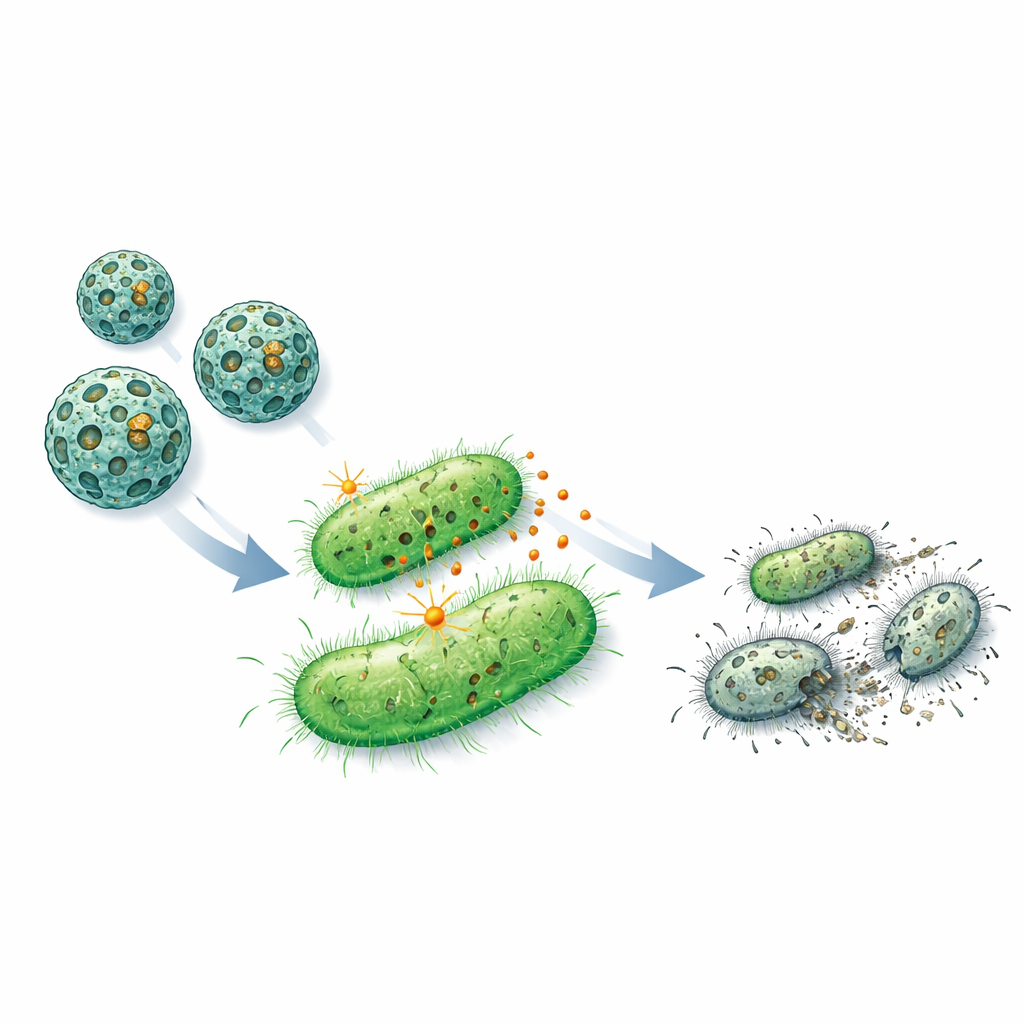
Where the copper nanosponges truly shined was in their ability to slow or stop the growth of harmful bacteria. The team tested them against one Gram-positive species, Staphylococcus aureus—a common cause of skin and wound infections—and four Gram-negative species, including Escherichia coli and Salmonella enterica, which can trigger serious intestinal disease. The crude sponge extract alone had almost no effect, and only weakly inhibited one strain at very high doses. By contrast, the copper-loaded nanosponges produced clear zones where bacteria could not grow, and they did so at concentrations up to 64 times lower than the extract. The strongest effects were seen against S. aureus and Aeromonas hydrophila. The likely reasons include copper ions disrupting the outer membrane of bacteria and promoting the formation of highly reactive oxygen species that damage vital molecules inside the cells.
Promise and Precautions for Future Uses
Overall, the study shows that a simple, low-energy “green” process can turn a cultivated marine sponge extract and a common copper salt into a stable material with strong antibacterial performance. To a non-specialist, the key message is that these hybrid nanosponges act like microscopic scrubbers that punch holes in harmful bacteria, while being made from relatively inexpensive, renewable ingredients. At the same time, the authors note that copper-based particles can be toxic at high levels and may raise environmental concerns if released unchecked. Before such materials are used in wound dressings, coatings, or drug delivery systems, their safety, durability, and long-term behavior in the body and the environment will need careful study. Still, this work offers a proof-of-concept platform for designing next-generation germ-fighting materials built from the chemistry of the sea.
Citation: Demirbas, A., Karsli, B., Uras, I.S. et al. Copper doped hybrid nanosponges functionalized with Aplysina aerophoba extract for enhanced bioactive performance. Sci Rep 16, 7854 (2026). https://doi.org/10.1038/s41598-026-39547-8
Keywords: marine sponge biomaterials, copper nanosponges, antimicrobial nanomaterials, green nanotechnology, Aplysina aerophoba