Clear Sky Science · en
Optimizing cement particle size for strength enhancement and CO₂ reduction in lightweight mortars
Why cement grains matter for climate and construction
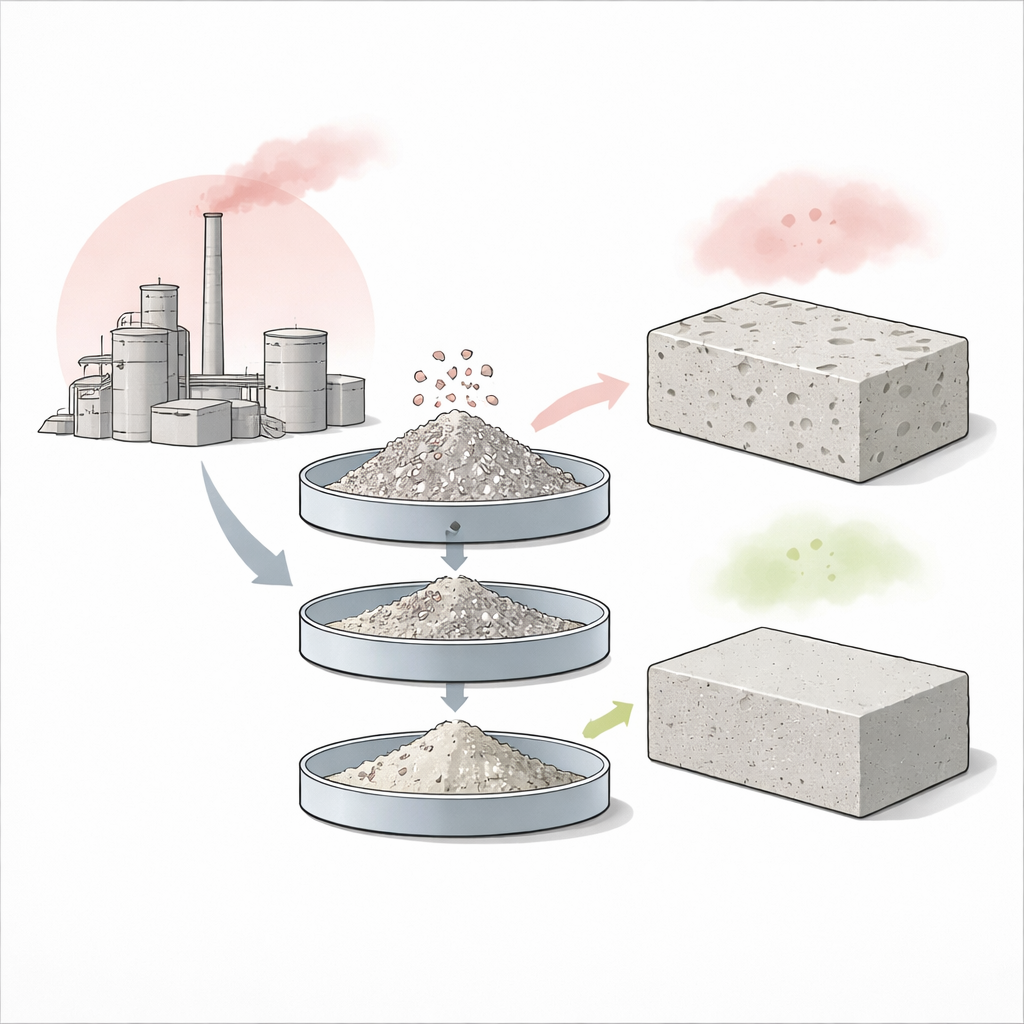
From bridges to apartment blocks, modern life leans heavily on cement. Yet making cement is one of the world’s largest industrial sources of carbon dioxide. This study explores a surprisingly simple lever for building stronger, lighter structures with a smaller carbon footprint: changing how fine the cement grains are, not by heavy grinding, but mainly by sieving out the coarser particles. The work shows how tuning grain size can boost strength, alter cracking behavior, and cut emissions per unit of strength in lightweight mortars used for thinner, lighter elements.
Smaller grains, lighter mixes, and everyday building needs
The authors focus on “lightweight mortars,” where some of the heavy sand is replaced with expanded clay. These mixes help reduce the weight of walls and slabs, which is attractive for high-rise buildings and renovations. However, lighter mixes often need more cement to reach the same strength, driving up both cost and emissions. To tackle this, the team compared three versions of the same Portland cement: a normal blend, a “fine” cement sieved so that particles above 50 micrometers were removed, and a “super fine” cement with only particles below 25 micrometers. Importantly, they did not grind the cement further—a process that is energy-hungry—but selectively screened out the largest agglomerates.
What finer cement does to fresh and hardened mortar
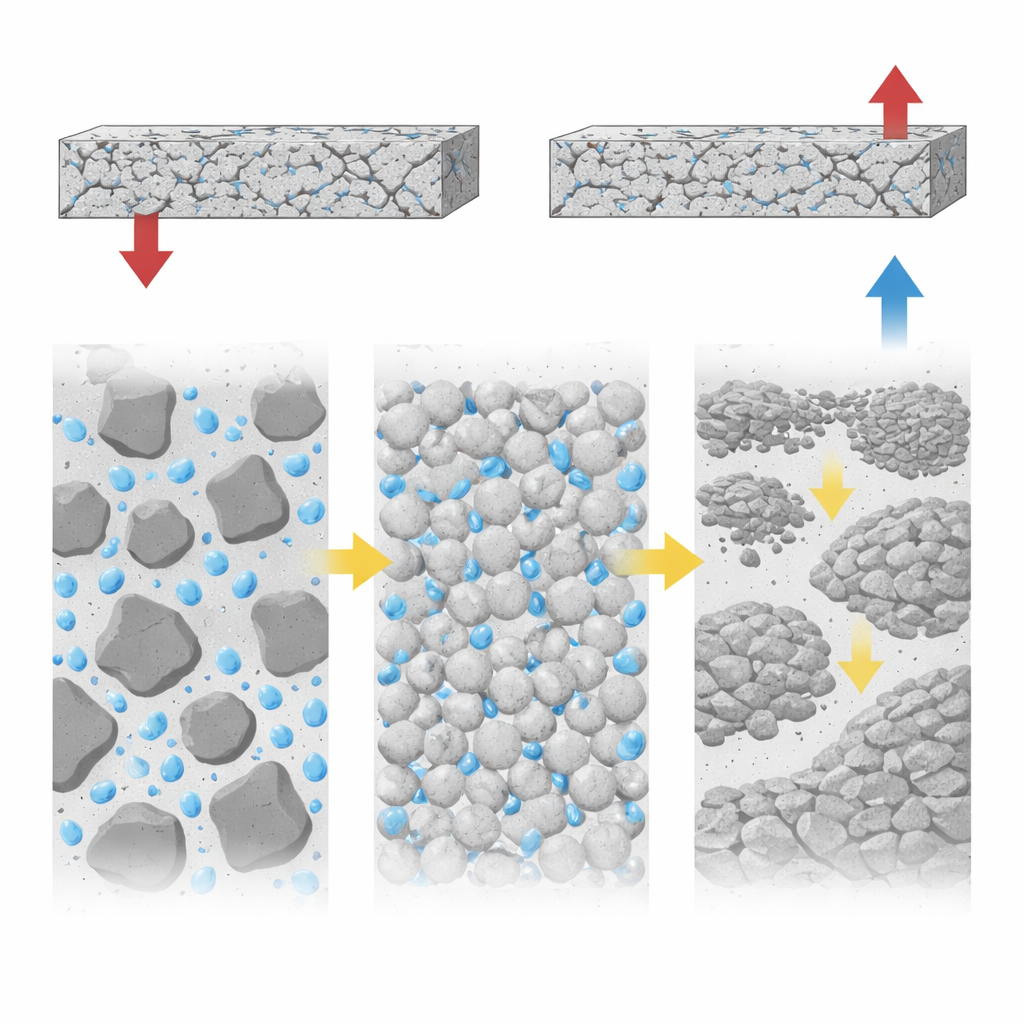
In the lab, the researchers mixed four mortars: a standard dense mortar, a lightweight version, and two lightweight versions made with the fine and super-fine cements. They kept the water content and chemical admixtures essentially constant so that only particle size would change the behavior. As cement got finer, the fresh mixtures flowed more easily and became slightly denser, a sign of better packing between grains. After hardening, compressive strength—the ability to withstand squeezing—rose sharply: the fine and super-fine mixes gained up to 40–45% more strength at three days and 15–21% more at seven days compared with the unsieved lightweight mortar. The trade-off was that resistance to bending went down modestly, and shrinkage increased, both linked to a stiffer, more brittle internal structure and a greater tendency for fine cracking.
Peering inside the grains to see reactions speed up
To understand why finer cement behaves this way, the team tracked its early reactions over the first 12 hours. Using X-ray diffraction, thermogravimetric analysis, and transmission electron microscopy, they watched key reaction products—especially the glue-like calcium silicate hydrate gel—form more quickly and in greater quantity in the finer cements. Microscopy images showed the internal “glue” evolving from scattered needle-shaped clusters to dense, foil-like and compact masses sooner when grains were small. Weight-loss measurements on heating confirmed more bound water and more hydrates in the fine and super-fine pastes, matching the observed jump in compressive strength. In other words, more surface area from finer grains gives water more places to react, so the internal skeleton of the material builds up faster and more densely.
Balancing energy use, emissions, and structural performance
Because cement production already consumes large amounts of energy and emits close to a ton of CO₂ per ton of product, the authors asked whether finer cement really helps the climate once processing is included. They built a life cycle assessment that compared three routes: ordinary cement, extra grinding to increase surface area, and simple sieving of standard cement into finer fractions. Grinding does raise emissions and electricity use, but it also increases strength enough that less cement is needed for a given design strength, slightly reducing CO₂ per unit of strength. Sieving turned out to be even more attractive. Passing cement through a 50 micrometer screen required only about 1% more energy but enabled up to 14% lower CO₂ emissions per unit strength in lightweight mortars; going all the way to 25 micrometers gave only modest extra strength at higher processing cost and higher shrinkage.
What this means for greener, lighter buildings
For non-specialists, the takeaway is that “how small the grains are” can be just as important as “how much cement you use.” By selectively removing only the coarsest particles, manufacturers can make mortars that are easier to place, significantly stronger in compression, and less carbon intensive per unit of strength—without massively increasing factory energy use. The study also warns that very fine cements can shrink more and crack more easily, which could affect long-term durability. Overall, the work suggests that a relatively low-tech adjustment—industrial sieving of cement near 50 micrometers—offers a practical path to lighter, stronger, and somewhat cleaner concrete-based materials.
Citation: Nieświec, M., Chajec, A., Walendzik, I. et al. Optimizing cement particle size for strength enhancement and CO₂ reduction in lightweight mortars. Sci Rep 16, 8418 (2026). https://doi.org/10.1038/s41598-026-39546-9
Keywords: cement fineness, lightweight mortar, compressive strength, CO2 emissions, life cycle assessment