Clear Sky Science · en
The role of habitat mosaics on biological communities at hydrothermal vents and their periphery
Hidden cities on the ocean floor
Far below the reach of sunlight, underwater hot springs called hydrothermal vents create oases of life on the dark seafloor. This study explores how life is arranged not just right on top of these vents, but also across the surrounding seabed. Understanding this patchwork of habitats matters because these same mineral-rich areas are drawing interest from deep-sea mining, putting little-known communities at risk before we even understand how they work.
A patchwork world under pressure
At the Lucky Strike vent field in the North Atlantic, the seafloor is anything but flat and uniform. Chimney-like structures, lava flows and rocky ledges mix with softer sediments, while hot vent fluids billow out and cool in the surrounding seawater. The authors used a remotely operated vehicle to photograph more than two hectares of seabed around several vent structures. From over 1,600 high-resolution images, they mapped both the animals present and key environmental features: how far each area lay from active venting, what kind of seabed it had (hard basalt, flatter rock slabs, sulphide deposits or loose sediment), and how rugged the terrain was. 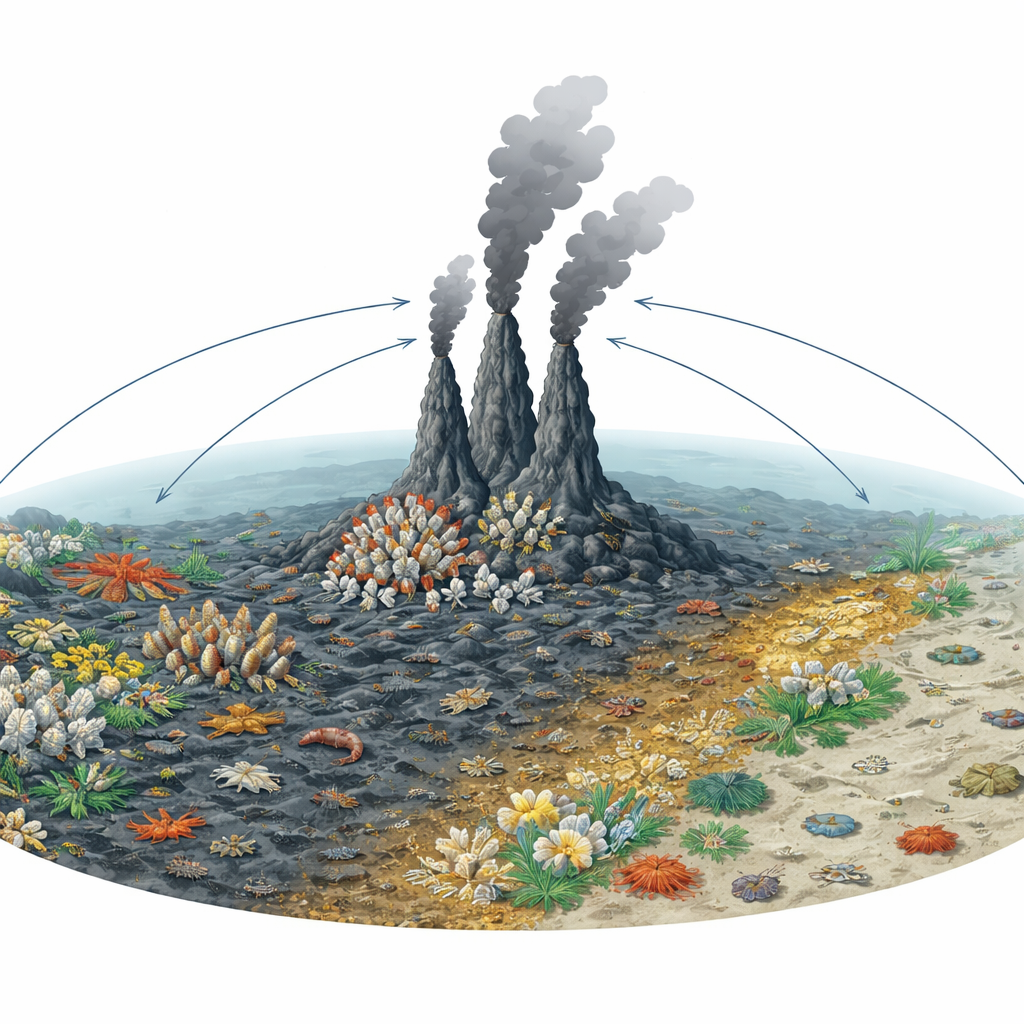
Life clinging to key structures
The survey revealed that large, sturdy vent edifices act as “keystone structures” that support dense, specialized communities. Massive towers coated in sulphide minerals hosted thick beds of vent mussels and their associated fauna. These mussel fields, in turn, provided habitat for other creatures such as shrimps, crabs and dense mats of tiny relatives of sea anemones (zoanthids). Because these edifices offer both a stable surface and a steady supply of chemical energy from vent fluids, they can sustain large, long-lived populations that help seed the wider region with larvae. Losing such structures would therefore have consequences that ripple far beyond their immediate footprint.
Communities beyond the vents
Moving away from the vents, the team found that life did not simply fade into a lifeless plain. Instead, there was a clear shift from vent specialists near active emissions to more varied deep-sea communities farther out. Within about 20 meters of active venting, life was dominated by organisms adapted to toxic, metal-rich fluids. Beyond that zone, roughly 30 different animal types shared the habitat, including shrimps, sea anemones, soft corals and sponges. These peripheral areas often had higher diversity than the hot core zones, especially where the seabed was hard and irregular, and where vent influence was weaker but still present.
Rocks that shape living neighborhoods
The type of ground underfoot turned out to be just as important as distance from the vents. Hard basalt with bouldery relief and solid slabs supported richer and denser communities than soft, loose sediments. Basaltic areas with complex topography hosted especially high numbers of suspension feeders such as glass sponges and branching corals, likely because rough surfaces enhance local currents and food delivery while offering shelter from the harshest vent conditions. Sulphide deposits near vents harbored their own distinct set of species, including tiny foraminifera that formed dense clusters. In contrast, soft volcaniclastic sediments were poorer in both density and diversity of large animals, reflecting how many deep-sea species need firm surfaces to anchor themselves.
A mosaic with big implications
Taken together, these results show that hydrothermal vent fields are surrounded by a fine-scale mosaic of habitats, shaped by the interplay of vent exposure, seabed hardness and terrain complexity. This patchwork, changing over distances of only tens of meters, supports a blend of vent specialists and more typical deep-sea fauna, boosting overall biodiversity. Because inactive and peripheral areas can be just as rich and ecologically distinctive as the vents themselves, treating them as expendable zones for mineral extraction is misleading. Any future mining plans that focus on supposedly “safe” inactive deposits risk destroying unique communities that we are only beginning to understand. 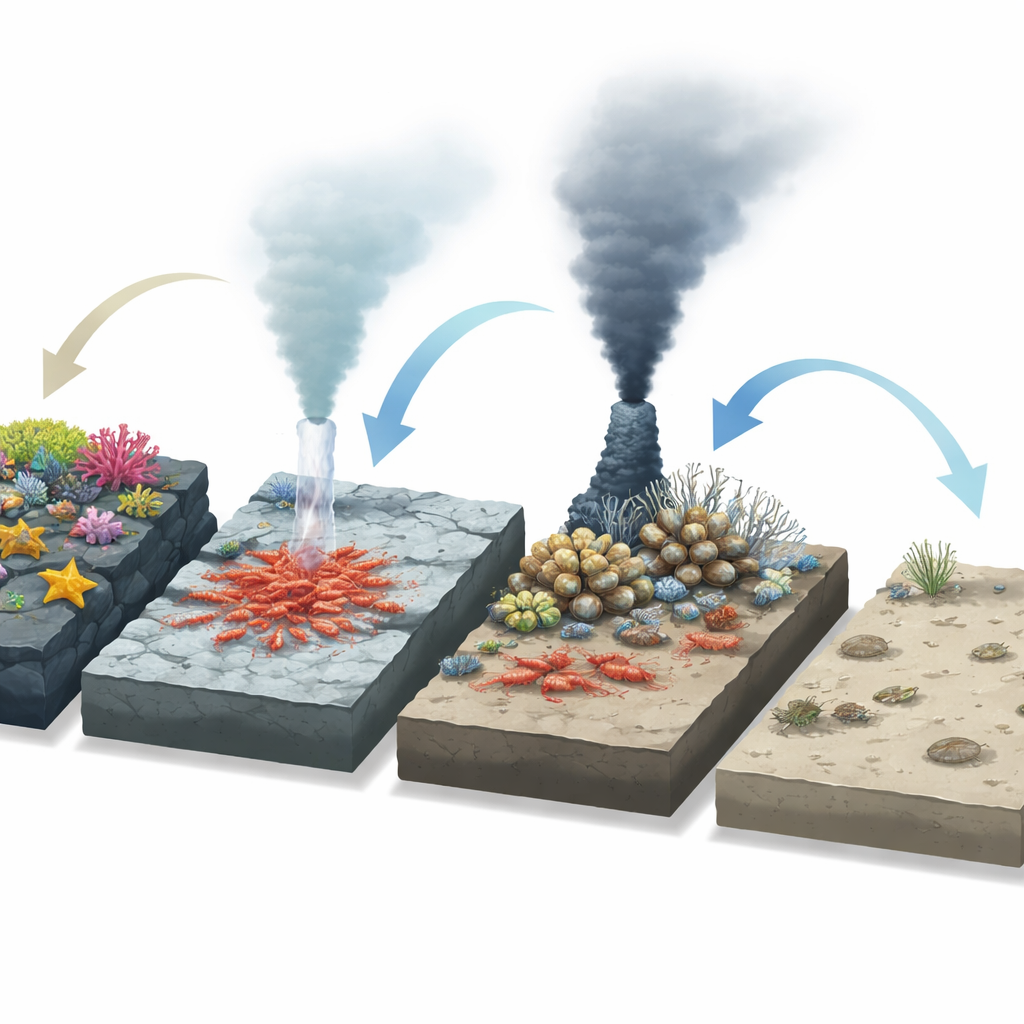
Citation: Loïc, V.A., Jozée, S., Annah, R. et al. The role of habitat mosaics on biological communities at hydrothermal vents and their periphery. Sci Rep 16, 9751 (2026). https://doi.org/10.1038/s41598-026-39544-x
Keywords: hydrothermal vents, deep-sea biodiversity, seafloor habitats, marine conservation, deep-sea mining