Clear Sky Science · en
A deep neural network model for heat transfer in darcy–forchheimer hybrid nanofluid flow with activation energy
Smarter Engine Oils for Tough Jobs
From car engines to power plants, modern machines push enormous amounts of heat through tight spaces. Ordinary oils struggle to keep up, especially under high temperatures, strong magnetic fields, or inside porous materials like filters and catalytic beds. This study explores a new class of “smart” lubricants—engine oils loaded with tiny ceramic particles—and shows how advanced neural networks can predict how these fluids move heat and dissolved chemicals much faster than conventional simulations.
Building a Better Working Fluid
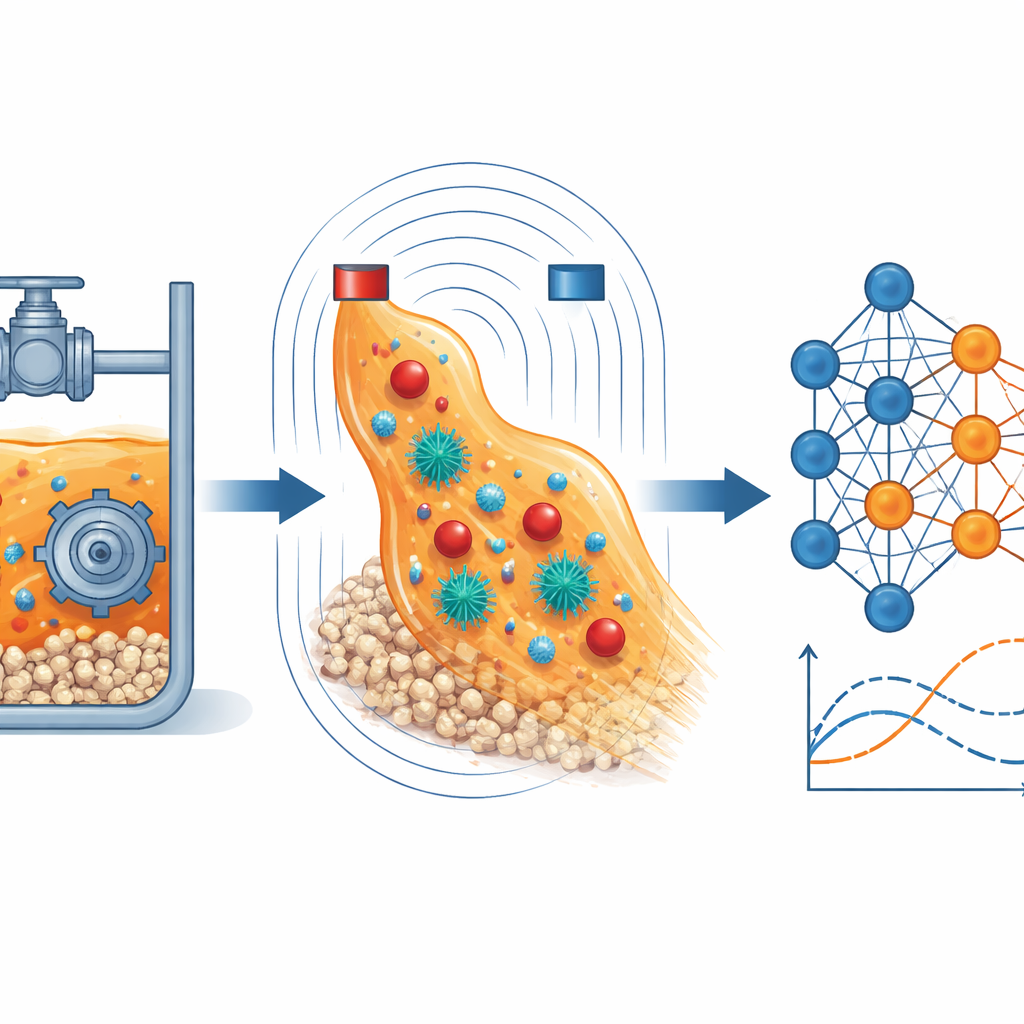
The researchers start by designing a hybrid nanofluid: regular engine oil is enriched with two kinds of nanoparticles, aluminum oxide and titanium dioxide. Each particle type brings high thermal conductivity and mechanical robustness, and together they boost the fluid’s ability to carry heat while remaining stable at temperatures above 300 °C. The base oil itself behaves like a non-Newtonian Casson fluid, meaning it resists motion until a certain stress is applied and then flows more easily—a realistic description of many industrial lubricants, paints, and polymer suspensions. This combination is tailored for demanding environments such as lubrication channels, catalytic porous beds, and compact heat exchangers.
Extreme Conditions Inside Porous Structures
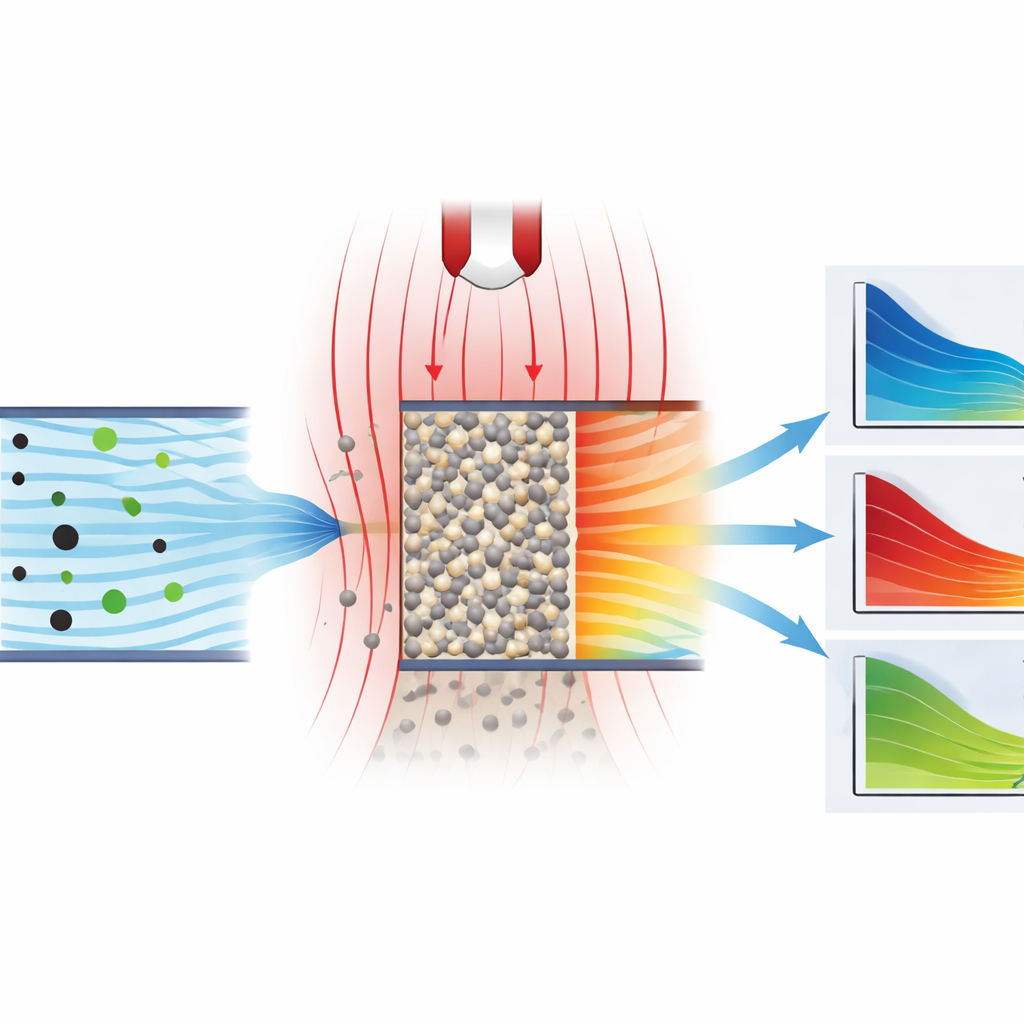
To mimic real industrial settings, the team analyzes the flow over a radially stretching surface embedded in a porous medium—a simplified stand-in for channels, filters, or packed beds. Here the fluid faces resistance from both simple permeability (Darcy drag) and additional inertial blocking (Forchheimer drag). A magnetic field is applied, generating a Lorentz force that resists motion, and the fluid both absorbs and emits thermal radiation. At the same time, a reactive chemical species dissolved in the fluid follows an Arrhenius-type law: reactions speed up sharply once enough activation energy is available. These intertwined effects shape three key profiles in the fluid layer: velocity (how fast it moves), temperature (how it carries heat), and concentration (how species spread and react).
From Hard Equations to Fast Predictions
Capturing all these couplings leads to a set of highly nonlinear differential equations, which are first reduced to a more manageable form using similarity transformations and then solved numerically with a boundary-value solver. These high-fidelity solutions become the training data for a specialized machine-learning model: a Morlet Wavelet Neural Network optimized using particle swarm intelligence and a secondary neural-network optimizer. Instead of learning from experimental measurements, the network learns directly from the detailed physics-based solutions, covering a wide range of settings for magnetic field strength, porous resistance, radiation intensity, and activation energy. Once trained, it can instantly predict velocity, temperature, and concentration profiles for new parameter combinations with accuracy above 99%, while cutting computation time by about 45% compared with rerunning the numerical solver every time.
How Fields, Heat, and Chemistry Reshape the Flow
The results reveal a clear physical picture. Stronger magnetic fields slow the fluid by 15–25%, as the Lorentz force acts like an extra brake. Increased porous drag further suppresses motion, converting some of the flow’s kinetic energy into heat. Thermal radiation and magnetic (Joule) heating raise temperatures by roughly 15–20%, thickening the thermal layer near the surface. In contrast, higher activation energy throttles the chemical reactions, so the reactive species is consumed more slowly and its concentration stays higher within the porous region. Compared with pure engine oil or suspensions containing a single nanoparticle type, the hybrid mixture improves heat transfer by about 12–30%, highlighting its promise for high-demand cooling and lubrication tasks.
Why This Matters for Real Machines
For engineers designing next-generation thermal systems, these findings offer both a new working fluid and a powerful design tool. The hybrid nanofluid delivers superior heat removal and lubrication under magnetic fields, radiation, and complex porous resistance, making it attractive for applications such as smart heat exchangers, lubricated bearings, transformers, and catalytic reactors. At the same time, the neural-network framework provides rapid, accurate predictions of flow, heat, and mass transfer without repeatedly solving expensive equations. In practical terms, this means faster optimization of operating conditions and fluid formulations, better energy efficiency, and more reliable thermal control in the harsh environments where modern machines must operate.
Citation: Ayman-Mursaleen, M., Saeed, S.T., Almohammadi, S.M. et al. A deep neural network model for heat transfer in darcy–forchheimer hybrid nanofluid flow with activation energy. Sci Rep 16, 8339 (2026). https://doi.org/10.1038/s41598-026-39536-x
Keywords: hybrid nanofluid, engine oil heat transfer, magnetohydrodynamics, porous media flow, neural network modeling