Clear Sky Science · en
Spatiotemporal infestation patterns of Aceria litchii Keifer (Acari: Eriophyidae) in a lychee orchard in South Florida
Why tiny tree pests matter
Lychee is a prized tropical fruit in Florida and around the world, but a microscopic mite now threatens this crop. The lychee erinose mite feeds on tender leaves and flowers, triggering fuzzy, blister-like growths that weaken trees and ruin fruit. This study tracked how the mite invaded a single lychee orchard in South Florida over one growing season, revealing how quickly it spreads, which trees are most at risk, and what that means for growers trying to protect their orchards.
Watching an invasion unfold
Researchers followed 190 lychee trees in an experimental orchard after the mite was first discovered there in early 2022. Every two weeks, they inspected each tree, recording whether it was infested and exactly where the damage appeared in the canopy. They also noted tree height, variety, and seasonal changes such as new leaf growth, flowering, and fruiting. By combining these observations with statistical models, they reconstructed how the infestation started from a few trees and then swept through nearly the entire block.
Fast spread, close neighbors
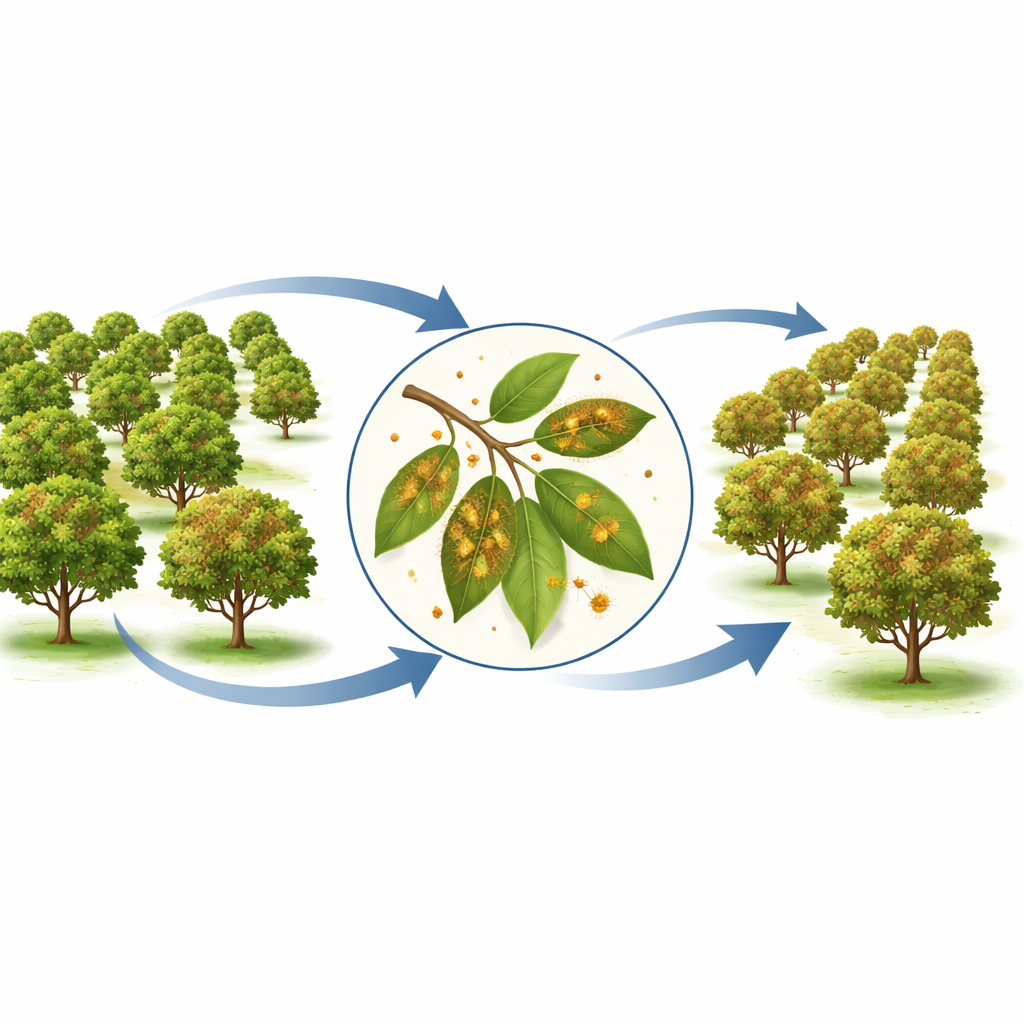
The invasion began slowly: it took almost 80 days for just 10 percent of the trees to show signs of attack. After that, the outbreak accelerated dramatically, jumping to around 90 percent of trees in only about 100 more days. Maps of the orchard showed that damage radiated out from two starting points in the center, with the odds of infestation strongly tied to how close a tree was to an already infested neighbor. This pattern points to short-range movement along branches and between touching canopies as the main engine of spread, with long-distance jumps playing a secondary role.
Where and which trees get hit hardest
The mites did not settle randomly on the trees. First signs of damage appeared most often on the lower and middle parts of the outer canopy, especially on the north-facing sides. Taller trees were more likely to be infested than shorter ones, likely because larger canopies produce more fresh growth and present a bigger target for mites drifting on air currents. Tree variety also mattered. Two popular commercial types, ‘Mauritius’ and ‘Sweetheart’, were readily infested, while ‘Brewster’ trees were less affected overall and had fewer damaged patches that progressed all the way to the final, dark stage of injury.
Growth spurts, flowers, and hidden hitchhikers
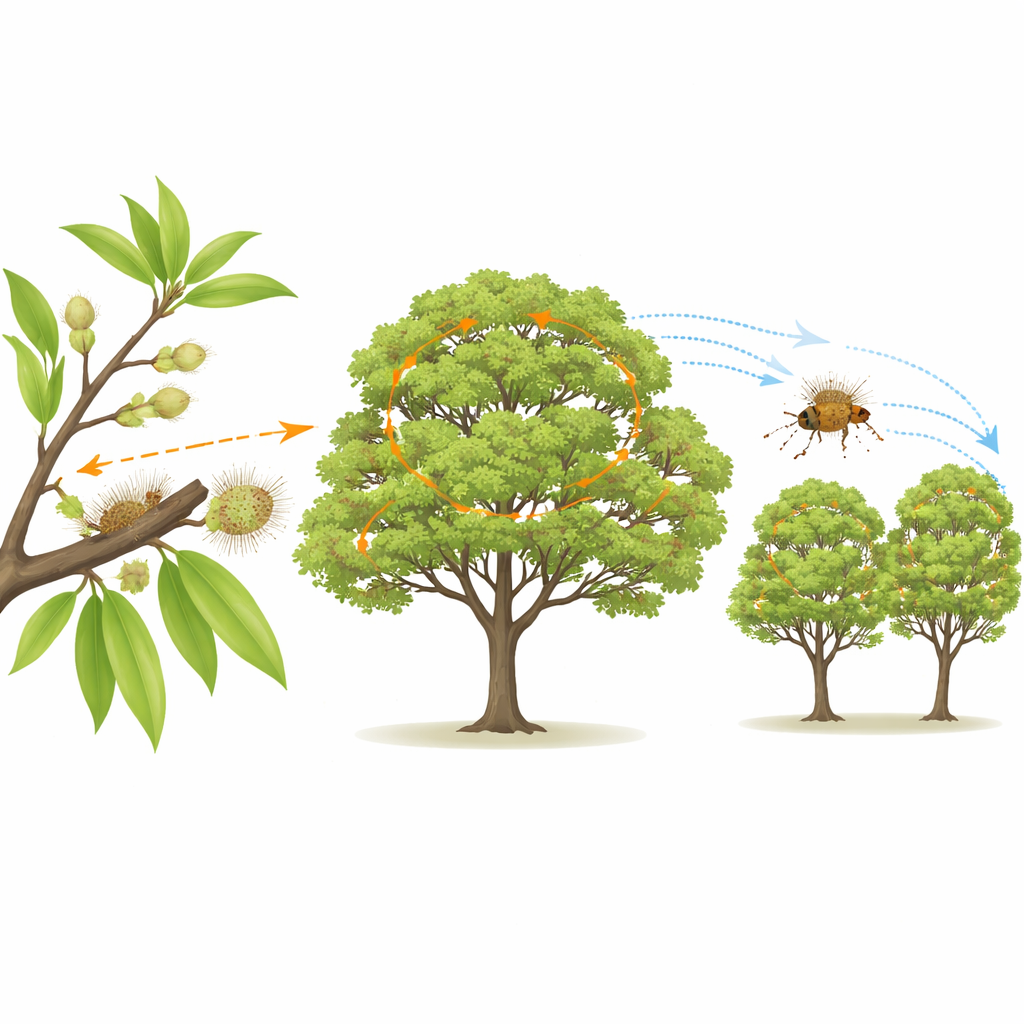
The timing of tree growth helped explain the infestation patterns. In South Florida, lychee trees produce new flushes of leaves for much of the year, with a strong surge from June to November. These tender shoots are the mite’s preferred food, and infestation levels rose in step with the amount of new growth. Flowering also coincided with the early spread of the mite. Other studies have shown that honeybees visiting lychee blossoms can carry the mites between trees. Together with wind, these pollinators likely move mites longer distances, while most of the day-to-day expansion appears to come from mites simply crawling from old, overused patches to nearby fresh tissues.
What this means for lychee growers
For growers, the message is that warm weather, nearly year-round new growth, and dense plantings create ideal conditions for this tiny invader to thrive in Florida. Nearly the entire orchard became infested within a few months, but the study also points to weak spots in the mite’s strategy. Because it tends to start on the outer middle parts of the canopy and tracks new growth and flowers, regular scouting of these areas can give early warning. The relatively lower damage on ‘Brewster’ trees, along with the finding that heavy pruning alone may not stop re-infestation, suggests that more targeted approaches—such as timed protective treatments after harvest or pruning, and attention to flowering periods when pollinators are most active—could limit mite buildup while preserving tree health and yield.
Citation: Ataide, L.M.S., Riley, S., Dutra, J. et al. Spatiotemporal infestation patterns of Aceria litchii Keifer (Acari: Eriophyidae) in a lychee orchard in South Florida. Sci Rep 16, 9025 (2026). https://doi.org/10.1038/s41598-026-39535-y
Keywords: lychee pests, invasive mites, orchard management, crop protection, Aceria litchii