Clear Sky Science · en
Fluid injection interruption causes temporary changes in local stress field and induced seismicity at Krafla caldera, Iceland
Why shaking from clean energy matters
Geothermal power promises low‑carbon electricity by tapping Earth’s internal heat. But pumping water into hot rocks can sometimes trigger small earthquakes, worrying nearby communities and regulators. This study zooms in on a famous geothermal field inside Iceland’s Krafla volcano to ask a deceptively simple question: what happens underground, and to local earthquake activity, when operators suddenly stop injecting cold water into the hot reservoir rock?
A natural laboratory inside an Icelandic volcano
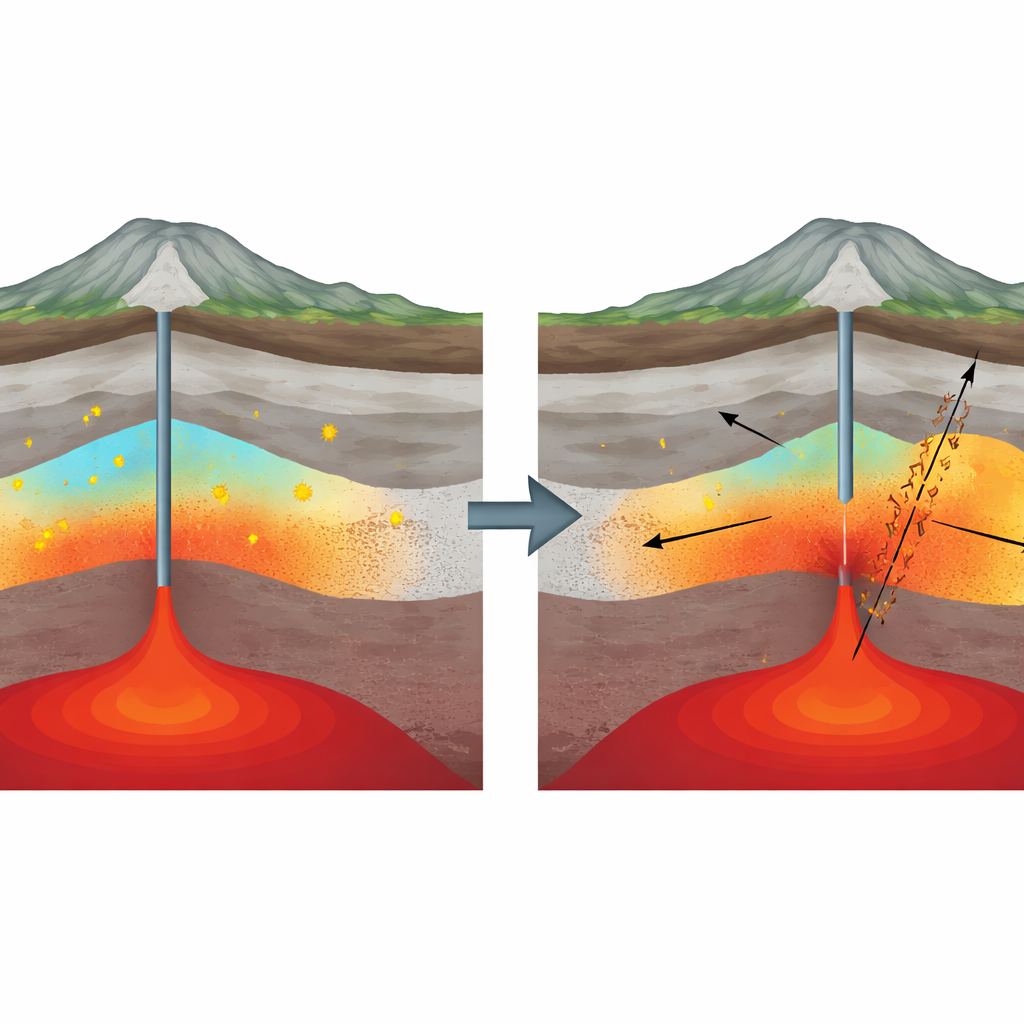
Krafla is a restless volcano sitting on Iceland’s spreading plate boundary, where the crust is already under strong tectonic and magmatic forces. For decades, engineers have drilled wells there to produce steam and hot water for electricity, and since 2002 one particular well, KG‑26, has been used to inject cooled geothermal water back into the subsurface. Because the area is blanketed by permanent seismometers, and a very dense temporary network of nearly one hundred instruments was deployed across the caldera in 2022, Krafla is one of the best‑monitored geothermal systems on Earth. That dense network gave scientists a rare chance to watch in fine detail how underground stresses and earthquake patterns respond when injection is deliberately paused for several days.
Listening to tiny quakes and polarized waves
The team first looked at thousands of small earthquakes recorded between 2017 and 2022. Using a technique called template matching, they searched for events whose seismic waveforms closely resembled a reference earthquake located beneath the injection well that showed sideways, or strike‑slip, motion on a nearly vertical fault. This allowed them to pull out a subtle cluster of similar strike‑slip quakes from the much broader background of normal faulting earthquakes typical of the region. At the same time, they analyzed how shear waves split into two components as they passed through cracked, fluid‑filled rocks. The direction of the faster wave and the delay between the two carry information about how fractures are aligned and how full of fluid they are, which in turn reflects the local stress field and pore pressure.
What changed when the pumps were turned off
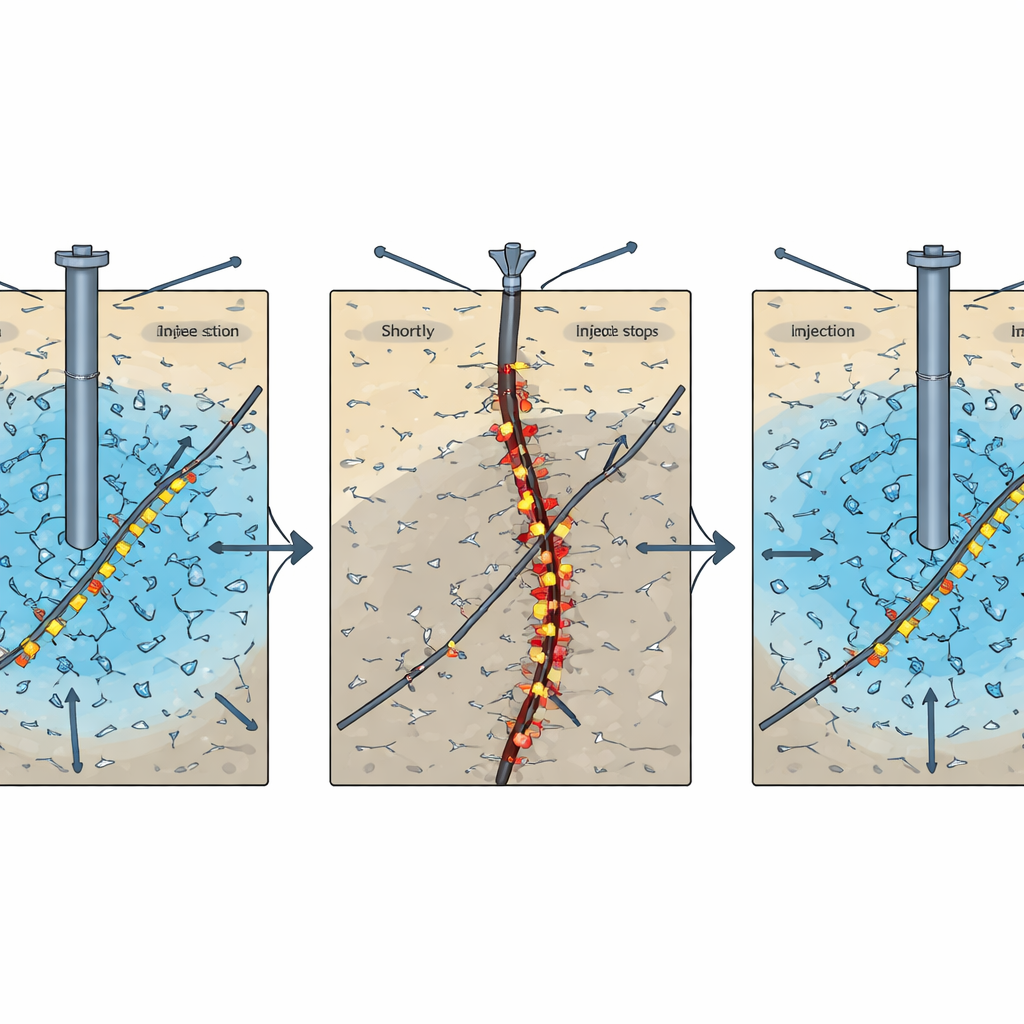
During a 25‑day experiment in summer 2022, operators shut off injection in well KG‑26 over a 30‑minute interval and kept it off for three days. Within hours, the dense nodal array detected a sharp burst of small earthquakes right next to the well, concentrated along a narrow strike‑slip fault rather than spread out across the wider field. At the same time, the polarization direction of the fast shear waves near the well flipped by about 90 degrees, and the time delay between the fast and slow components shrank. Both changes point to a rapid reorganization of how fractures were stressed and how fluids occupied them immediately after injection stopped. Stations only a few hundred meters farther away did not show the same behavior, indicating that the disturbance was tightly focused around the volume affected by injected water.
A hidden water body and a stressed fault
To understand where fluids were accumulating, the researchers combined their earthquake data with earlier three‑dimensional imaging of seismic wave speeds beneath Krafla. Those images reveal a compact zone with unusually high ratios of compressional to shear wave speeds at the depth of the well bottom, consistent with a pocket of relatively cold liquid water in otherwise very hot rock. Earthquakes in the strike‑slip cluster line up along the edge of this pocket. The observations suggest that during long periods of steady injection, high pore pressure in the fluid‑saturated cracks helps “lubricate” the fault and maintain a kind of background load that is mostly released quietly. When injection is halted abruptly, pressure in the reservoir drops and the balance of forces along the fault shifts, raising the effective shear stress on part of the fault and allowing it to slip in a swarm of small events.
What this means for safer geothermal power
From a lay perspective, the study shows that the subsurface beneath a geothermal plant can be surprisingly sensitive to how operators manage fluid injection, not just to whether injection happens at all. At Krafla, stopping the flow of cold water briefly was enough to rotate the local stress field, change how seismic waves traveled, and awaken a previously quiet strike‑slip fault, even though the broader volcanic region stayed unchanged. When injection resumed, earthquake activity near the fault quickly died down and indicators of fluid‑filled fractures began to move back toward their earlier state. These findings suggest that careful control of how and when injection is reduced or paused—avoiding sudden shut‑offs and understanding the size and location of fluid‑rich pockets—could help geothermal projects reap clean energy while minimizing the risk of felt earthquakes.
Citation: Glück, E., Davoli, R., Ágústsdóttir, T. et al. Fluid injection interruption causes temporary changes in local stress field and induced seismicity at Krafla caldera, Iceland. Sci Rep 16, 7942 (2026). https://doi.org/10.1038/s41598-026-39532-1
Keywords: geothermal energy, induced seismicity, fluid injection, Krafla volcano, fault reactivation