Clear Sky Science · en
Methodology for quantifying particle charge statistics in electric fields of gas insulations
Why tiny specks matter for big power grids
Modern electrical grids rely on equipment filled with insulating gases to keep extremely high voltages under control. Inside these metal enclosures, stray dust-like particles only a few micrometers across can quietly accumulate electric charge. That charge can distort the field, trigger small sparks, and in the worst case help initiate a full electrical breakdown. Yet, until now, the actual charges on such particles were mostly guessed from rough formulas. This study presents a direct way to measure those charges and reveals that their behavior is far more variable—and sometimes more dangerous—than previously assumed.
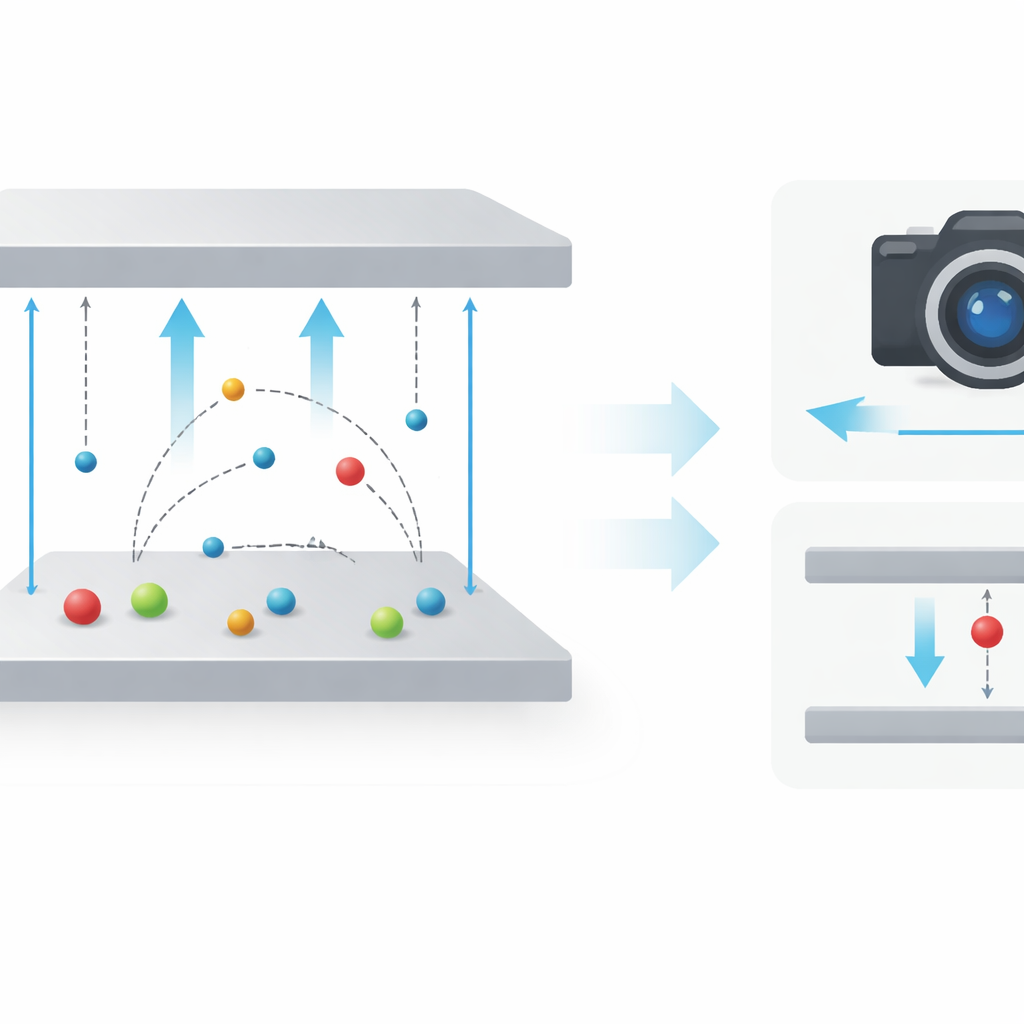
How the experiment watches charged dust in flight
The researchers built a carefully controlled laboratory version of a gas-insulated system: two smooth metal plates facing each other with a uniform direct-current electric field between them in air. Micrometer-sized particles made of both metals and electrical insulators were gently placed on the lower plate. When a high voltage was applied, some particles acquired charge, lifted off, and oscillated between the plates. A high-speed camera recorded their motion, and a force balance—considering gravity, air resistance, electric pulling force, and subtle image-charge effects—was used to calculate the charge on each individual particle from its acceleration.
What they found about charge sizes and timing
Across a wide size range, from about 1 to 170 micrometers in diameter, particles carried charges from roughly one thousandth of a trillionth of a coulomb up to ten trillionths of a coulomb (1 fC to 10 pC), with both positive and negative polarities. Larger particles consistently reached larger maximum charges, while increasing the field strength from 5 to 10 kilovolts per centimeter had a comparatively modest effect. The charging itself happened very quickly: during a brief touch of a few milliseconds on either electrode, particles could gain or reverse their charge. This rapid, contact-based transfer—similar in spirit to rubbing a balloon on a sweater—points to contact electrification, rather than a slow buildup from ions in the gas, as the dominant mechanism.
Sticky forces that set the charge threshold
A key surprise came from how "sticky" the particles were. Using an atomic force microscope, the team directly measured the adhesion between individual particles and an electrode surface. For both irregular metallic vanadium particles and nearly perfect spherical silica grains, the pull-off force was typically ten to forty times stronger than the particle’s weight, and in rare cases even higher. This means that, before a particle can move at all, its electric force must overcome not just gravity but a much larger adhesive force. Translating these adhesion measurements into the charge needed for lift-off showed that adhesion largely sets the minimum and sometimes the extreme charges. Rare high-adhesion contacts can demand unusually large charges, explaining why a few particles carry much more charge than most of their peers.
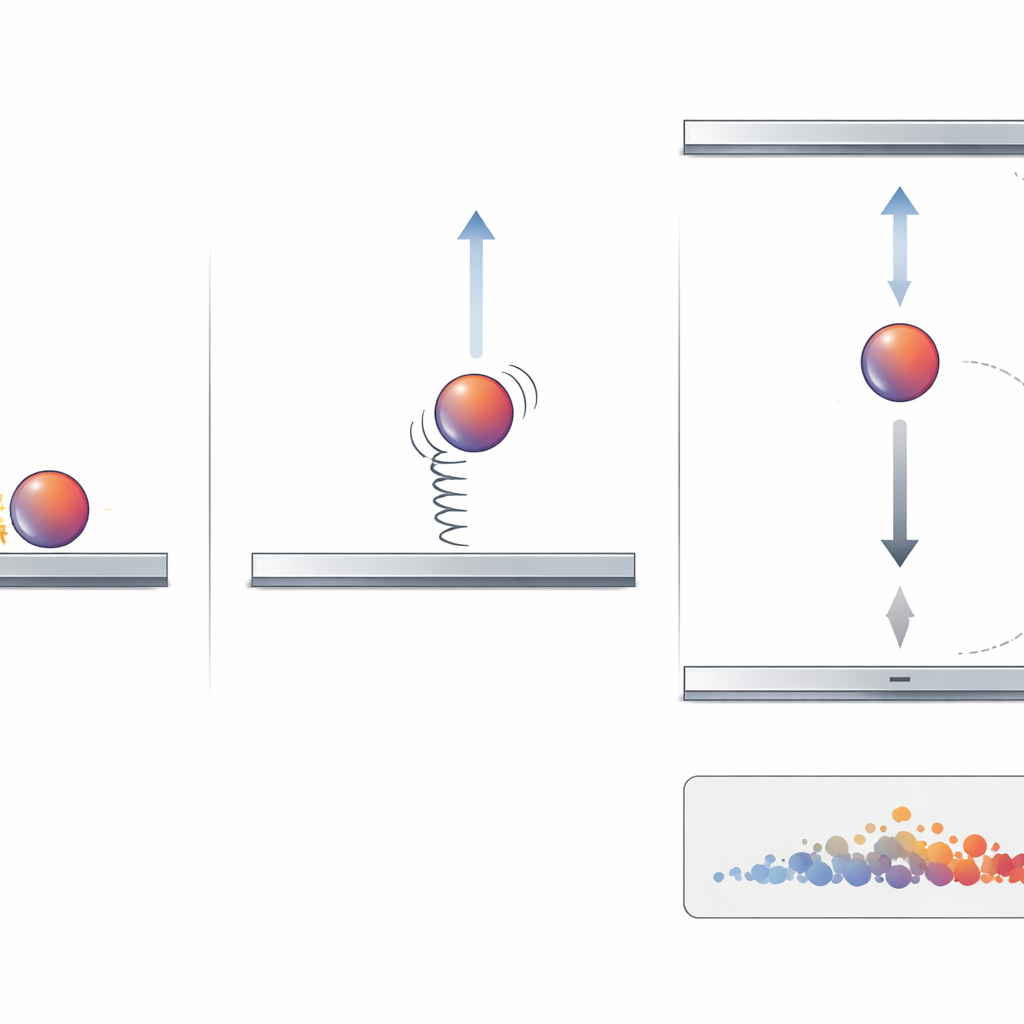
Charge behavior that refuses to be average
Instead of a narrow bell curve centered on a typical value, the measured charges followed broad, skewed distributions for all tested materials—metals and insulators alike. Most particles carried relatively modest charges, but a small fraction reached much higher values. Importantly, these extremes, although statistically rare, are the ones most likely to distort the electric field or trigger partial discharges. For some highly charged particles, the researchers observed charge gradually leaking away during flight, most plausibly through tiny field-induced discharges at the particle surface. In the earliest part of their motion, the particles also felt an extra tug from the image charge they induced in the nearby electrode, subtly bending their trajectories—an effect usually neglected in gas-insulated system models.
What this means for safer, more efficient equipment
The study shows that the influence of dust in gas-insulated power equipment cannot be captured by a single “typical” particle charge. Instead, charges are inherently statistical: most are modest, but rare high values matter most for safety. The new measurement method links those extremes to how strongly particles stick to electrode surfaces and to how quickly they charge upon contact. While the experiments were done in air at normal pressure, the same approach can now be applied to the real gases and pressures used in power-grid hardware. This will allow engineers to better predict when tiny contaminants become a serious risk—and to design cleaning, filtering, and surface treatments that keep the grid reliable while enabling more compact, efficient insulation systems.
Citation: Töpper, HC., Scherrer, S., Isa, L. et al. Methodology for quantifying particle charge statistics in electric fields of gas insulations. Sci Rep 16, 8667 (2026). https://doi.org/10.1038/s41598-026-39529-w
Keywords: gas insulation, particle charging, contact electrification, adhesion forces, high-voltage reliability