Clear Sky Science · en
Accumulation of eight heavy metals in water chestnut (Trapa natans L.) of four major water bodies of Jammu and Kashmir, India
Why this matters for people and lakes
Across the Kashmir Valley, a spiky little nut called water chestnut is an important seasonal food and a source of income for local families. At the same time, the lakes where it grows are under pressure from sewage, farm runoff, and other waste. This study asks a question that matters to anyone who eats from, works on, or cares about these waters: as pollution builds up, how much of it ends up locked inside the plants we harvest and eat?
Lakes under growing pressure
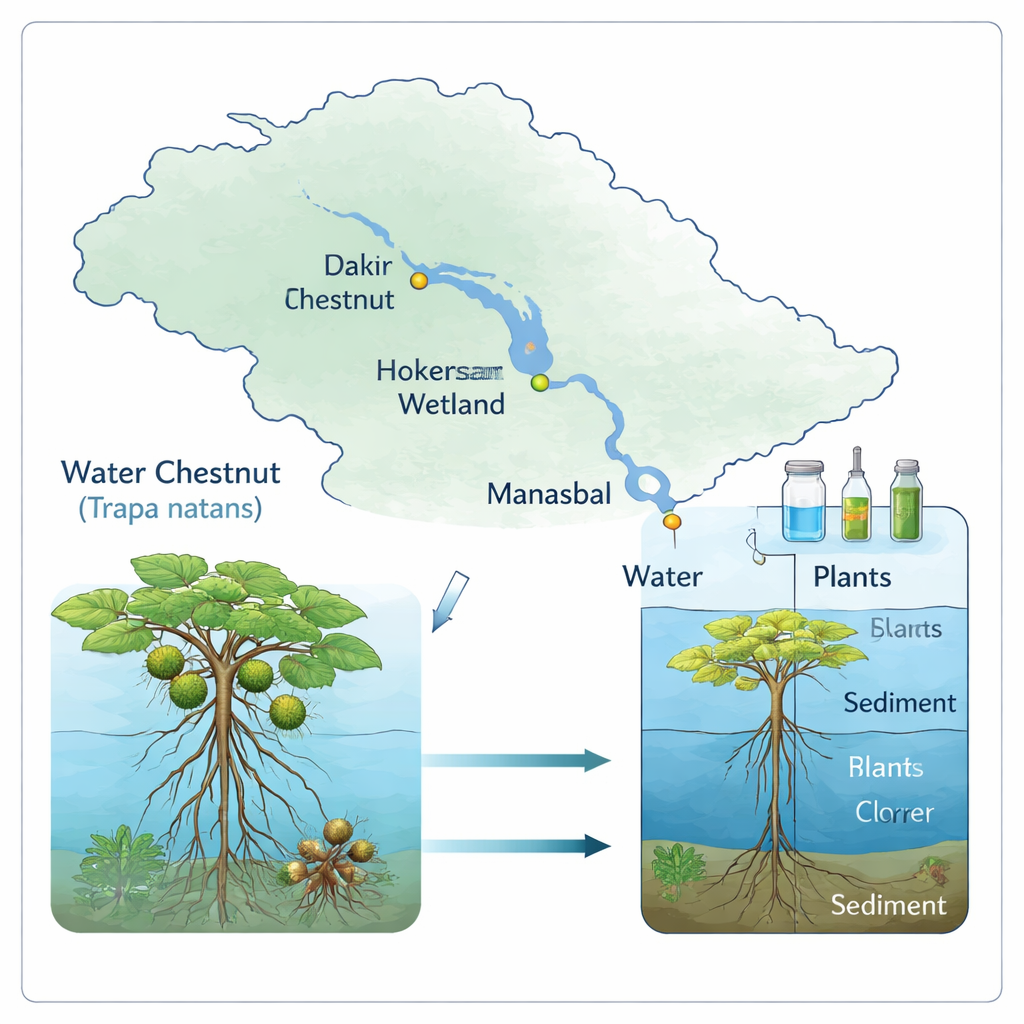
The researchers focused on four major freshwater bodies in Jammu and Kashmir: Dal Lake, Hokersar Wetland, Manasbal Lake, and Wular Lake. These lakes support drinking water, irrigation, fisheries, tourism, and migratory birds, but they sit along a gradient of human impact. Dal Lake, ringed by houses, hotels, and boats, receives large amounts of untreated sewage and runoff, while Manasbal and Wular are more open and better flushed. The team measured standard water quality indicators such as acidity, dissolved salts, organic matter, and oxygen demand, alongside eight metals that commonly build up in polluted waters, including iron, zinc, copper, nickel, chromium, and cadmium.
Hidden pollution in water and mud
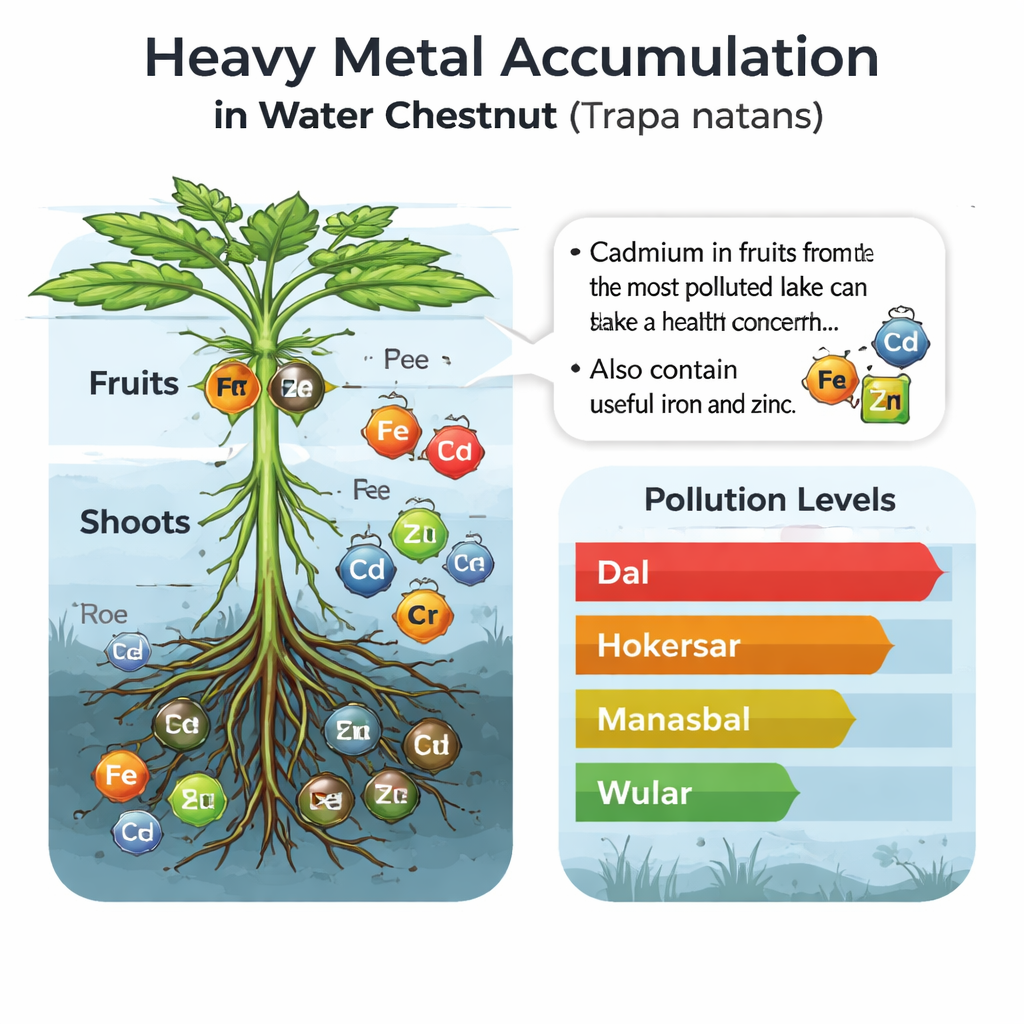
Sampling from 2024 showed that Dal Lake was the most stressed system by far. It had the highest loads of nutrients and organic matter, as well as metal levels that exceeded international guideline values for several elements. Hokersar Wetland also showed elevated contamination, while Manasbal and Wular were comparatively cleaner. Importantly, the lake bottoms acted as long-term storage zones: metals and nutrients that enter the water tend to bind to particles and organic debris, settle, and accumulate in sediments. These buried pollutants can later be released back into the water or taken up by plant roots, turning the lake bed into a slow but persistent source of contamination.
A useful plant that doubles as a sponge
Water chestnut (locally called Singhara or Ghour) forms floating rosettes of leaves, anchored by long roots in the mud and prized for its starchy, edible fruits. Because it draws nutrients directly from both water and sediment, it can also soak up metals. The team collected separate samples of roots, shoots, and fruits from each lake and analyzed them with a sensitive optical technique. Roots consistently showed the highest metal levels, often dozens to hundreds of times greater than the surrounding water, revealing that the plant is an efficient natural “sponge.” Most metals, especially iron and zinc, were strongly held in the root zone, with only partial movement into stems, leaves, and fruits.
Good nutrients mixed with risky metals
The fruits contained meaningful amounts of iron and zinc, which are essential nutrients for human health. In moderate quantities, eating water chestnut could help people meet daily needs for these micronutrients. But there was a downside: in the most polluted lakes, especially Dal, the same fruits also carried elevated levels of cadmium, a toxic metal linked to kidney and bone problems when exposure builds up over time. By estimating how much fruit a typical adult might eat each day, the authors calculated a “hazard index” for each metal. For most elements, including copper, manganese, nickel, iron, and zinc, the risk remained low. Cadmium was the exception: the calculated value for Dal Lake fruits crossed the threshold at which long-term consumption may become a concern.
Balancing clean-up, livelihoods, and food safety
To a lay reader, the main message is straightforward: water chestnut plants are doing some of the cleanup work by pulling metals from Kashmir’s lakes, but in the dirtiest waters they also become a possible pathway for these pollutants into people’s diets. The study concludes that Dal Lake, and to a lesser extent Hokersar, need stronger controls on sewage and farm runoff, better treatment of waste, and careful management of sediments. At the same time, routine testing of harvested fruits and setting aside cleaner areas for collection could help protect both livelihoods and health. In short, the health of the lakes and the safety of the local food are tightly linked—and improving one will help safeguard the other.
Citation: Elbagory, M., Altihani, F.A., El-Mesery, H.S. et al. Accumulation of eight heavy metals in water chestnut (Trapa natans L.) of four major water bodies of Jammu and Kashmir, India. Sci Rep 16, 7383 (2026). https://doi.org/10.1038/s41598-026-39522-3
Keywords: water chestnut, heavy metals, Dal Lake, phytoremediation, food safety