Clear Sky Science · en
Design of a multiepitope immunotherapy for fish allergy
Why a Fish Allergy Shot Matters
For many people, eating fish is not just a healthy choice but a serious gamble. Even a trace of fish protein in a sauce or processed food can trigger hives, breathing trouble, or life-threatening shock. Today, the only real protection is total avoidance and carrying rescue medication. This study explores a very different idea: a highly tailored "molecular" shot built from tiny pieces of fish proteins, designed on a computer, that could one day retrain the immune system to react calmly instead of violently.

The Hidden Challenge Inside Fish Proteins
Fish allergy is less common than peanut allergy but can be just as dangerous. The problem lies in several fish proteins that the immune system misidentifies as threats. One major troublemaker, called parvalbumin, appears in many species, which is why someone allergic to cod might also react to salmon or tuna. Other proteins, such as enolase and aldolase, can also spark reactions. Together they form a complex mix of allergy triggers, making it hard to create a single treatment that works for most patients.
Turning Allergens into a Safer Training Tool
The authors use a strategy sometimes called "reverse vaccinology": instead of starting with whole proteins in the lab, they start with their sequences in a database and work backward on a computer. They scan parvalbumin, enolase, and aldolase to find short stretches that immune cells pay attention to. Crucially, they focus on pieces that can stimulate helpful immune cells while avoiding the three‑dimensional regions that usually grab allergy antibodies and cause dangerous flare‑ups. Using several online tools, they filter out any fragments predicted to be allergenic or toxic, and they also compare them with known antibody‑binding sites to lower the chance of triggering a classic allergic attack.
Building a Custom Protein from Selected Pieces
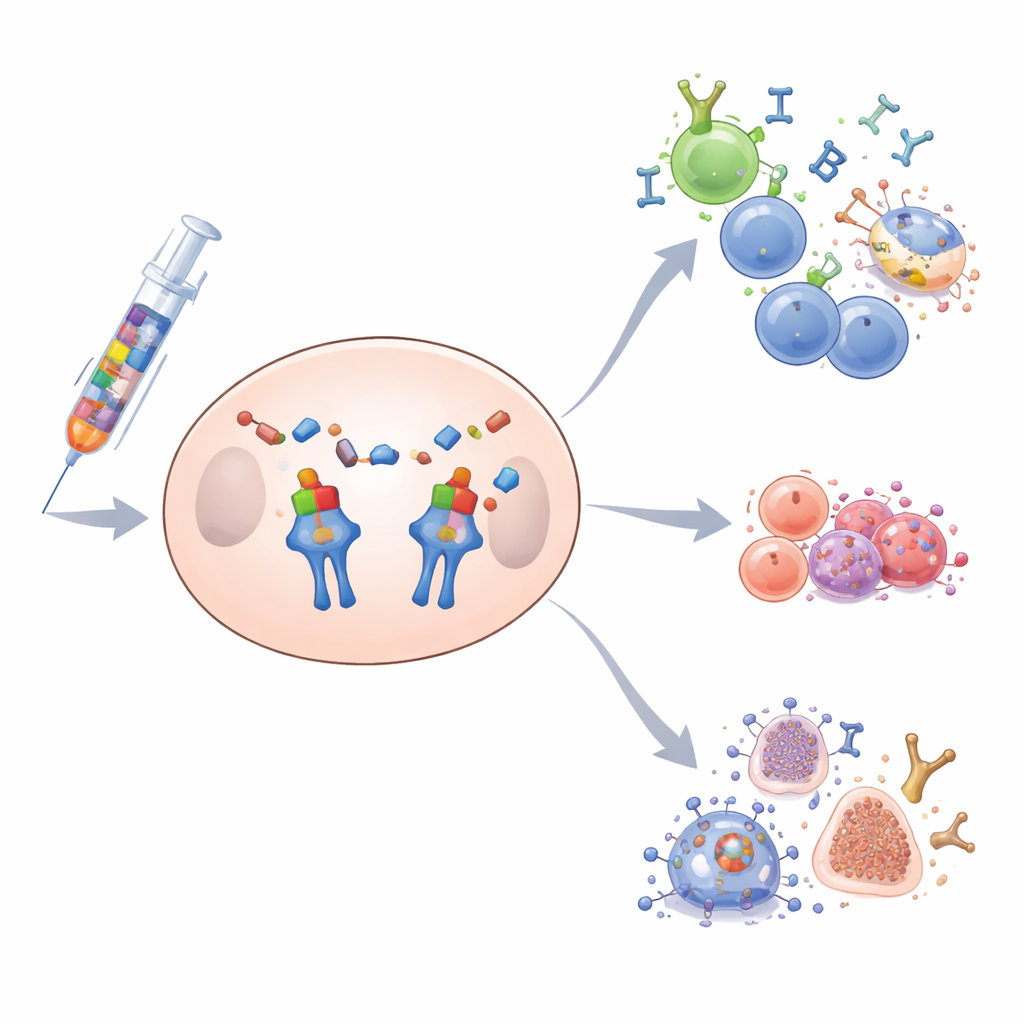
From this digital screening, the team stitches together a long, custom protein made of many carefully chosen fragments, linked like colored beads on a string. Some fragments are meant to alert helper immune cells, others to activate killer cells, and others to engage B cells that make antibodies. The design also includes built‑in "boosters"—short sequences known to wake up the immune system broadly—and segments that mimic natural danger signals recognized by innate sensors on immune cells. The result is a 432‑unit chimeric protein that, on paper, looks stable, soluble, and unlikely to resemble any human protein, reducing the risk of unwanted cross‑reactions.
How the Candidate Talks to the Immune System
To explore how this engineered protein might behave, the researchers use computer models to predict its shape and how it might dock onto immune sensors called Toll‑like receptors. Simulations suggest it can form especially tight and stable contacts with one such sensor, TLR4, which helps kick‑start early immune responses. Additional virtual experiments imitate what might happen after an injection: the model immune system produces waves of antibodies and T cells, some of which acquire a memory‑like state that, in theory, could promote a more balanced, less allergic response over time. These results do not prove that the vaccine works, but they hint at a plausible path from injection to immune retraining.
What This Means for Future Treatments
In practical terms, this work offers a detailed computer blueprint for a next‑generation fish allergy shot built from many small pieces rather than whole allergenic proteins. The design aims to nudge the immune system away from panic reactions and toward tolerance, while lowering the chance of triggering a severe episode during treatment. However, everything shown here is theoretical: the construct has not yet been made or tested in cells, animals, or people. The study’s real contribution is to map out how digital tools can be used to assemble a highly focused, potentially safer immunotherapy that future lab work will need to confirm—or correct—before it ever reaches the clinic.
Citation: Chourir, A., Essaadi, H., Makhloufi, F. et al. Design of a multiepitope immunotherapy for fish allergy. Sci Rep 16, 8838 (2026). https://doi.org/10.1038/s41598-026-39519-y
Keywords: fish allergy, epitope-based vaccine, immunotherapy, immunoinformatics, tolerance induction