Clear Sky Science · en
Optical soliton wave profiles for the (2 + 1)-dimensional complex modified Korteweg–de Vries system with the impact of fractional derivative via analytical approach
Waves That Refuse to Fade
From internet data streams in glass fibers to ripples in plasma and fluids, many modern technologies rely on waves that travel long distances without breaking apart. This article explores a mathematical model for such stubborn waves—known as solitons—in complex media, and shows how refining the underlying equations can reveal new ways to describe, predict, and eventually harness these durable pulses.
Why Long-Lived Waves Matter
Solitons are wave packets that keep their shape as they move, instead of spreading out like ordinary ripples on a pond. They show up in optical fibers that carry our data, in plasma created in fusion experiments, and in shallow water flows. Understanding how these waves form, interact, and persist is crucial for building faster communication systems, more stable energy devices, and accurate models of natural phenomena. The study focuses on a powerful wave equation, the complex modified Korteweg–de Vries (CmKdV) system, which captures how nonlinearity (waves affecting each other) balances with dispersion (different parts of a wave traveling at different speeds) in two spatial dimensions plus time.
Adding Memory to the Wave Story
Real-world materials often “remember” what happened to them: past stretching, heating, or excitation can influence their present response. To incorporate such memory effects, the authors adopt a modern tool called a fractional derivative. Unlike the ordinary derivative from school calculus, which measures change at a sharp instant, a fractional derivative blends present and past behavior. Here, they use a specific version called the truncated M-fractional derivative, which preserves many familiar mathematical properties while allowing the model to account for heredity and memory in a controlled way. This upgrade turns the standard CmKdV system into a richer, fractional version better suited to complex media such as advanced optical materials and plasmas.
Turning a Tough Problem into a Tractable One
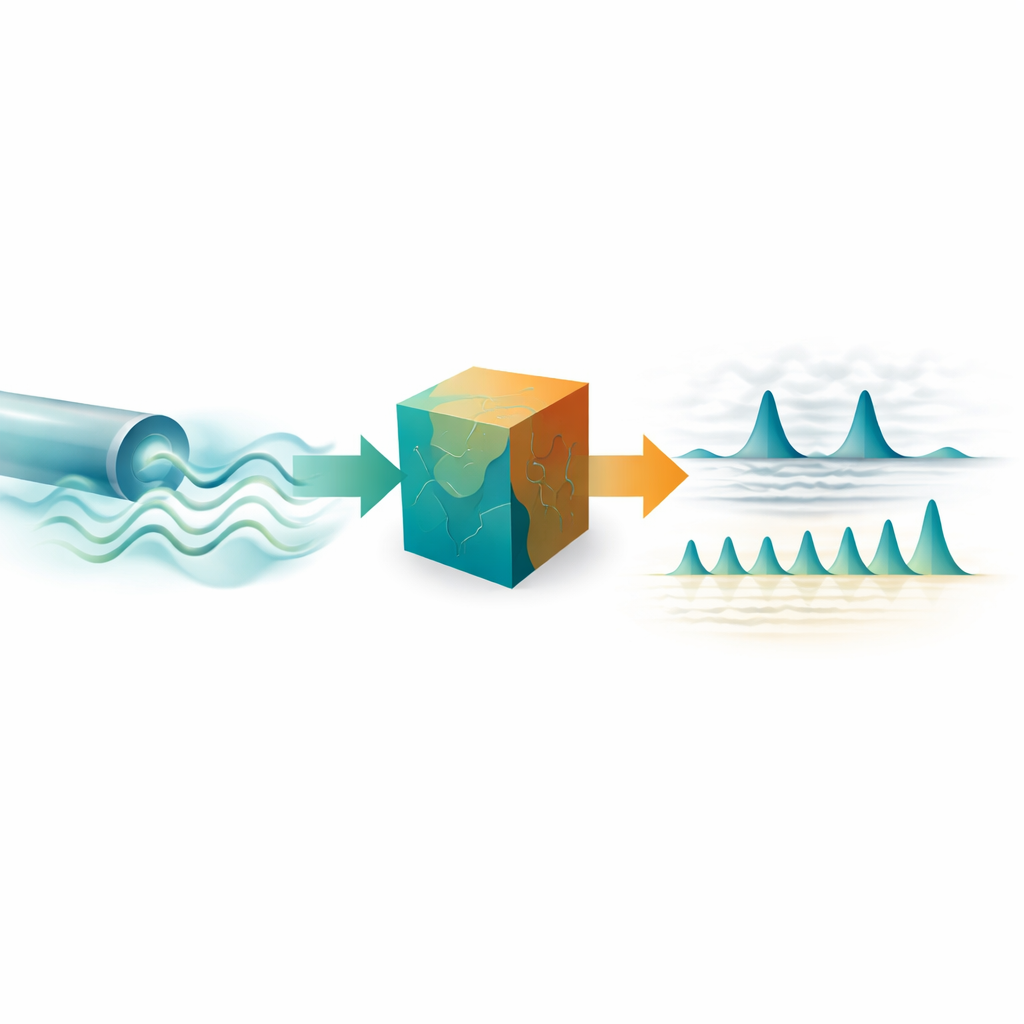
The upgraded wave equation is still highly nonlinear and difficult to solve directly. The authors tackle this by converting the original partial differential equations into simpler ordinary differential equations using a traveling-wave transformation. In essence, they follow the profile of a wave moving through space, which reduces the number of variables and reveals underlying patterns. They then apply the Jacobi elliptic function expansion method, a systematic way of building exact solutions from a catalog of well-understood periodic functions. By balancing the strongest nonlinear and dispersive terms, they determine how many terms are needed in the expansion and solve the resulting algebraic conditions to obtain exact formulas for a wide family of wave shapes.
A Zoo of Wave Shapes
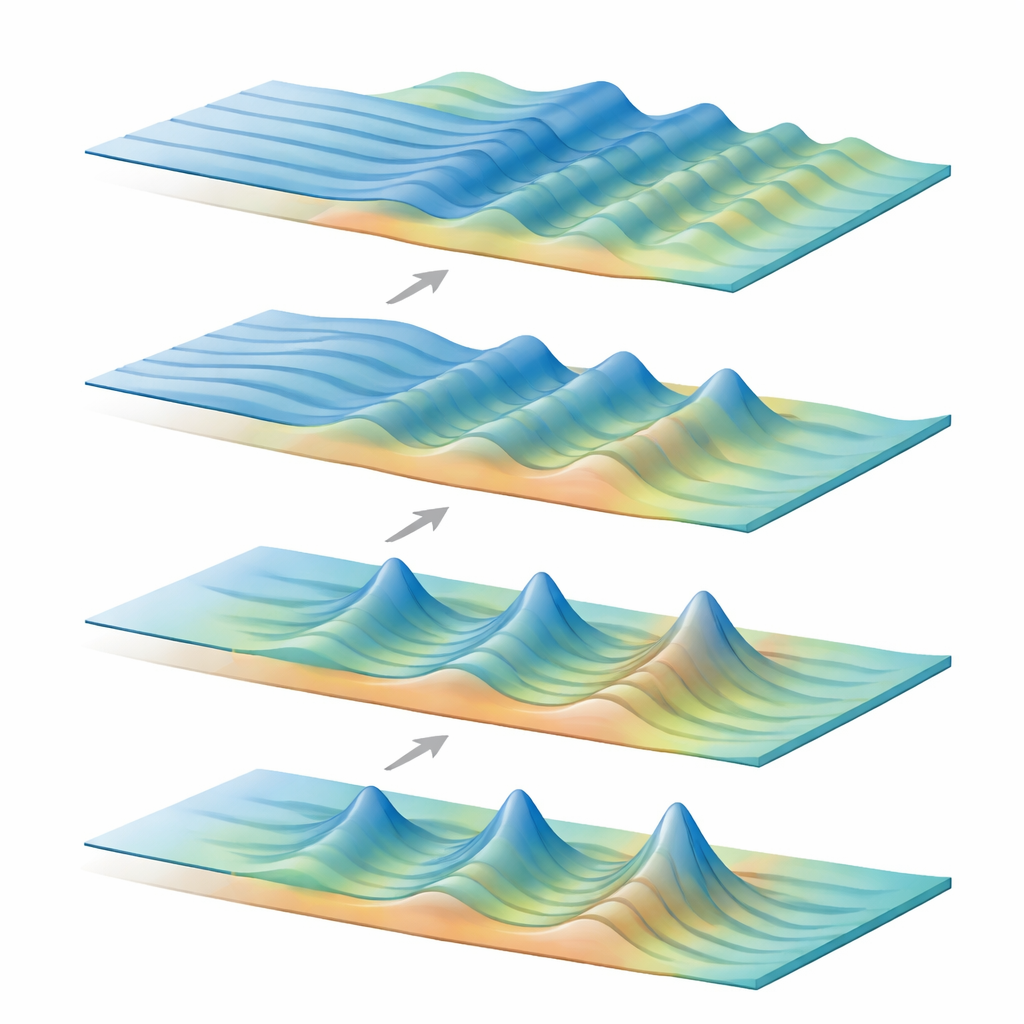
With this framework, the authors construct an impressive collection of solutions. Some describe smoothly repeating waves, others single isolated peaks or dips (bright and dark solitons), and still others sharp, step-like transitions known as shock waves. By tuning key parameters—such as the fractional order and a quantity called the wave number—they show how the waves’ height, width, and speed can be adjusted. Using computer graphics, they visualize these solutions in two and three dimensions, along with contour plots that highlight regions of concentrated energy. These pictures reveal how memory effects encoded by the fractional derivative can sharpen, broaden, or reshape the propagating structures, offering knobs to control wave behavior without changing the basic physical setting.
From Pure Math to Practical Tools
Beyond cataloging exotic wave forms, the study demonstrates that combining fractional calculus with the Jacobi elliptic expansion method gives a robust toolkit for tackling difficult nonlinear wave equations. The exact solutions serve as benchmarks for numerical simulations and newer data-driven approaches, including physics-informed neural networks, which require trustworthy reference patterns to train and validate against. In simple terms, the authors show that by carefully enriching the mathematical description of waves—and then solving it exactly—researchers can better predict how durable wave packets behave in realistic, memory-bearing media, advancing both fundamental theory and future technologies in optics, fluid dynamics, and signal processing.
Citation: Khan, M.I., Khan, M.A., Iqbal, M. et al. Optical soliton wave profiles for the (2 + 1)-dimensional complex modified Korteweg–de Vries system with the impact of fractional derivative via analytical approach. Sci Rep 16, 8319 (2026). https://doi.org/10.1038/s41598-026-39517-0
Keywords: optical solitons, nonlinear waves, fractional calculus, wave equations, optical fiber modeling