Clear Sky Science · en
Reversible data hiding for electronic patient information security for telemedicine applications
Why hiding secrets in medical scans matters
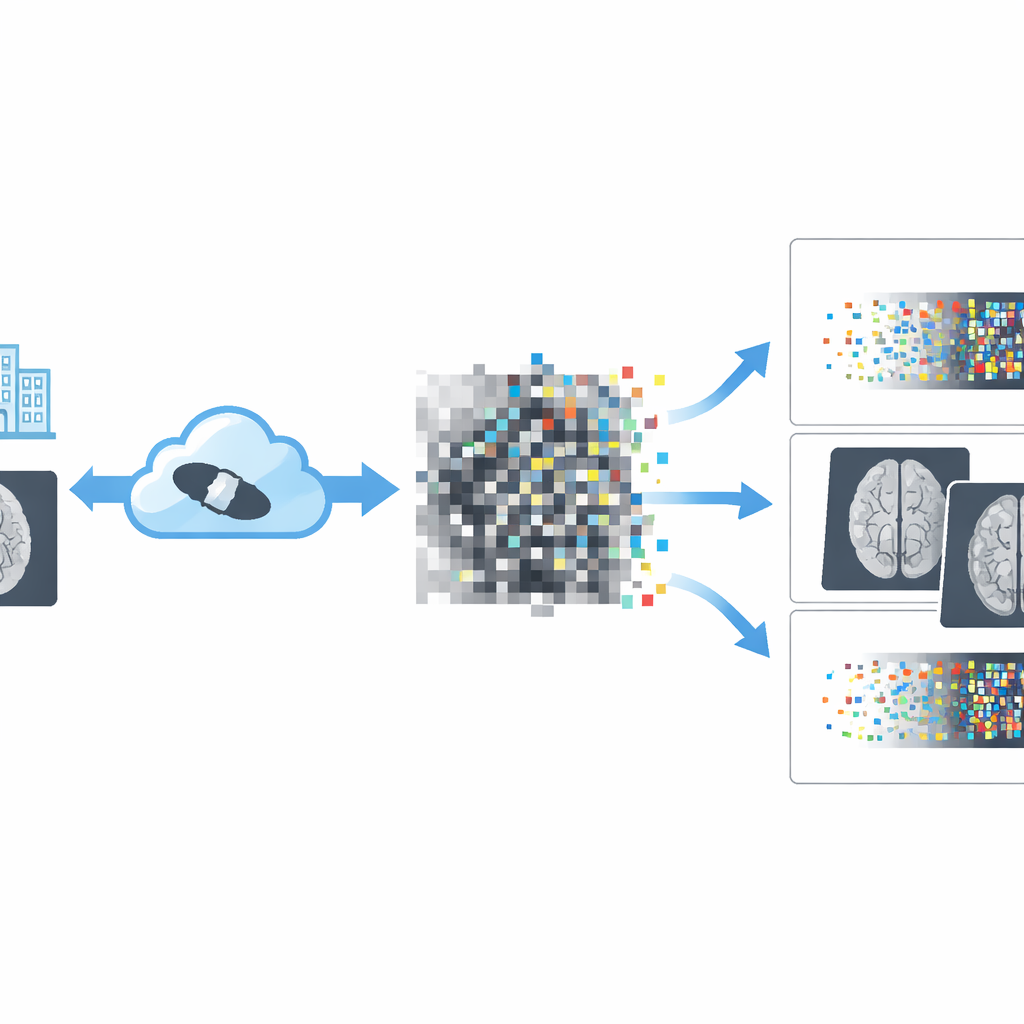
When you get an X-ray, MRI, or CT scan, those images often travel across cities or even countries so specialists can review them. Along the way, your personal details and medical notes need strong protection. This paper introduces a way to tuck sensitive patient information directly inside encrypted medical images, then later pull out both the hidden data and the original image without a single pixel lost. It is designed for telemedicine, where doctors must balance privacy, speed, and trustworthy diagnosis.
Keeping patient data safe in a connected world
Telemedicine has made it possible to see doctors remotely, easing travel burdens and improving access to care. Yet every digital visit creates a trail of records: scans, reports, and identifiers that must stay private. Traditional encryption scrambles these files so outsiders cannot read them, but it does not solve every problem. Health systems still need to attach extra information—such as authenticity checks, brief notes, or tracking tags—without breaking strict privacy rules or altering what doctors see. Reversible data hiding offers a compromise: extra data are woven into an image in such a way that, if needed, the original can be restored perfectly, as if nothing had ever been added.
A new way to hide data without harming the picture
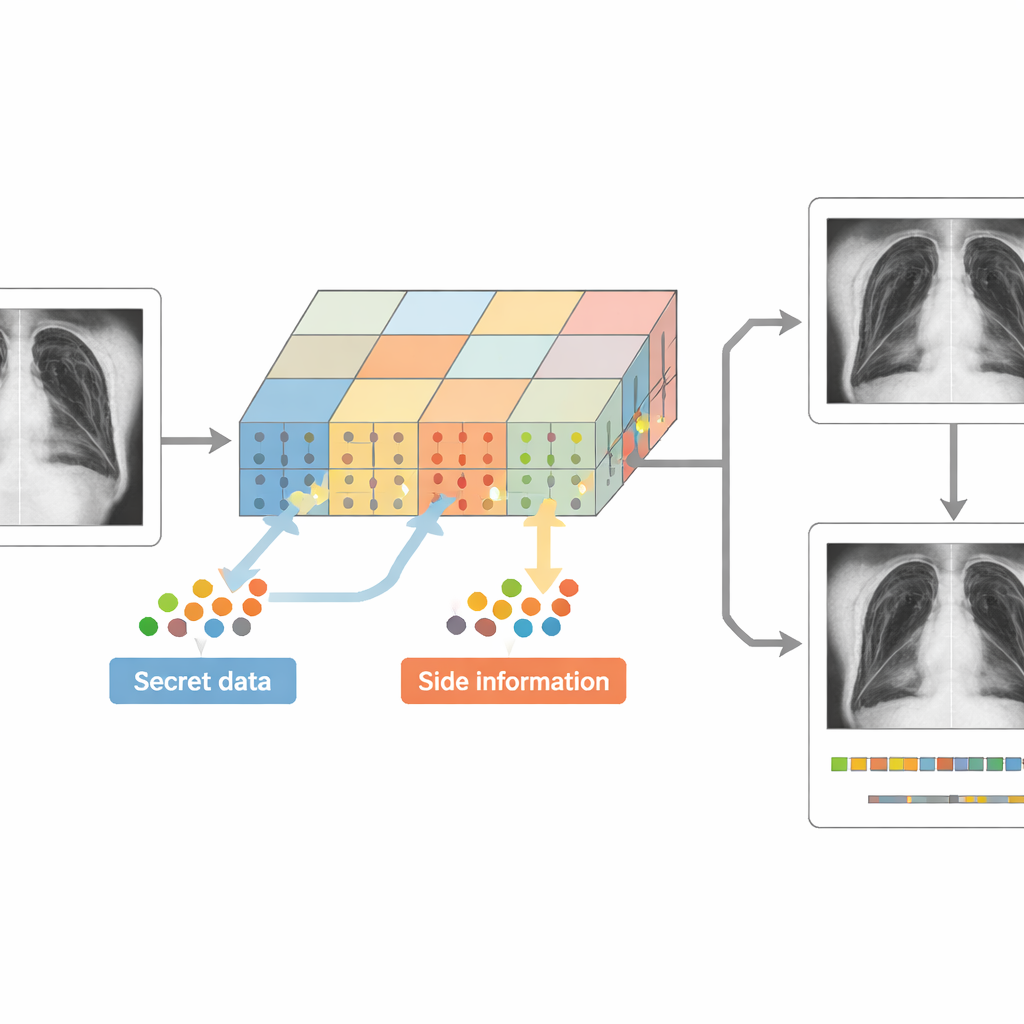
The authors present a reversible data hiding scheme built specifically for encrypted medical images. First, the original scan is turned into an unreadable form using a standard cipher (AES in counter mode) with a secret key and a one-time code, called a nonce, that is stored harmlessly with the file. Next comes the clever part. Instead of globally altering the image, the method divides it into many small blocks and, for each block, uses a second secret key to generate local rules that say where and how to hide bits. This control mechanism, called Generation of Encryption Parameters (GEP), lets the system treat each block slightly differently while keeping the overall process predictable for authorized users.
Two layers of hiding for full reversibility
Inside the encrypted image, the method hides data by tweaking only the least significant bits—the tiny binary switches that have the smallest impact on image quality. It uses two levels of embedding. In the first level, applied to odd-numbered blocks, it groups these tiny bits in threes and changes at most one bit per trio to carry the secret payload, keeping visual damage very low. In the second level, applied to even-numbered blocks, it stores all the side information needed to undo those changes later, including which groups were altered and what their original states were. This design means that one party with only the "hiding" key can pull out the payload from the encrypted picture, another party with only the encryption key can see a clear diagnostic image, and someone with both keys can recover both the hidden data and the exact original scan, bit for bit.
Tested on real scans with strong quality and security
To see how well the approach works in practice, the researchers tried it on 90 real medical images—30 X-rays, 30 MRIs, and 30 CT scans—each 512 by 512 pixels. They measured how similar the decrypted images were to the originals and how random the encrypted versions looked. On average, the directly decrypted images scored high on standard quality measures, indicating that key anatomical details would remain clearly visible to clinicians. When both keys were used, the recovered images matched the originals exactly. At the same time, measures of randomness and sensitivity showed that the encrypted images behaved like strong ciphers should: they were highly resistant to attempts to infer patterns or to predict how changing one pixel in the input would affect the output.
What this means for future remote care
In simple terms, this work offers a way to mail a sealed envelope that not only hides your medical secrets from prying eyes, but also quietly carries extra notes inside the paper itself—and yet can still be unfolded into a completely untouched sheet. For telemedicine providers, that means they can attach important patient information to scans, keep those scans confidential in transit, and still guarantee that doctors receive images as pristine as the originals. While the method does not yet address every real-world challenge—such as lossy compression, image resizing, or clinical validation—it points toward a future where security, flexibility, and diagnostic trust can all travel together in the same digital file.
Citation: Muhudin, A., Hussein, O.D., Osoble, A.M. et al. Reversible data hiding for electronic patient information security for telemedicine applications. Sci Rep 16, 8381 (2026). https://doi.org/10.1038/s41598-026-39512-5
Keywords: telemedicine security, medical image encryption, reversible data hiding, patient privacy, digital watermarking