Clear Sky Science · en
Intelligent classification and dynamic evolution simulation study on air conditioner product demand characteristics
Why online chatter about air conditioners matters
When people shop for air conditioners online, they leave behind a trail of comments about what they like, what annoys them, and what they wish manufacturers would fix. Buried in this flood of messages are early clues about shifting needs: quieter nights, smarter controls, lower bills, or better installation. This study shows how those scattered remarks can be turned into a living map of customer priorities, helping companies design air conditioners that truly fit everyday life instead of guessing from slow surveys or simple sales numbers.

From messy comments to clear signals
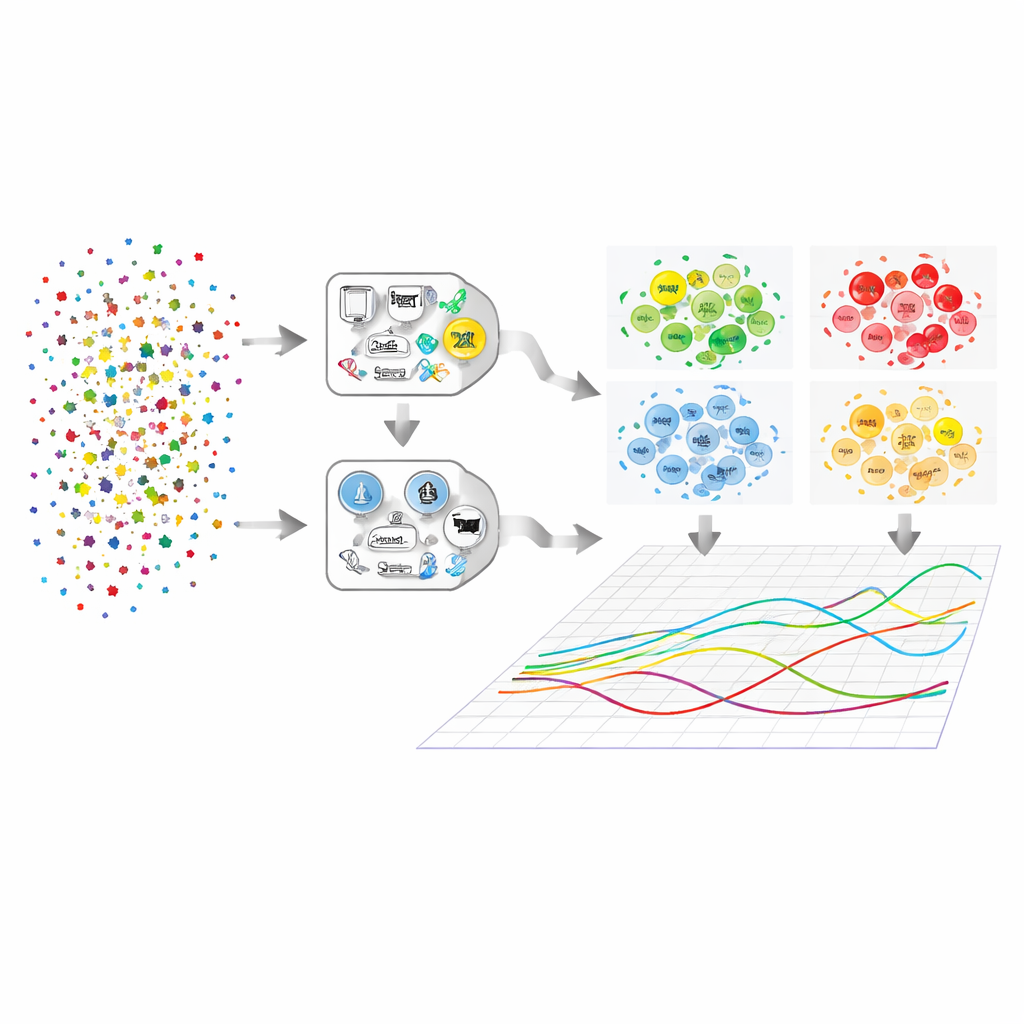
Online reviews are powerful but messy. A single post might praise cooling performance, complain about delivery, and mention bedroom décor all at once. Traditional tools often mix these strands together, or only take snapshots at fixed points in time. The authors tackle this by first separating reviews into two broad streams: comments about the product itself and comments about services like delivery or installation. They focus on the product-focused stream to avoid having shipping troubles distort what people really think of the air conditioner’s design and performance.
Smarter sorting with digital “whales”
To do this sorting reliably, the team builds a hybrid computer model combining Support Vector Machines, a classic pattern-recognition method, with an upgraded Whale Optimization Algorithm, a search technique inspired by the way humpback whales hunt. The improved version, called IWOA-SVM, automatically fine-tunes the many settings that make or break classification accuracy. Through a series of benchmark tests, the enhanced algorithm proves better at avoiding dead ends and handling noisy, high‑dimensional data than several popular alternatives. When applied to thousands of real reviews from the Chinese e‑commerce site JD.com, the model correctly labels about 94 percent of test comments, giving the later stages a clean, trustworthy starting point.
Finding themes and feelings in people’s words
Once product-related comments are isolated, the study turns to the question: what exactly are people talking about, and how do they feel about it? Here, a topic-mining method called BERTopic groups together reviews that share similar meanings, even if the exact words differ. These clusters reveal recurring themes such as cooling and heating performance, noise, exterior design, smart control features, overall comfort, and energy saving. In parallel, a commercial sentiment-analysis service scores how positive or negative each comment is. By combining topic clusters with emotional tone, the authors can say not only which features people discuss, but also how satisfied they are with each one.
Watching needs change over seasons
The story becomes more interesting when time is added. The researchers slice the data into six quarters from early 2023 to mid‑2024 and track how each topic’s visibility and satisfaction score shift. They then place every feature on a simple two‑axis chart: importance (how much people talk about it) and satisfaction (how happy they are). Repeating this chart for each quarter and connecting the dots creates a three‑dimensional “evolution path” showing how, for example, smart control moves from a weak point to a standout strength, or how noise concerns grow even when cooling remains solid. Seasonal weather, new product launches, and changing expectations all leave their fingerprints in these trajectories.
What this means for buyers and makers
For everyday readers, the main takeaway is that our casual online comments can collectively steer how future air conditioners are built. The study shows that customers are no longer satisfied with units that simply change the temperature; they want quiet operation, attractive design that fits their homes, intelligent control via phones or voice, gentle and comfortable airflow, and visible energy savings. By turning a chaotic stream of reviews into a structured, time‑aware picture, the framework helps manufacturers focus improvements where they matter most—such as reducing nighttime noise or refining smart features—rather than blindly upgrading hardware. In short, the paper demonstrates a practical way to listen to the crowd at scale and translate that evolving voice into better, more responsive home technology.
Citation: Wu, Z., Liang, C., Zhang, S. et al. Intelligent classification and dynamic evolution simulation study on air conditioner product demand characteristics. Sci Rep 16, 9285 (2026). https://doi.org/10.1038/s41598-026-39506-3
Keywords: online reviews, consumer demand, air conditioners, sentiment analysis, product design