Clear Sky Science · en
Effects of Trichoderma harzianum and Azospirillum brasilense on tomato growth, fruit quality, yield, and water productivity under deficit irrigation
Tomatoes in a Thirsty World
Tomatoes are among the world’s most popular vegetables, but growing them takes a lot of water—a mounting challenge in drought‑prone regions. This study explores whether friendly soil microbes can help tomato plants stay productive when water is scarce, potentially allowing farmers and gardeners to use less irrigation without sacrificing yield or fruit quality.
Tapping the Power Beneath the Soil
The researchers focused on two helpful microbes that live around plant roots: a fungus called Trichoderma harzianum and a bacterium called Azospirillum brasilense. These organisms are known to stimulate root growth, improve access to nutrients, and help plants better tolerate stress. In field experiments over two growing seasons in northern Iran, tomato seedlings were either left untreated or had their roots dipped in solutions containing one or both microbes before planting. The plants were then grown under four watering plans, ranging from normal irrigation down to rain only, to see how the microbes influenced growth, fruit production, and how efficiently water was turned into harvestable tomatoes. 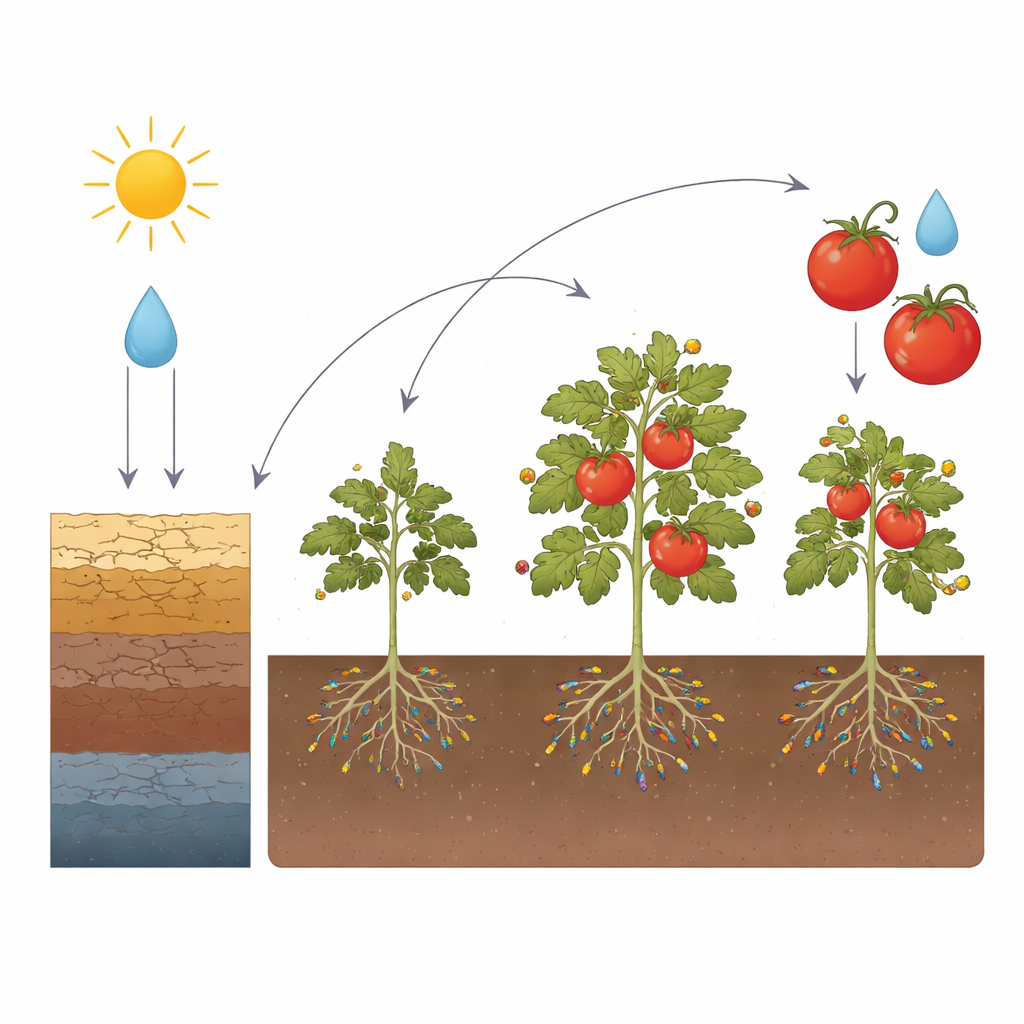
Roots, Leaves, and Green Pigments
As expected, cutting back on water reduced root mass and leaf area, but the biological treatments softened these losses. Under full watering, plants treated with the microbes—especially those given Trichoderma—developed heavier roots and larger leaves than untreated plants. Even when water was reduced to 75 percent of the usual amount, Trichoderma-treated plants maintained leaf areas comparable to fully irrigated controls. The leaves of inoculated plants also tended to hold more chlorophyll, the green pigment that drives photosynthesis. Higher chlorophyll levels were strongly linked with heavier roots and fruits, suggesting that healthier foliage translated directly into better growth and yield.
Sugars, Color, and Stress Signals
When water became scarce, the plants shifted their internal chemistry in ways that signaled stress. Under rainfed conditions with no microbial help, leaves accumulated the highest levels of protective compounds such as carotenoids and anthocyanins, along with more glucose, sucrose, and total sugars. These changes help plants cope with drought but were negatively associated with root size, leaf area, and fruit weight. In contrast, plants that received biological treatments under good watering had lower sugar and pigment build‑up, consistent with being under less stress. The pattern suggests that the microbes did not simply boost growth; they also helped the plants avoid entering a high‑stress state in the first place.
Fruit Load, Firmness, and Taste
For growers, the most important question is what happens to the harvest. Here, Trichoderma again stood out. Under full watering, it produced the highest fresh and dry fruit weights and the greatest overall yield—about 30 percent higher than untreated plants. Remarkably, tomatoes receiving Trichoderma but only 75 percent of the usual water performed about as well as fully irrigated, untreated plants, hinting that some irrigation could be saved without losing crop. Drier conditions naturally produced firmer fruits with more dissolved solids, traits often linked to more intense flavor, but extreme water shortage sharply reduced yields. The combination of Trichoderma and Azospirillum did not consistently outperform the single treatments and sometimes performed worse, likely because the two microbes competed with each other in the root zone. 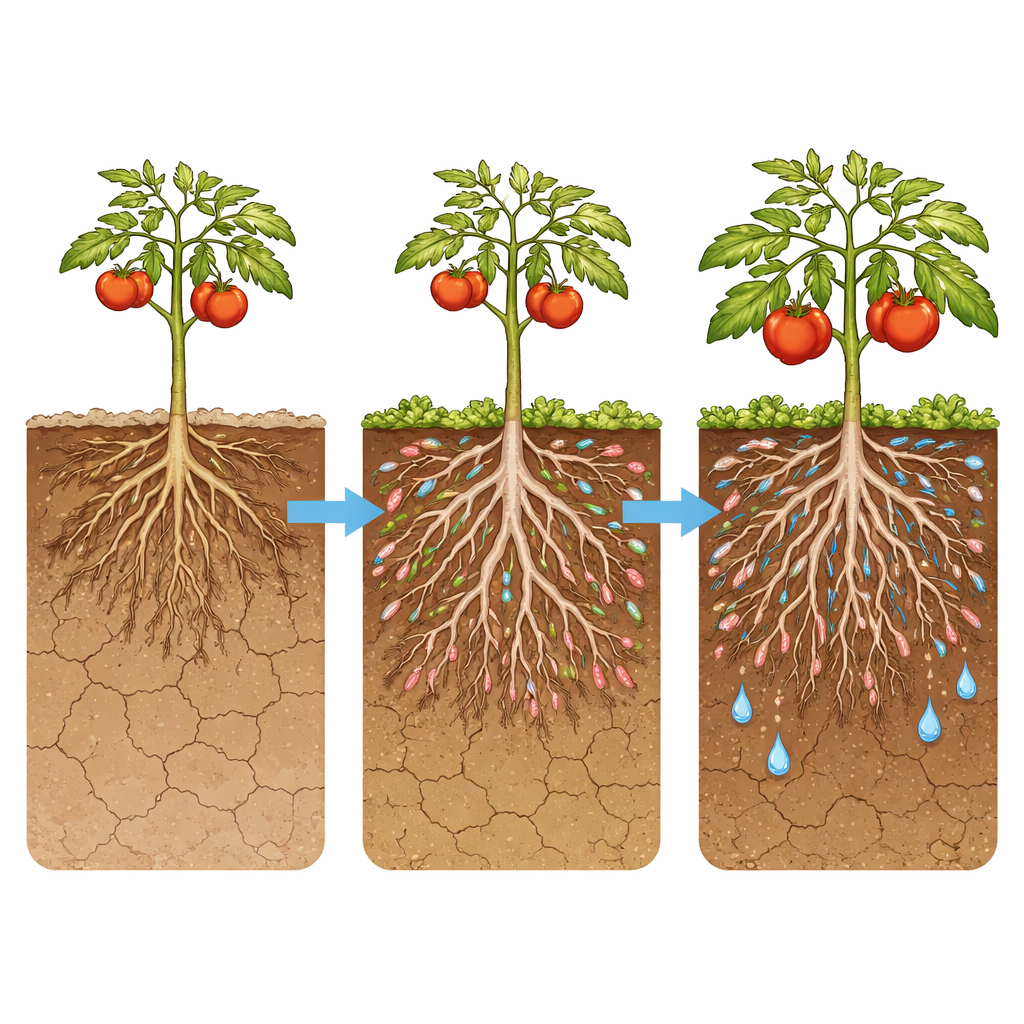
More Tomatoes per Drop
Beyond yield, the team calculated how much water was required to produce each kilogram of tomatoes. The best water productivity was achieved with Trichoderma under full irrigation, which needed about 180 liters of water per kilogram of fruit—less than either untreated plants or those treated with Azospirillum alone. Although severe water cuts still hurt performance, under moderate deficit the microbial treatments, especially Trichoderma, helped keep water use in check while sustaining production. Overall, the study suggests that using this beneficial fungus as a biological fertilizer can strengthen tomato roots, keep leaves greener, and produce more fruit from the same—or slightly less—water, offering a promising tool for more sustainable tomato farming in a drying climate.
Citation: Dehkordi, A.G., Mashayekhi, K., Mousavizadeh, S.J. et al. Effects of Trichoderma harzianum and Azospirillum brasilense on tomato growth, fruit quality, yield, and water productivity under deficit irrigation. Sci Rep 16, 7924 (2026). https://doi.org/10.1038/s41598-026-39498-0
Keywords: tomato drought, beneficial microbes, biological fertilizer, water use efficiency, Trichoderma