Clear Sky Science · en
Computational biomechanics of human knee joint in maximum voluntary isometric extension with focus on the role of joint center positioning
Why this matters for sore and injured knees
For anyone who has felt knee pain climbing stairs or coming back from an injury, tests of thigh muscle strength are a familiar part of rehab. This study looks under the skin during one of the most common tests, a seated "push against a strap" knee extension, to ask a simple question with big consequences: when we measure how strong the quadriceps are, what is really happening inside the knee joint, and how much do our computer models get right or wrong?
Looking inside the knee during a strength test
The authors used an advanced digital replica of a human leg built from a healthy young woman’s knee. Instead of treating the knee as a simple hinge, their model included bones, cartilage, menisci, ligaments, and twelve muscles that cross the joint. They simulated the standard maximum voluntary isometric contraction (MVIC) test: the person is seated with the hip bent about 90 degrees, the knee held at a fixed angle, and the lower leg pushing forward against a padded bar that pushes backward. They examined three common knee bend positions—30, 60, and 90 degrees—and varied how hard the person pushed, where along the shin the strap was attached, and how much the hamstrings and calf muscles tensed at the same time.
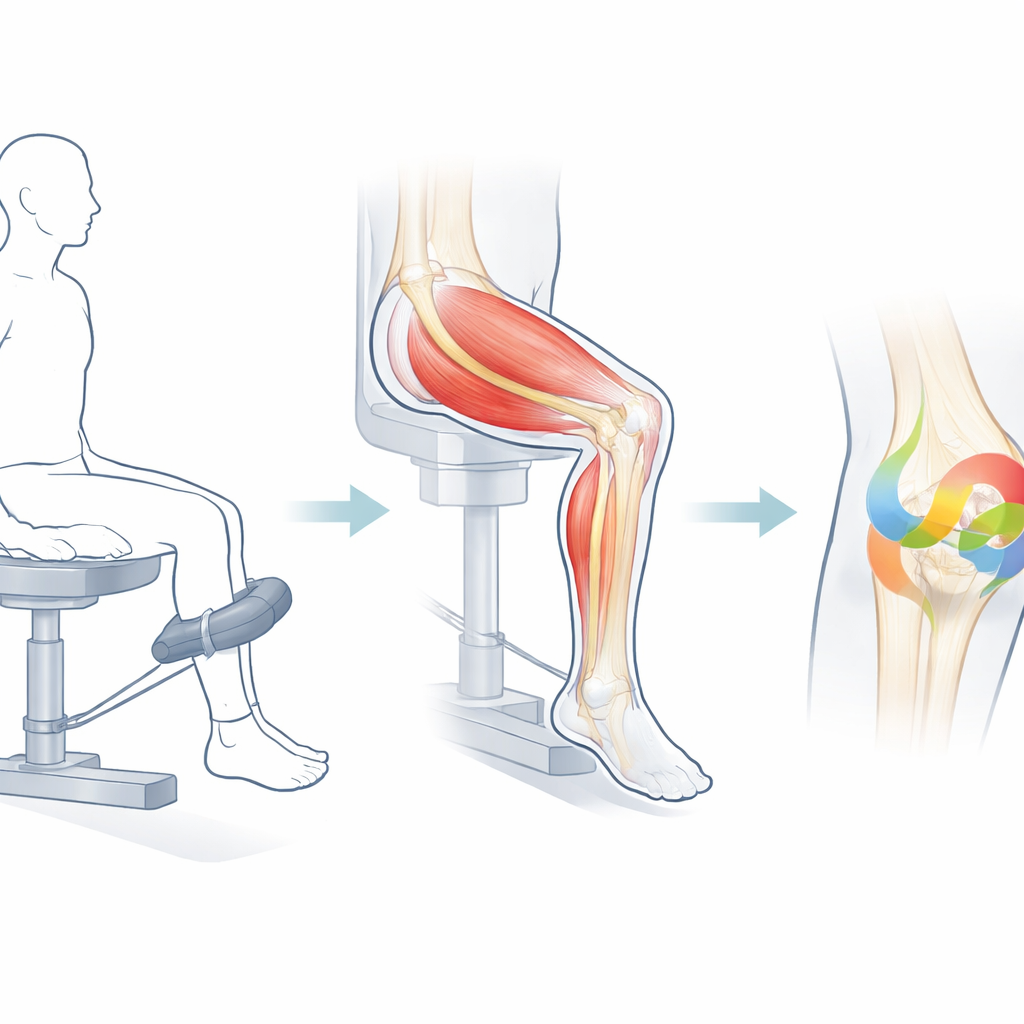
How muscle effort turns into joint loading
As the virtual person pushed harder, quadriceps forces rose sharply, reaching more than six times body weight at the deepest bend. Patellar tendon forces and contact forces between the kneecap and thigh bone also climbed steadily with knee bend, while pressure between the main knee surfaces followed a more complex pattern: lowest at 30 degrees, peaking around 60 degrees, then easing slightly at 90 degrees. At deeper angles, the area of contact behind the kneecap grew, but so did peak pressure, reaching values far higher than those seen in typical walking. These patterns help explain why exercises performed with the knee deeply bent can aggravate pain at the front of the knee even though they are excellent for building strength.
What the strap position and helper muscles really do
The study found that moving the strap farther down the shin, which gives the external force a longer lever arm, changed how shear forces acted on the knee. A more distant strap position reduced the backward pull on the shin, which in turn led to substantially higher tension in the anterior cruciate ligament (ACL) and lower load in the posterior cruciate ligament (PCL). Co‑tension in hamstrings and calf muscles—often encouraged to stabilize the joint—did increase overall muscle forces, but had limited effect on ACL loading compared with the strap position and overall effort. These results suggest that small choices in exercise setup, such as where the pad rests on the leg, can meaningfully alter how safely the cruciate ligaments are loaded during strength testing or training.
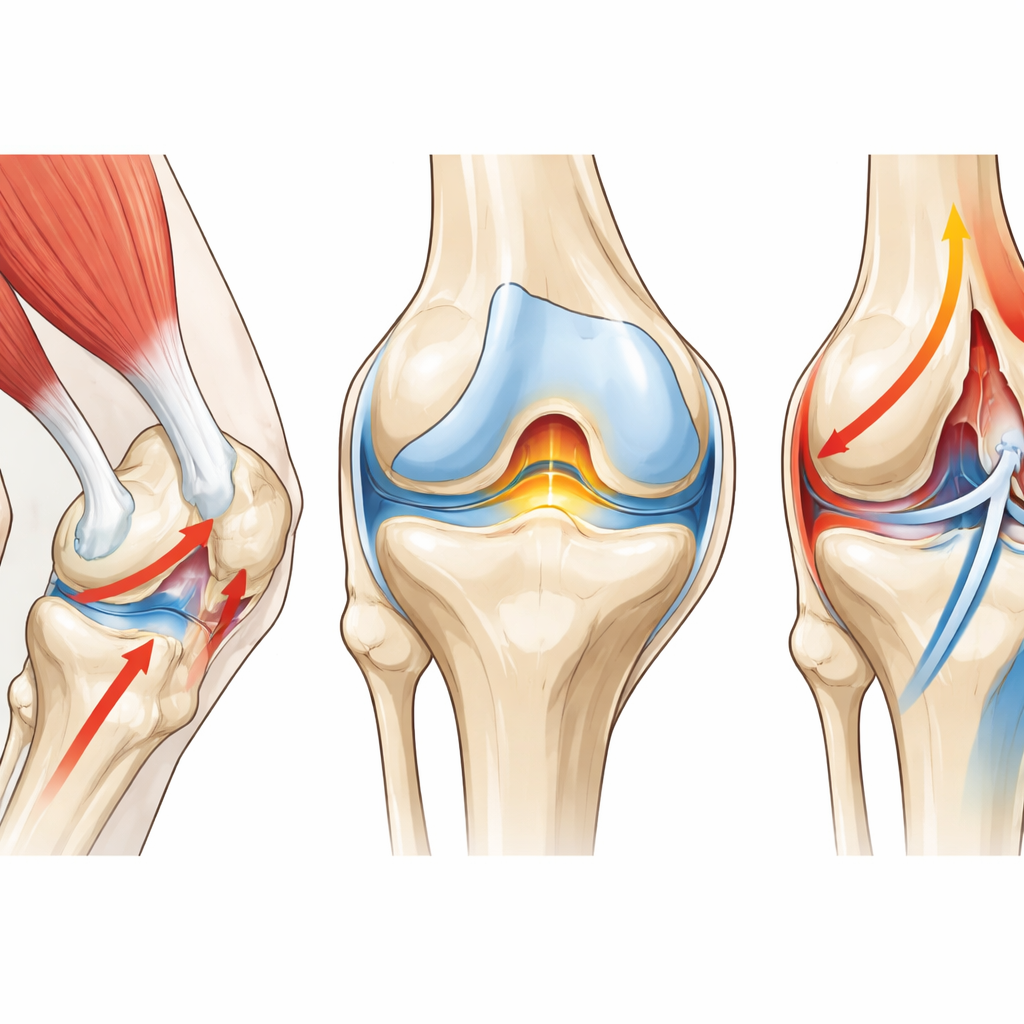
Why the choice of "joint center" in computer models matters
To interpret motion‑capture and strength data, researchers often use simplified musculoskeletal software that treats the knee as a perfect hinge located at a single "joint center." The authors compared their detailed deformable‑joint model with a widely used open‑source program that uses this simplification. When they shifted the assumed joint center forward or backward by only a couple of centimeters, the simplified model’s estimates of quadriceps force changed by more than 30 percent, and internal ligament and contact loads shifted accordingly. In contrast, the detailed model, which allows the joint surfaces and ligaments to share load naturally, kept muscle and contact forces essentially unchanged; only a passive balancing moment inside the joint varied with the chosen reference point.
Take‑home message for patients and practitioners
In plain terms, this work shows that seated knee extension tests generate very large forces inside the knee, especially at deeper bends, and that details such as strap placement can markedly affect how much the ACL and other structures are stressed. It also reveals that common computer tools used to interpret such tests can misjudge muscle and ligament loads if they oversimplify where the knee’s pivot is located. For clinicians and coaches, the message is to be thoughtful about test positions and to be cautious in relying on simplified models when making decisions about injury risk or rehabilitation programs. For patients, it underlines why certain angles may feel more uncomfortable and why careful adjustment of exercise setups can make strengthening both safer and more effective.
Citation: Salehi, P., Shirazi-Adl, A. Computational biomechanics of human knee joint in maximum voluntary isometric extension with focus on the role of joint center positioning. Sci Rep 16, 8582 (2026). https://doi.org/10.1038/s41598-026-39495-3
Keywords: knee biomechanics, quadriceps strength, ACL loading, computer modeling, rehabilitation exercise