Clear Sky Science · en
Age-dependent efficiency of magnetic drug targeting in young and old patient-specific aortic models
Why age matters for future targeted treatments
Many serious diseases of the body’s main artery, the aorta, strike later in life and are hard to treat without risky surgery. One emerging idea is to steer tiny, magnet-sensitive drug particles through the bloodstream and pull them into a diseased region with an external magnet. This study asks a surprisingly simple but important question: does this magnetic drug targeting work differently in young and old arteries, and if so, how should that shape future therapies? 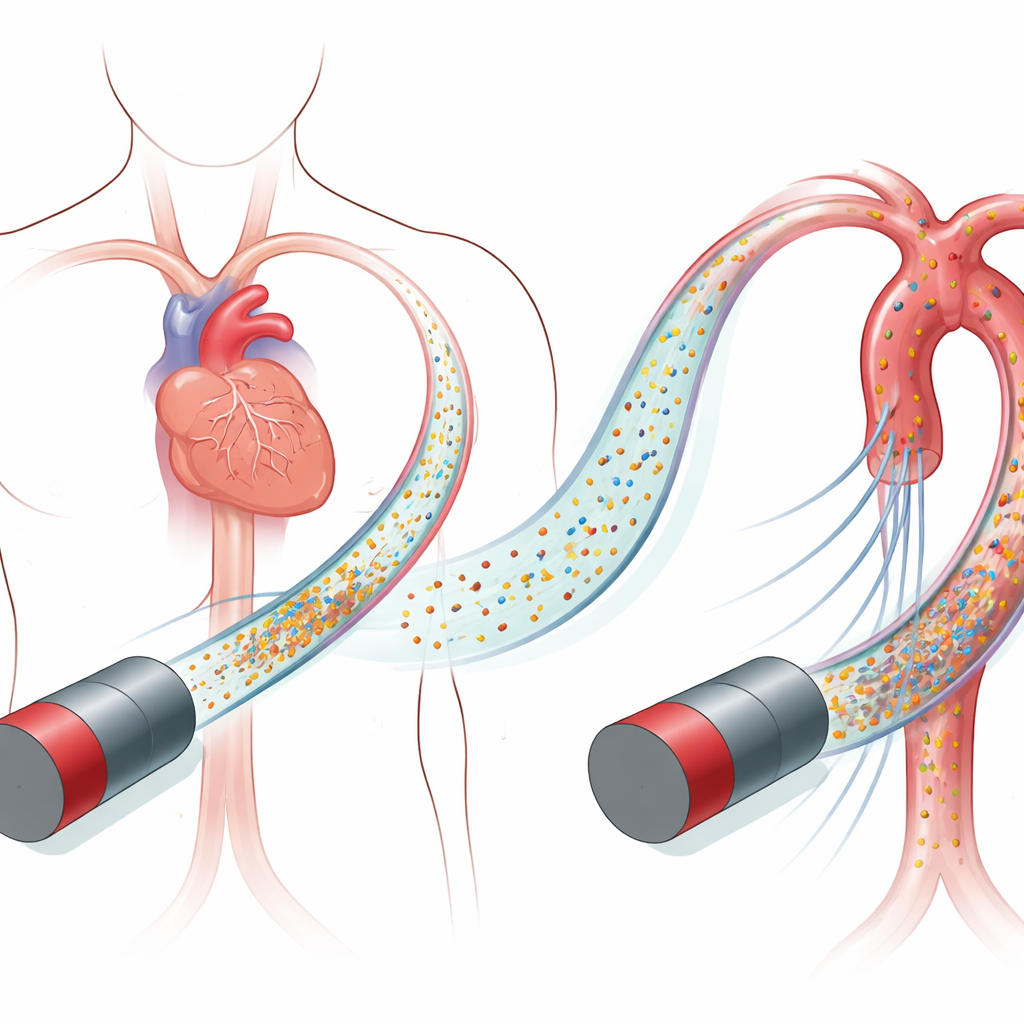
The big idea behind magnetic drug delivery
Magnetic drug targeting relies on nanoparticles—minute beads that carry medicine and respond to a magnetic field. When these particles move with the blood, an external magnet placed on the body can tug them sideways toward a chosen spot on the vessel wall, concentrating treatment where it is needed and limiting exposure elsewhere. The challenge is that blood does not flow like tap water, and real blood vessels are not straight pipes. Their shape, size, and the push and pull of each heartbeat all influence whether particles are swept past the target or have enough time to be pulled out of the stream and attached to the wall.
Virtual aortas from young and old patients
To capture these effects, the researchers built three-dimensional computer models of the thoracic aorta for two real patients: a healthy 22-year-old and a 78-year-old woman. Using medical CT scans, they reconstructed the exact curves and branches of each aorta, then simulated pulsating blood flow through them. They also added a realistic cylindrical magnet placed outside the chest, strong enough to match medical safety limits used in MRI-like settings. Thousands of virtual magnetic nanoparticles of different sizes were released into the blood at the aortic inlet, and the team tracked how many were pulled onto the vessel wall within a chosen treatment region in the descending aorta. 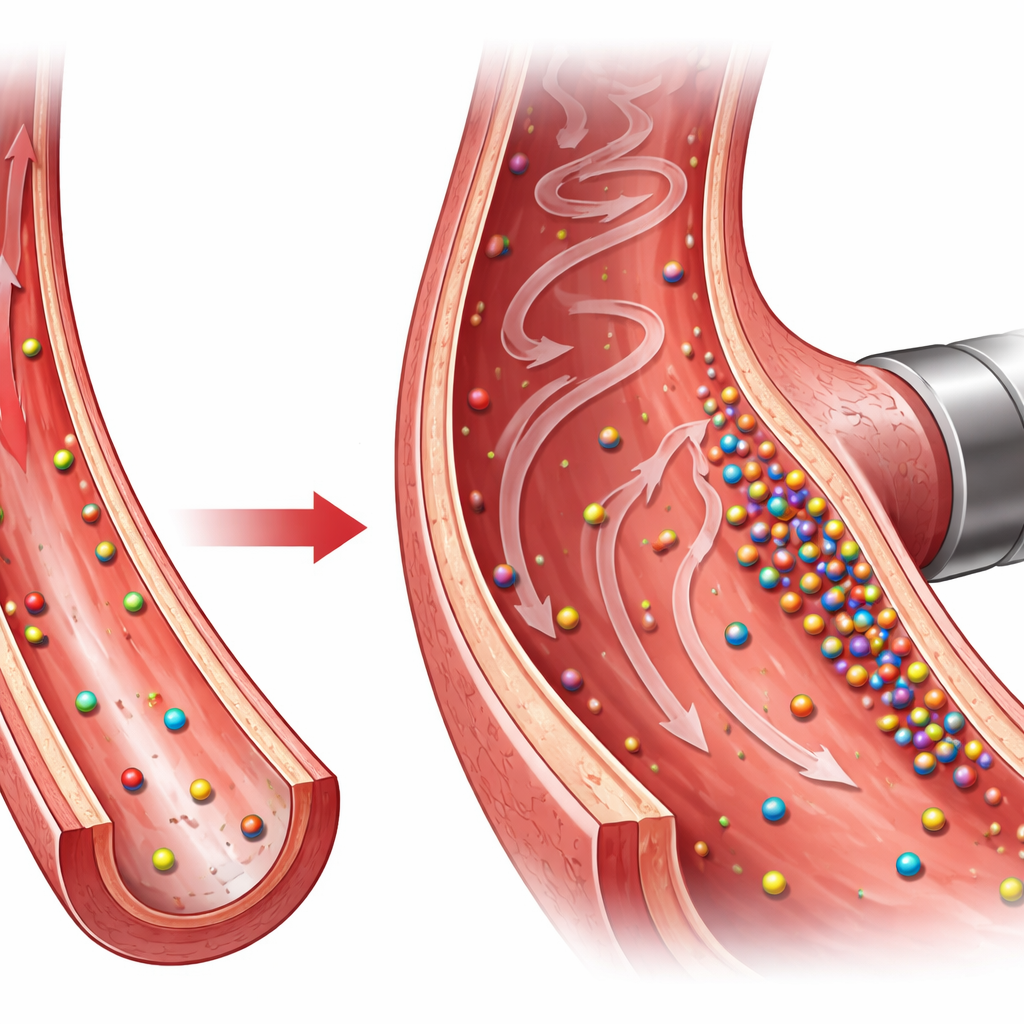
How blood flow and magnet strength shape particle capture
The study revealed that several knobs control how well the approach works. Larger particles were captured more easily than smaller ones, because magnetic force grows faster than the resisting drag from flowing blood. Stronger magnetic fields also raised capture efficiency, with performance improving sharply between modest and high field values. However, when the team treated blood as a simple, water-like fluid, the model consistently overstated how many particles could be trapped. When they instead used more realistic descriptions of blood’s “thick-then-thin” behavior under different shear rates, predicted capture fell, showing that oversimplified models can give overly optimistic expectations for this therapy.
Why older arteries actually help magnets
Counterintuitively, the older patient’s aorta proved slightly better for magnetic targeting across most of the tested conditions. With age, the aorta tends to widen, stiffen, and develop more bends. In the simulations, the older aorta had a larger cross-section, slower peak blood speeds, lower wall shear stress, and less forceful pulsations than the younger one. All of this meant that nanoparticles spent more time in the target region and faced weaker hydrodynamic “headwinds” opposing the magnet. As a result, the fraction of particles successfully captured in the older model was typically about 1.4–1.6 times higher than in the young model, even when both experienced the same field strength and particle sizes.
What this means for future patient-specific therapies
In simple terms, the work shows that aging arteries, while more disease-prone, may actually make magnetic drug targeting easier, because slower, more relaxed flow gives magnets more leverage over tiny particles. At the same time, the results warn that using idealized vessel shapes or overly simple blood models can mislead designers about how effective such systems will be in real people. For magnetic nanoparticle therapies to succeed in the clinic, magnets, particle size, and dosing will likely need to be tailored not just to the disease location, but also to patient age and vessel anatomy. This study lays groundwork for that kind of age-aware, personalized design, suggesting that elderly patients with aortic disease could be prime candidates for carefully optimized magnetic drug delivery.
Citation: Hosseini, S.B., Almosawy, W., Takrami, R.K. et al. Age-dependent efficiency of magnetic drug targeting in young and old patient-specific aortic models. Sci Rep 16, 7911 (2026). https://doi.org/10.1038/s41598-026-39486-4
Keywords: magnetic drug targeting, aortic disease, nanoparticles, vascular aging, computational hemodynamics