Clear Sky Science · en
Network pharmacology and molecular simulation reveal the entourage effect mechanisms of psilocybin-producing mushrooms on the brain
Why these mushrooms matter for the mind
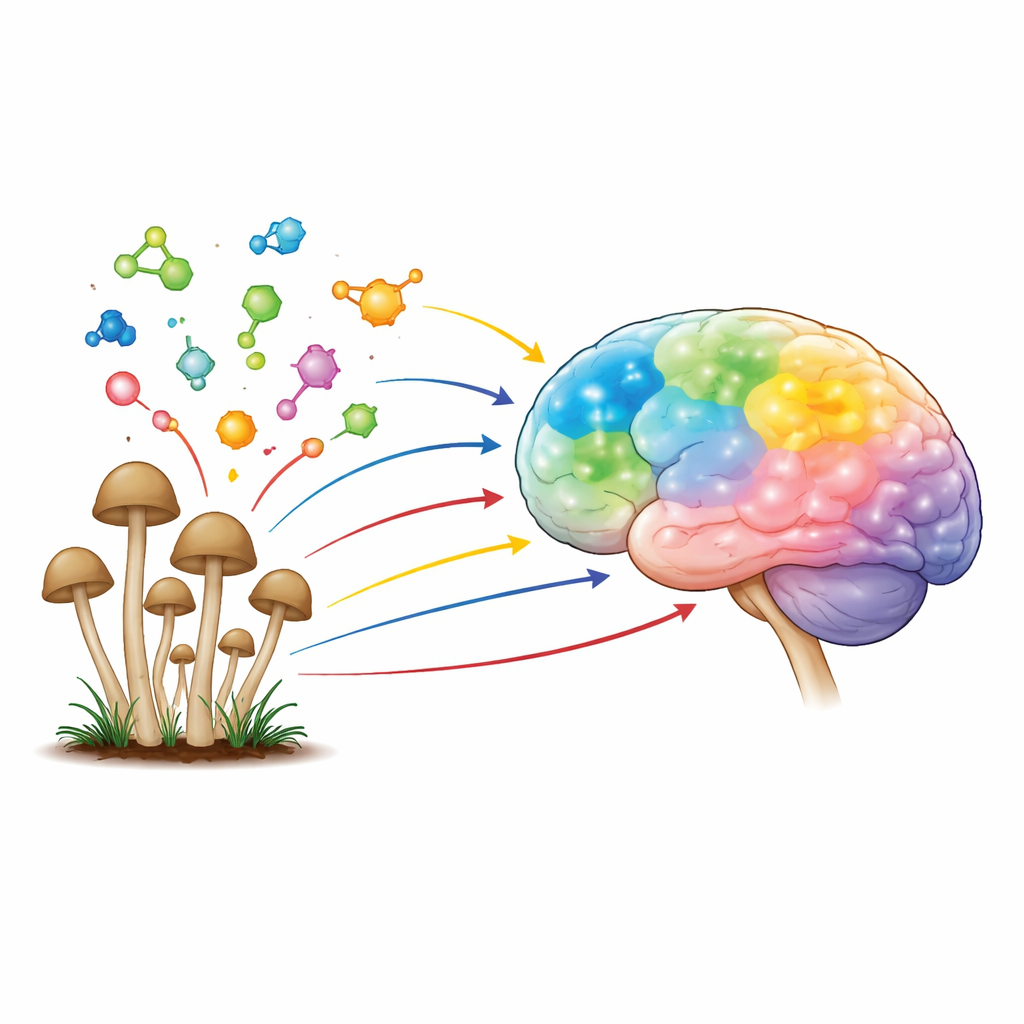
Magic mushrooms are often talked about for their mind-bending effects, but scientists are now asking a deeper question: are we focusing too much on just one ingredient, psilocybin, and overlooking the rest of the chemical "orchestra" inside the mushroom? This study uses advanced computer-based methods to explore how a whole suite of natural compounds in psilocybin-producing mushrooms might work together on the brain, potentially explaining why some people and animal studies suggest that mushroom extracts can feel or heal differently than pure psilocybin alone.
Many ingredients in one natural package
The researchers began by gathering all known small molecules found in psilocybin-producing mushrooms from previous chemical studies. They focused on fifteen compounds and then narrowed these down to eight that, according to predictive tools, are likely to be well absorbed when taken by mouth and able to cross the blood–brain barrier, the body’s tight security gate that normally shields the brain from many substances. These key compounds included psilocin (the active form of psilocybin), several close chemical cousins, the simple brain messenger phenylethylamine, and a group of molecules called beta-carbolines, such as harmane and harmol. Importantly, computer models suggested that these substances are not highly toxic at typical doses and are unlikely to strongly interfere with many of the liver enzymes that process common medications, though the beta-carbolines may slow the breakdown of some drugs.
Mapping a web of brain targets
Next, the team asked which parts of the brain’s machinery these compounds are most likely to touch. By comparing their shapes to thousands of known drug–protein pairs, they predicted 44 human proteins that could act as docking sites. When these predicted targets were laid out as a network, a clear pattern appeared: many belonged to tightly connected groups of proteins that control serotonin and dopamine, the chemical messengers that shape mood, reward, and perception. One dense cluster contained several serotonin receptors, dopamine receptors, and transporters that recycle these messengers, along with enzymes that break them down. Another cluster involved receptors for adrenaline-like signals that help regulate attention, blood pressure, and arousal. This web suggests that mushroom compounds do not act on a single switch, but rather nudge multiple, related systems at once.
How mushroom compounds might boost or prolong signals
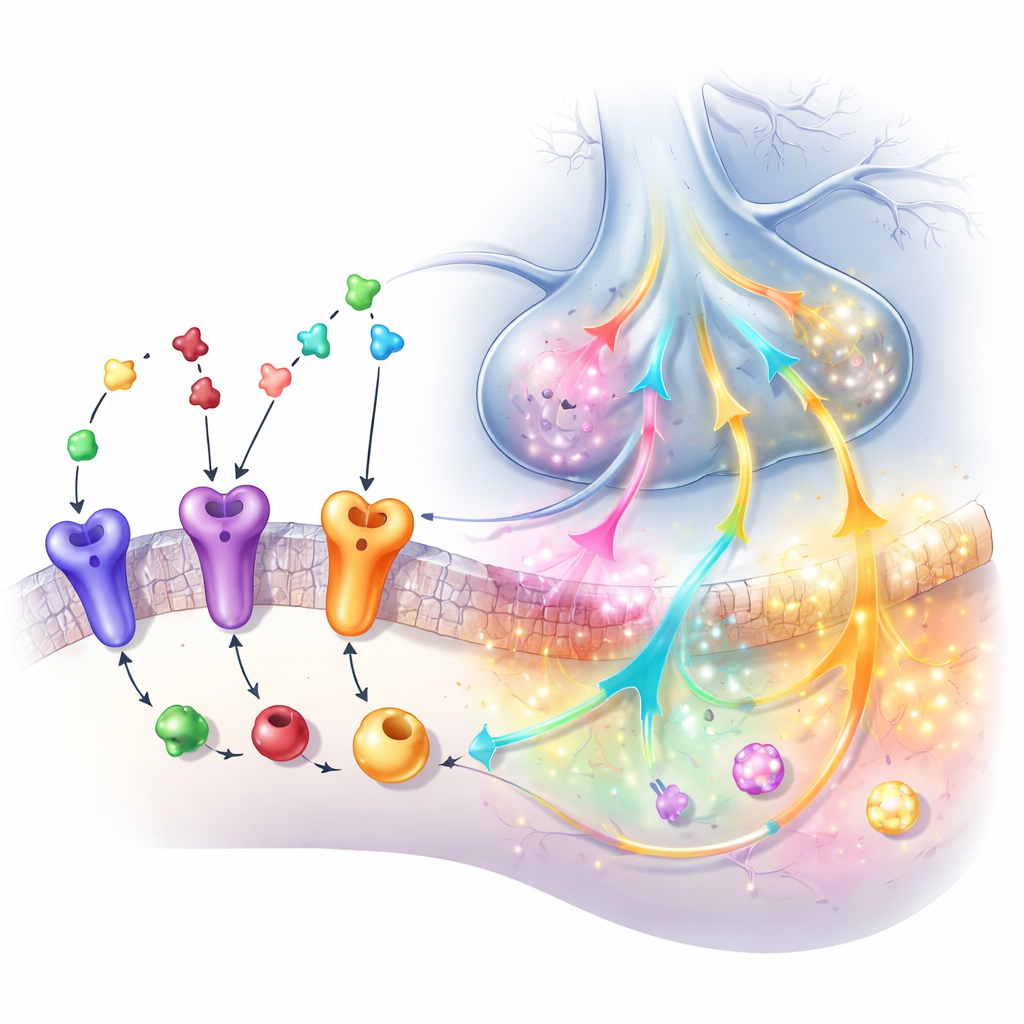
To probe these interactions in finer detail, the researchers used molecular docking and long computer simulations to see how strongly each compound might bind to selected brain proteins. They found that several mushroom molecules could sit snugly in the binding pocket of the serotonin 2A receptor, a key gateway for psychedelic experiences, forming the same kind of stabilizing contact as serotonin itself. Others fit well into the active site of monoamine oxidase A, an enzyme that normally breaks down serotonin, dopamine, and related messengers. Beta-carbolines, in particular, appeared to grip this enzyme tightly in the simulations, in ways similar to known monoamine oxidase inhibitors. In simple terms, some mushroom compounds may turn on certain receptors, while others partially block the enzyme that would normally clear those signals away, stretching out and amplifying their effects.
Ripples across brain circuits and the body
When the predicted targets were compared against known biological pathways, they lined up with circuits involved in serotonin and dopamine signaling, learning-related changes at synapses, and chemical cascades that control how blood vessels widen or tighten. Many of the proteins are concentrated in brain regions tied to mood, self-awareness, and emotional processing, such as the prefrontal cortex, hippocampus, and deeper structures like the amygdala and midbrain. This fits with brain imaging work showing that psilocybin can temporarily loosen rigid patterns of brain activity, increase communication between normally separate networks, and alter how we process fear and meaning. The same pathways also connect to the heart and blood vessels, and to channels involved in inflammation and pain, hinting that magic mushroom chemistry could have both mental and physical effects—useful or risky, depending on the context and dose.
What this means for future therapies
Taken together, the study supports the idea of an "entourage effect" in psilocybin-producing mushrooms: instead of one magic bullet, an ensemble of compounds may work in concert to shape brain activity. Psilocin may directly stimulate key serotonin receptors, while beta-carbolines slow the breakdown of mood-related messengers, and other small molecules tweak transporters and receptors along the same circuits. This layered action could help explain why, in some experiments and patient reports, whole mushroom preparations seem to have longer-lasting or qualitatively different effects than pure synthetic psilocybin. While these conclusions are based on powerful computer models rather than experiments in people, they lay out a testable roadmap for how the full chemical mix in magic mushrooms might support new treatments for depression, anxiety, addiction, and possibly pain—while also underscoring the need to watch for cardiovascular and drug-interaction risks as this field moves from the lab bench to the clinic.
Citation: Murray, Z., Lewies, A., Wentzel, J.F. et al. Network pharmacology and molecular simulation reveal the entourage effect mechanisms of psilocybin-producing mushrooms on the brain. Sci Rep 16, 9016 (2026). https://doi.org/10.1038/s41598-026-39483-7
Keywords: psilocybin mushrooms, entourage effect, serotonin receptors, monoamine oxidase, psychedelic therapy