Clear Sky Science · en
The significance of structural coal in regional coal and gas outbursts in southern Sichuan Coalfield
Hidden dangers beneath the coalfields
Deep beneath the hills of southern Sichuan, China, miners work in coal seams charged with high‑pressure gas. When that gas suddenly erupts together with coal, it can blast hundreds or even thousands of tons of rock into tunnels in an instant. This study asks a practical question with life‑or‑death consequences: can we use the structure of the coal itself to predict where these violent coal–gas outbursts are most likely to happen, before mines are ever dug?
A troubled landscape of folds and faults
The southern Sichuan Coalfield is geologically complex, carved by broad folds and criss‑crossed by faults. The authors show that this architecture strongly shapes where gas builds up. Gentle limbs of large folds and zones around concealed, tight faults tend to trap gas, while nearby water‑bearing rocks can sometimes drain it away. As coal seams lie deeper, rising rock pressure squeezes them, closes natural pathways for gas to escape, and lengthens the journey to the surface, all of which raise gas content and the odds of dangerous eruptions. In this region, more than four out of five mines are classed as high‑gas or outburst‑prone, and some single events have hurled up to 3,100 tons of coal and rock.
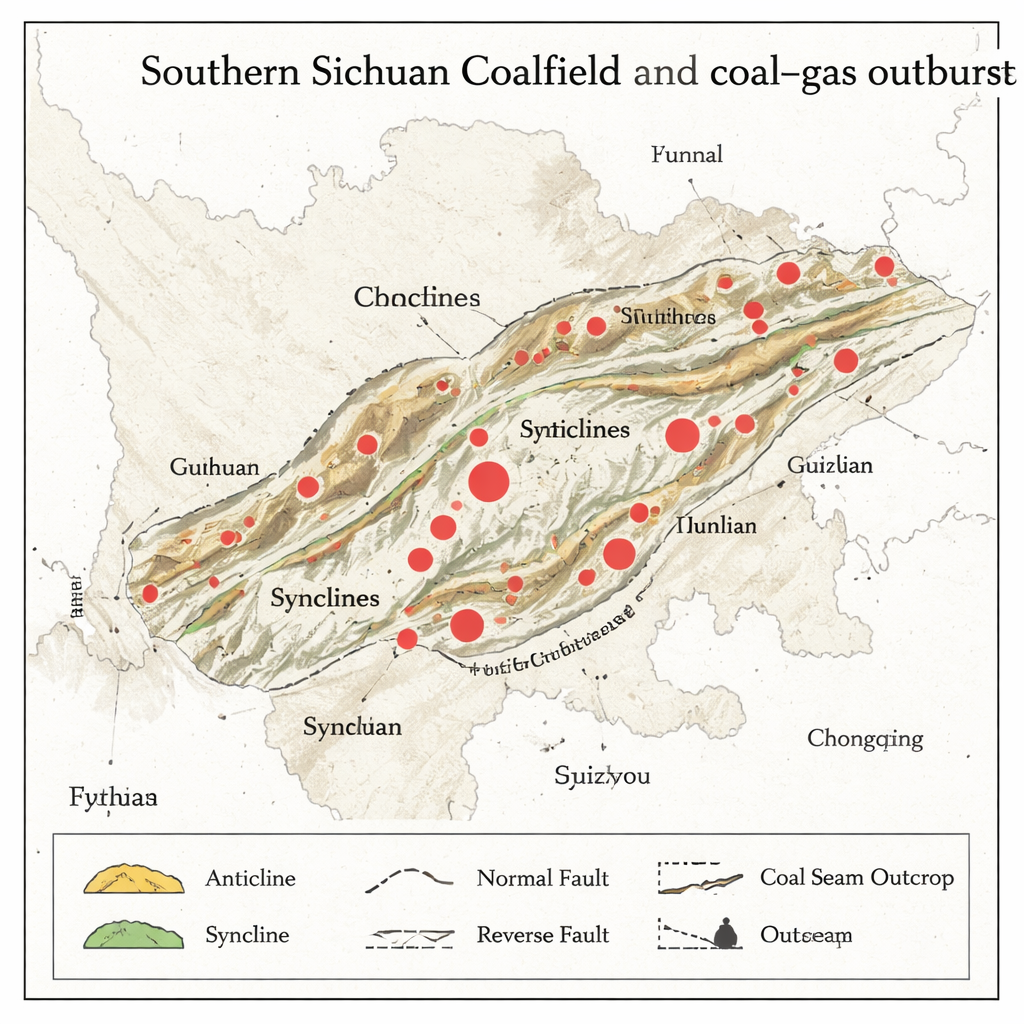
When solid coal turns to structural coal
The study focuses on “structural coal” – coal that has been crushed, sheared or softened by tectonic forces. Compared with intact blocks, this damaged coal is weaker, more broken and richer in pores and cracks. That makes it easier for gas to enter and be stored, but also easier for the coal to fail suddenly when disturbed. By analyzing borehole samples across three mining districts, the researchers quantified how the share of structural coal within a seam relates to two standard warning indicators: the firmness coefficient f (how strong the coal is) and a composite outburst index K. Where structural coal makes up a larger fraction of the seam, f drops and K rises, signaling softer, more unstable coal that is primed for violent gas release.
Thickness as a trigger for violent bursts
Beyond the overall proportion of damaged coal, the thickness of individual structural coal layers turned out to be crucial. Using records from multiple mines, the team found that outburst intensity increases exponentially as the thickest single structural coal layer grows. Where that layer is thinner than about 1.1 meters, bursts tend to be small or moderate, involving less than 500 tons of material. Between 1.1 and 1.25 meters, large outbursts become common. Once the structural coal exceeds roughly 1.25 meters, exceptionally severe events – often over 1,000 tons – are likely. In other words, the thicker the weak, fractured coal band, the more energy can be stored and suddenly unleashed.
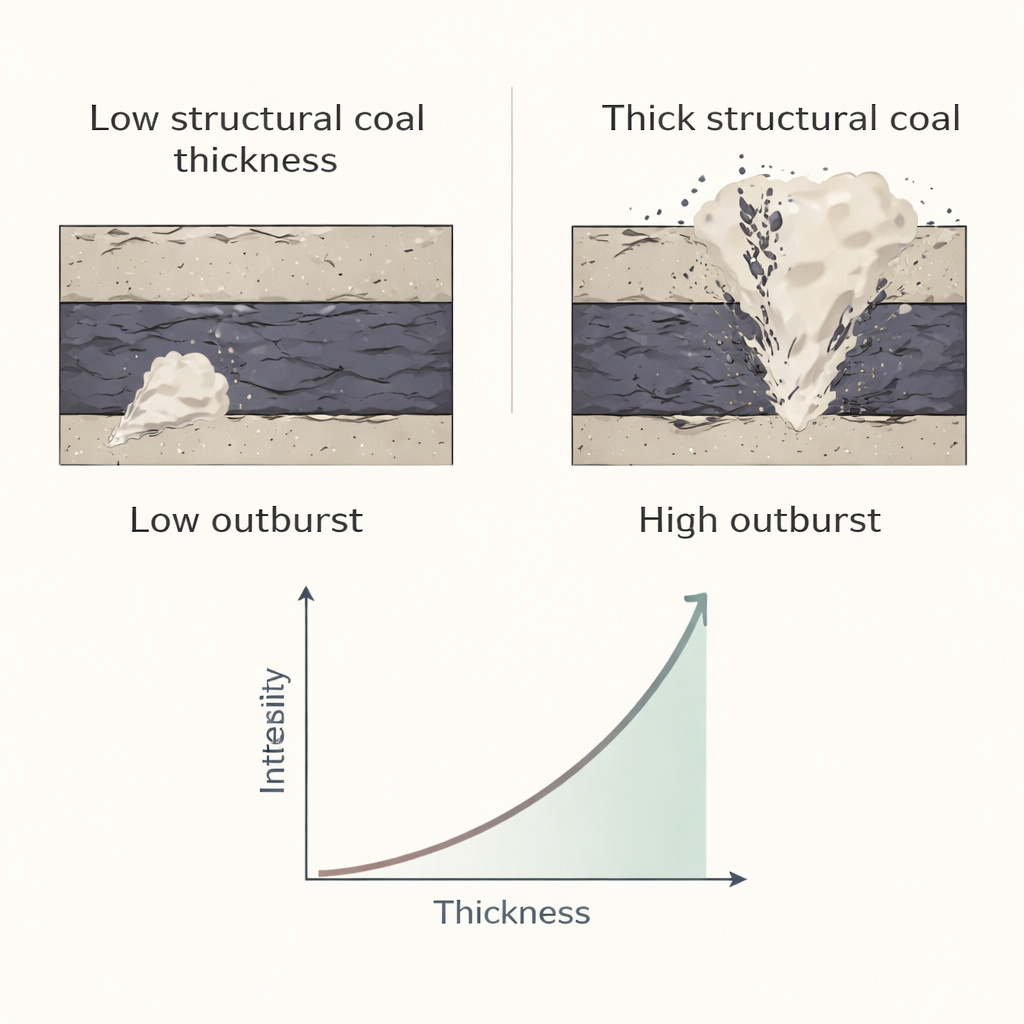
Turning logging data into a hazard map
To move from scattered boreholes to a regional forecast, the authors turned to modern downhole logging tools. Using the JGS‑6 digital logging system, they measured how electrical signals and radiation respond to changes in rock properties. Structural coal, with its higher water content and distinctive density, produces a characteristic pattern in these logs: lower apparent resistivity, low gamma‑ray anomalies, and subtle shifts in density curves. By standardizing how these signatures are interpreted, the team estimated structural coal thickness across the coalfield, then plugged those values into their mathematical links to f, K and outburst intensity. The predicted values matched field measurements closely, with average differences of less than one percent for key indicators and the same order of magnitude for actual burst sizes.
From scientific model to safer mines
Combining geological mapping, borehole data and logging interpretation, the authors produced a zoned hazard map for the southern Sichuan Coalfield. Areas such as Daxueshan and Baijiao emerge as extreme outburst hotspots with potential events approaching 9,000 tons, while Guanwen and Shiping are flagged for large outbursts and other districts face mainly smaller events. For non‑specialists, the takeaway is straightforward: by carefully measuring how broken and thick certain coal layers are before mining advances, engineers can anticipate where the ground is most likely to explode and prioritize gas drainage, support and monitoring. The work does not remove all uncertainty – other factors like changing stresses and limited data still matter – but it offers a concrete, data‑driven way to make deep coal mining in this dangerous region significantly safer.
Citation: Sun, W., Zhao, Q., Cui, D. et al. The significance of structural coal in regional coal and gas outbursts in southern Sichuan Coalfield. Sci Rep 16, 6779 (2026). https://doi.org/10.1038/s41598-026-39480-w
Keywords: coal mine safety, gas outburst, structural coal, geophysical logging, Sichuan coalfield