Clear Sky Science · en
Robust broadband adaptive beamforming for planar arrays with tunable nulls in high-dynamic scenario
Why blocking unwanted signals matters
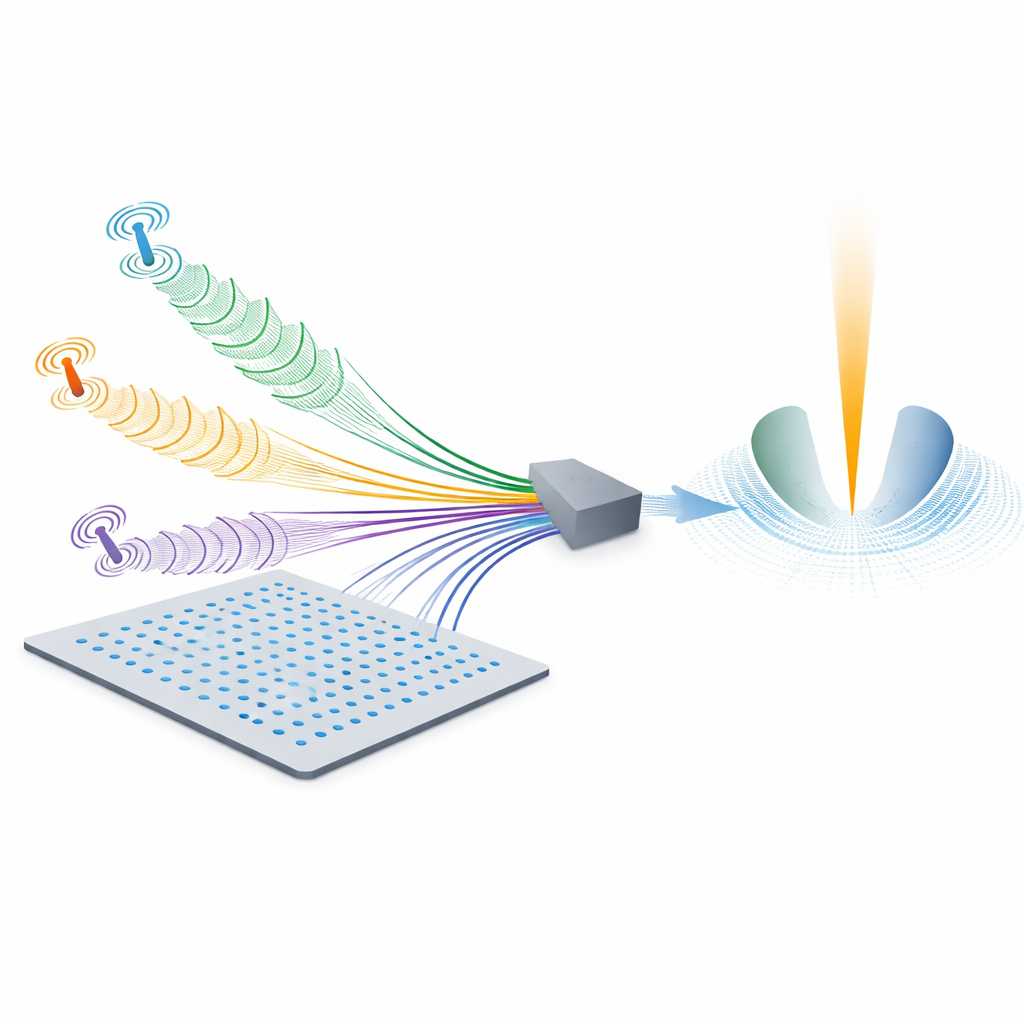
Modern technologies like satellite navigation, wireless communication, radar and sonar all depend on sensitive antennas to pick up faint signals from far away. But these systems operate in crowded airwaves, where powerful interfering signals can easily drown out the weak ones we actually care about. When either the receiver platform or the interfering source is moving quickly, these unwanted signals sweep across the antenna’s field of view so fast that conventional defenses struggle to keep up. This paper presents a new way for planar antenna arrays to carve out broad, precisely shaped “quiet zones” in the directions of moving interferers, while still listening carefully to the desired signal.
Listening with many ears at once
The work builds on space–time adaptive processing, a technique in which a grid of antenna elements (a planar array) is combined with digital filters acting over time. Instead of treating each antenna separately, the system looks at all elements and time samples together, building a large covariance matrix that describes how signals and noise are related across space and time. By solving a mathematical optimization problem, it computes a set of weights that make the array highly sensitive in the direction of the desired source, while forming deep “nulls” in the directions of interference. For stationary jammers, this produces razor-thin dark notches that suppress them effectively.
Why fast-moving interference breaks old methods
In real systems, however, strong interferers do not stand still. For example, a jammer may move relative to a satellite navigation antenna, or a radar platform may sweep its field of view. In those situations, a narrow null can no longer follow the interference quickly enough, because updating the adaptive weights takes time. Researchers have tried to fix this by deliberately widening the nulls, so that they cover a range of possible directions rather than a single point. Earlier approaches, however, either assumed special prior knowledge about where the interference would come from, worked only for one-dimensional linear arrays, or forced the nulls to be symmetric and of equal width in all directions. That symmetry wastes a valuable resource called degrees of freedom and can unnecessarily damage the useful signal.
Shaping wide and uneven quiet zones
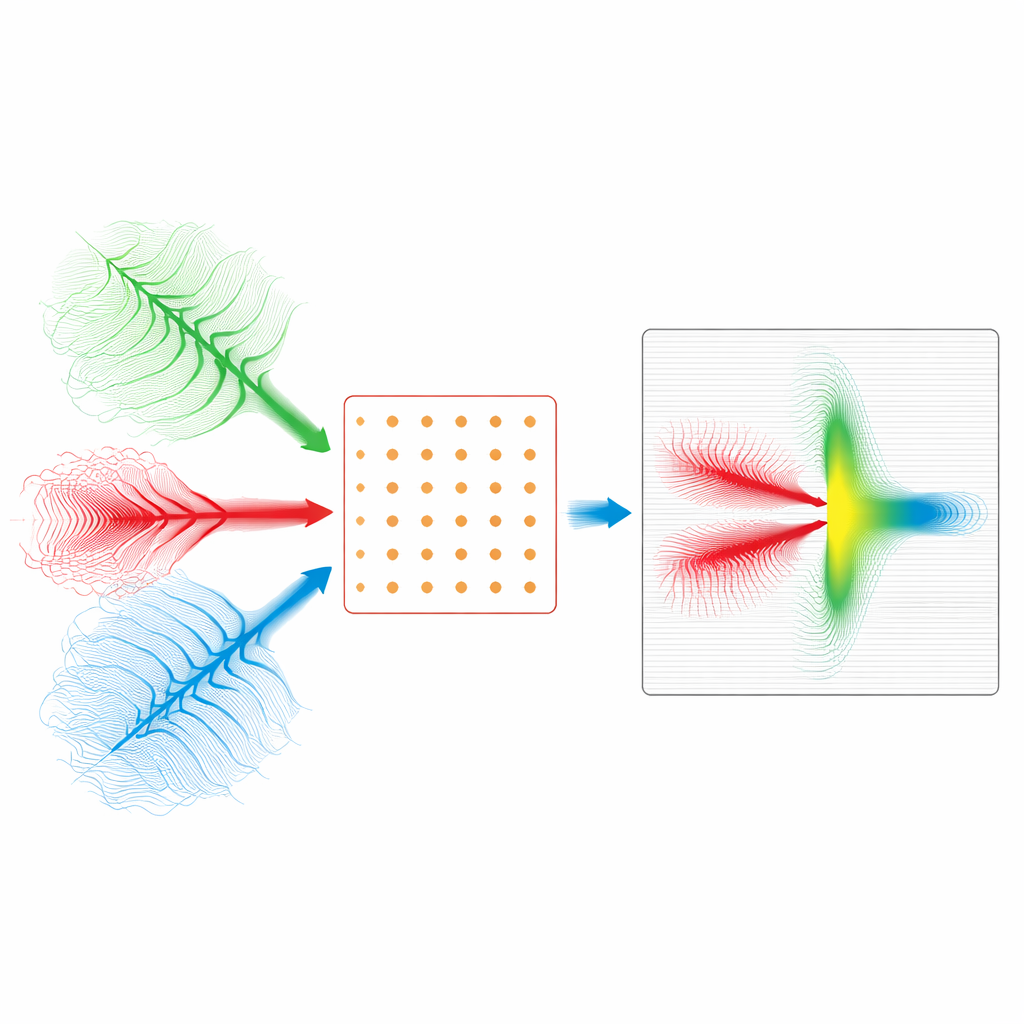
The authors introduce a new strategy tailored for two-dimensional planar arrays that can generate nulls whose width and shape can be tuned independently in horizontal (azimuth) and vertical (elevation) angles. The key idea is to sprinkle an artificial cloud of “virtual interferers” around each real one, following a triangular probability pattern known here as a Simpson-statistical distribution. This pattern can be skewed so that the artificial interferers are more densely placed on one side than the other, naturally leading to asymmetric widening. From this cloud, the team derives a closed-form taper matrix that gently reshapes the covariance matrix, effectively smearing each real interferer into a broader, controllable region in angle space without requiring any iterative optimization.
Targeting each interferer separately
Because different interferers may move differently, the method does not treat them all alike. Using eigen-decomposition of the covariance matrix, the algorithm breaks the overall signal space into components associated with each interference source. For each one, it constructs a dedicated taper with its own widening parameters, then reconstructs a modified covariance matrix that encodes these customized quiet zones. A specially designed beamformer ensures that, across the full signal bandwidth, the desired signal passes through with a flat amplitude response, which is crucial for precise phase and timing measurements in systems like global navigation satellite receivers. The authors also add a small stabilizing term so that this flexible shaping does not destabilize the side lobes.
What simulations reveal in practice
Extensive simulations with a sizeable planar array show several practical benefits. First, the method can widen the null around a single interferer in a chosen direction while keeping other interferers sharply suppressed, demonstrating fine-grained control. Second, it can assign different asymmetries and widths to different interferers, closely matching their motion and saving many degrees of freedom compared with conventional covariance-matrix tapering. Third, performance metrics such as output signal-to-interference-plus-noise ratio remain high even when an interferer moves across the widened sector, and when the array suffers from realistic modeling errors. Compared with traditional methods, the proposed beamformer better preserves the gain toward the desired target, especially when a strong interferer lies close to the main beam. All of this is achieved with essentially the same computational cost as standard approaches.
Clear signals in a crowded sky
In plain terms, this work gives planar antenna arrays a more agile way to “look away” from trouble while still “looking straight” at the signal of interest. By carefully shaping wide, uneven quiet zones in the directions where interference is likely to wander, the method protects navigation, radar, sonar and communication systems in fast-changing environments without demanding extra processing power. The result is more robust reception of weak, information-bearing signals even when powerful, mobile jammers are trying to overwhelm them.
Citation: Hao, F., Yu, B., Cong, Z. et al. Robust broadband adaptive beamforming for planar arrays with tunable nulls in high-dynamic scenario. Sci Rep 16, 8131 (2026). https://doi.org/10.1038/s41598-026-39479-3
Keywords: adaptive beamforming, planar antenna arrays, interference suppression, space-time processing, satellite navigation