Clear Sky Science · en
Spatio-temporal evolution and driving factors of China’s foreign aid: a country-level analysis
Why China’s Giving Matters to the World
When people think about foreign aid, they often picture Western governments helping poorer countries. Yet over the past two decades, China has become one of the world’s most influential donors, funding everything from highways and power plants to hospitals and disaster relief. This study takes a long, careful look at how China has spread its aid across the globe from 2000 to 2021, and what really shapes where the money and projects go. Understanding these patterns helps ordinary readers see how aid connects to global development, trade, and politics—and whether claims about “debt traps” or resource grabs hold up to the data.
Where the Money and Projects Go
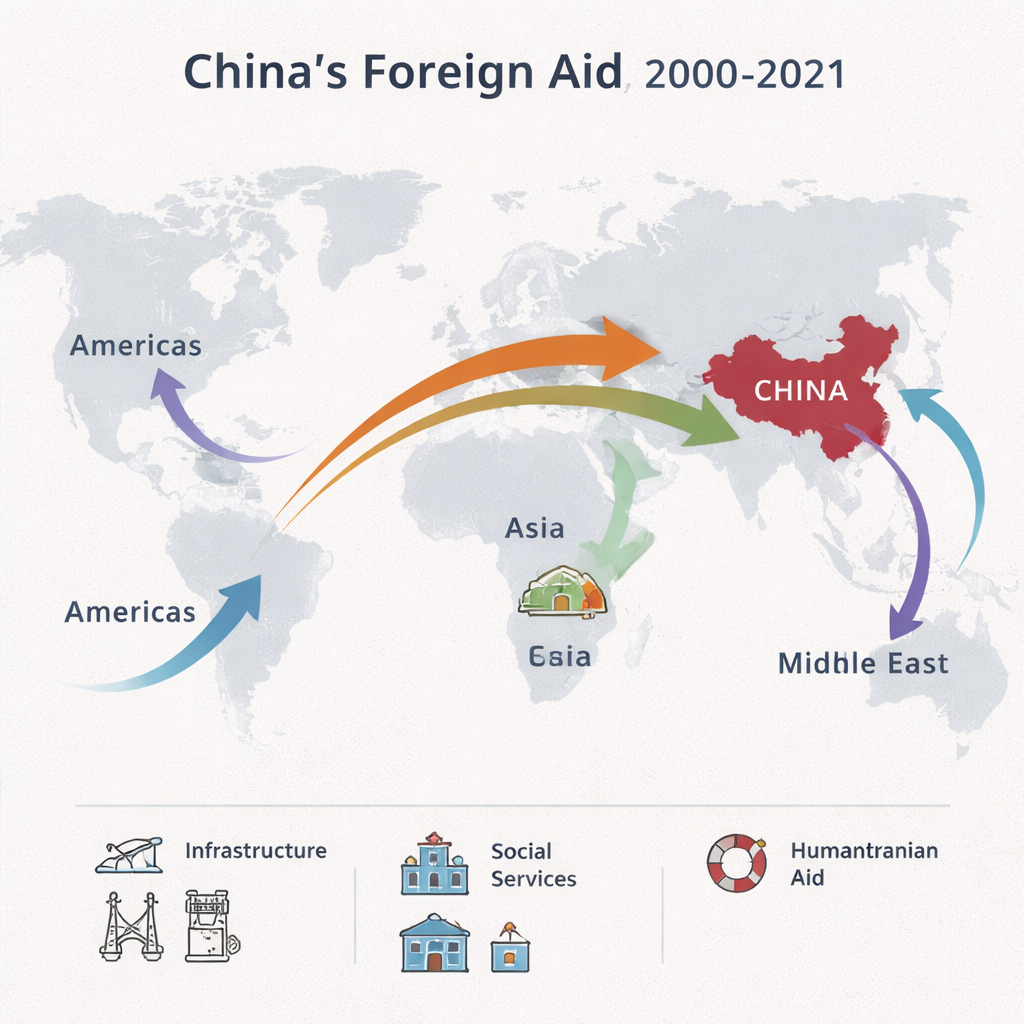
The authors assemble detailed records of nearly 21,000 Chinese aid projects drawn from the AidData database, then match them with economic, social, trade, and political indicators for almost 100 recipient countries. They track not only how much funding flows each year, but also how many projects are launched, in what sectors, and on which continents. Over the 21-year period, China’s aid expands in waves: it starts modestly in the early 2000s, grows sharply after the 2008 global financial crisis, peaks around the launch of the Belt and Road Initiative in the mid‑2010s, and then shifts again during the COVID‑19 pandemic. Throughout, Africa and Asia stand out as the main destinations, forming a “dual core” of activity, while Latin America, Europe, Oceania, and the Middle East play more limited roles.
What Kind of Help Is Being Offered
Looking more closely, the study finds that China’s aid is heavily tilted toward building basic foundations for development. Large sums of money go into infrastructure such as transport, energy, and water systems, whereas the largest numbers of individual projects cluster in social services like health, education, and other public facilities. This creates a dual structure: a few big-ticket projects absorb most of the funding, while many smaller projects spread support more widely. Regional differences are clear. Africa and Asia receive broad mixes of infrastructure and social programs; the Americas tend to see fewer but larger projects, often in energy and major construction; Oceania mostly receives small, targeted efforts; and Europe is more likely to get support tied to production, economic cooperation, or institutional capacity rather than bricks-and-mortar works.
Clusters on the Map
Using spatial statistics, the authors map how aid clusters across countries. When they count projects, strong “hot spots” emerge in Sub‑Saharan Africa and South Asia, with countries like Nigeria, Côte d’Ivoire, India, and Bangladesh repeatedly ranking as core partners. These clusters expand and contract over time but remain rooted in the Global South. Funding, however, behaves differently. Large sums concentrate in a small and shifting set of strategically important countries—first in Southeast Asia and parts of Latin America, then extending into Central Asia and Russia, before narrowing again. In other words, China’s aid presence by project is broad and dense, but its biggest financial bets are more selective and mobile.
What Drives China’s Choices
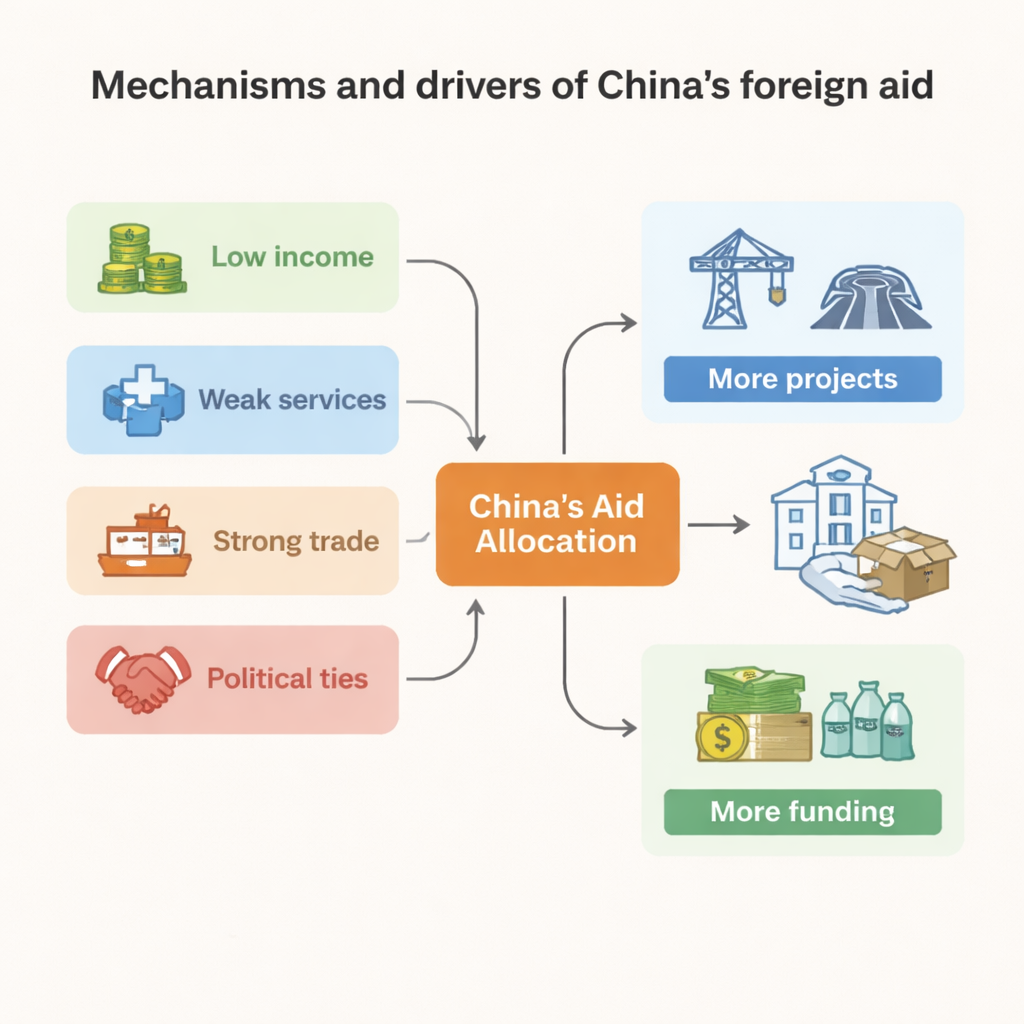
To probe the forces behind these patterns, the study combines traditional regression analysis with modern machine-learning tools that can detect complex, nonlinear relationships. Several consistent drivers emerge. Countries with lower incomes and weaker basic services—measured by indicators like electricity access and health spending—are more likely to receive more Chinese aid, reinforcing a development-focused logic. Stronger trade ties, especially when China imports more from a country, become increasingly important in later years, suggesting that economic integration matters. Political alignment, captured by how similarly countries vote at the United Nations, also plays a steady role: those closer to China politically tend to attract more projects and money. By contrast, measures of natural resource dependence show little systematic impact, offering scant support for the idea that China’s aid is mainly a tool to secure raw materials.
How the Story Comes Together
For non-specialists, the key message is that China’s foreign aid is neither a simple act of charity nor a one-dimensional power play. The evidence points to a layered decision process. First, China focuses on countries with clear development needs, particularly in Africa and Asia, and channels large resources into infrastructure and public services that can underpin long-term growth. Second, deeper trade links and shared political positions increase the likelihood and scale of support—but mainly among low- and middle-income countries, and only up to certain thresholds. Taken together, the findings suggest that China’s aid is guided by a mix of development goals, economic partnerships, and diplomatic considerations, rather than by an overriding quest for resources or uniform geopolitical control.
Citation: Cheng, X., Luo, Z. & Shi, J. Spatio-temporal evolution and driving factors of China’s foreign aid: a country-level analysis. Sci Rep 16, 5955 (2026). https://doi.org/10.1038/s41598-026-39475-7
Keywords: China foreign aid, global development, infrastructure projects, South–South cooperation, aid and geopolitics