Clear Sky Science · en
Facial mark based biometric differentiation of identical twins using dynamic feature enhancement
Why Tiny Skin Details Matter
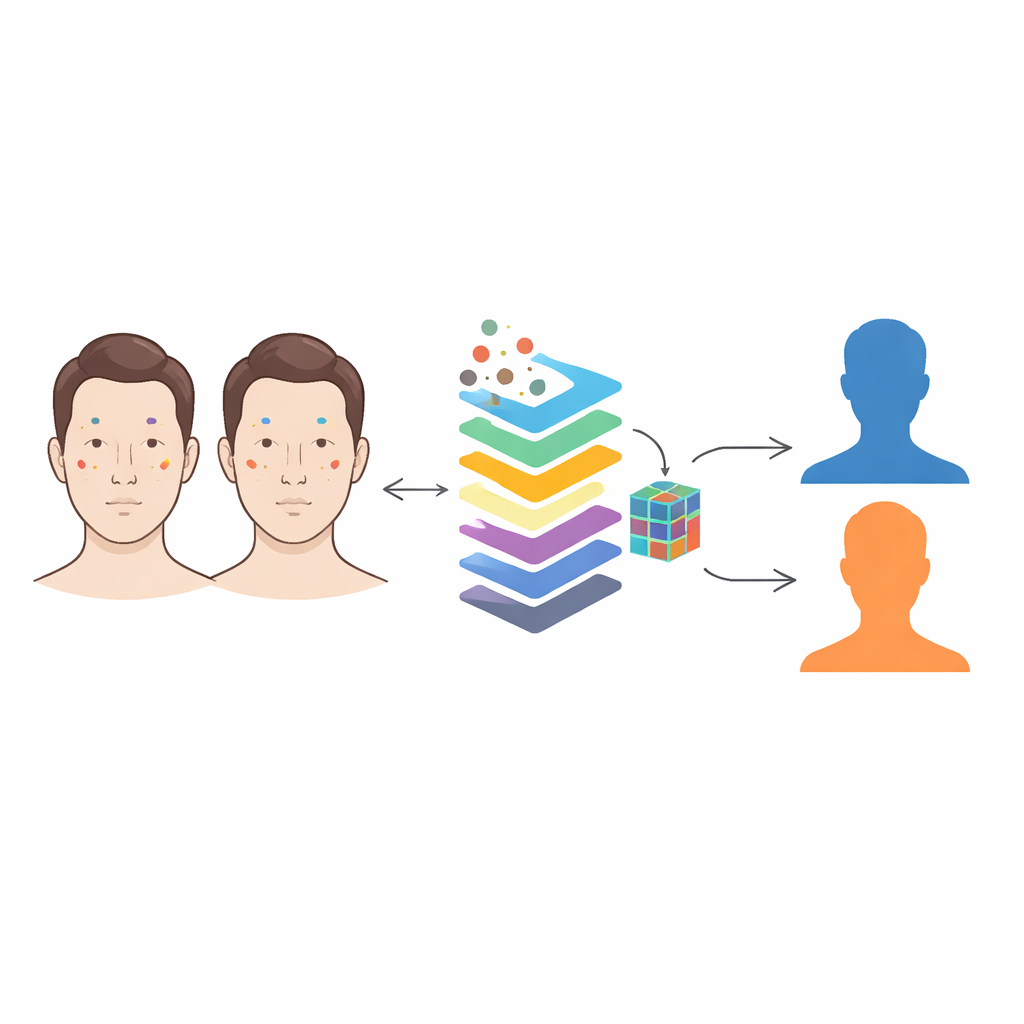
Most of us assume that identical twins are, well, identical—so alike that even high-tech cameras and DNA tests struggle to tell them apart. That similarity creates serious headaches in real-world situations, from solving crimes to securing borders. This study shows that the solution may lie in something we rarely notice: the small, stable marks and blemishes scattered across our faces. By treating these moles, spots, and pores as a kind of “skin map,” the researchers built an automated system that can reliably distinguish identical twins, pointing toward more precise and explainable biometric tools.
From Confusing Faces to Clear Skin Maps
Traditional face recognition systems focus on overall facial structure—the distance between the eyes, the shape of the nose, the outline of the jaw. For identical twins, these features are nearly carbon copies, which is why even advanced algorithms and DNA profiling often fail to say which twin is which. The authors instead concentrate on the tiny, largely permanent details of facial skin: acne scars, dark spots, pores, and wrinkles. These marks tend to form unique patterns over a person’s lifetime, even in people who share almost all of their genes. The core idea is simple but powerful: while twin faces may look the same at a glance, their constellations of skin marks do not.
How the System Sees What We Miss
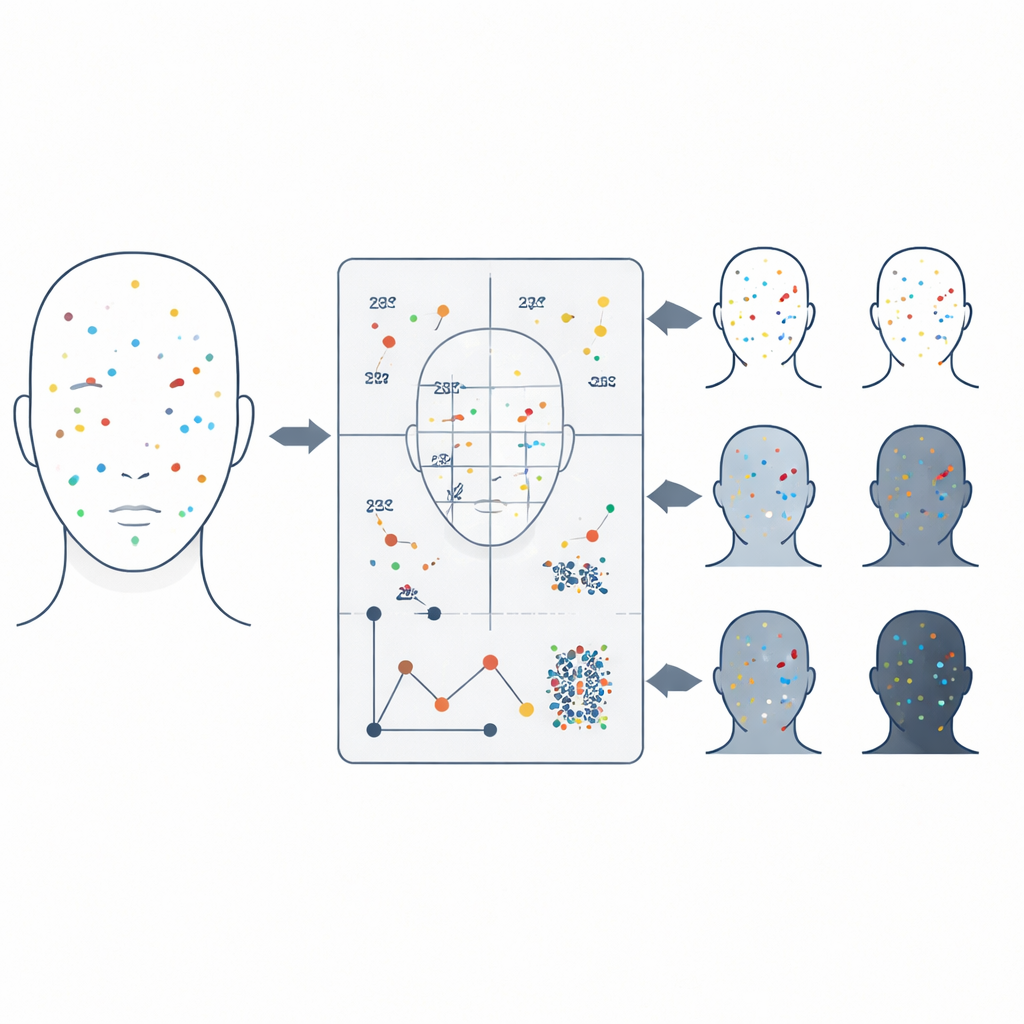
The team worked with 319 facial photos from 74 pairs of twins in a well-known research collection. First, they used a pre-trained computer vision model to scan each face and detect different types of skin features—such as acne, dark circles, or pores—drawing invisible boxes around each one. Importantly, they set the detector to be very sensitive, willing to pick up even faint marks at the cost of also catching some noise. Rather than trusting each detection on its own, they summarized all the marks into a rich profile for each person: how many marks of each type appear, how tightly they cluster, how they are spread across the face, and how large they are on average.
Turning Skin Patterns into Twin Decisions
Next, the researchers compared these skin profiles between pairs of images—sometimes true twins, sometimes unrelated people—to measure how similar or different they were. They combined several intuitive comparison steps: how closely the mix of mark types matches, how similar the overall sizes of marks are, how evenly marks are shared between left and right or top and bottom of the face, and how the marks are arranged in space, including how far they sit from the center of the face and how strongly they cluster. These similarity scores were then fed into a machine learning model that learned to answer a yes–no question: do these two faces belong to the same twin pair or not?
Smart Tuning Without Wasting Time
Building such a classifier is not just about what information you give it, but also how you tune its many internal “knobs,” such as how complex the model is allowed to become. The study systematically compared four different strategies to search for the best settings, ranging from an exhaustive grid of possibilities to more exploratory methods inspired by random sampling and swarming behavior in nature. While a swarm-based method edged out slightly in raw accuracy during testing, a simpler random search delivered nearly identical performance in a fraction of the time. This balance matters in practice: a system that is both accurate and efficient is far more likely to see real-world use in police labs, border checkpoints, or medical research.
What the Skin Says About Identity
Overall, the framework reached about 96.6% accuracy in cross-validation and a strong score on tests that measure how well it separates twins from non-twins, with minimal signs of overfitting. The most decisive signal was not which types of marks people had, but where those marks appeared on the face—the spatial pattern acted like a unique signature. Counts of mark types, differences between facial regions, and subtle clustering patterns added extra reliability. Importantly, the system’s decisions can be visualized and explained, allowing investigators to see which aspects of the skin map drove a match or non-match. For lay readers, the message is striking: even in the most look-alike humans we know, the skin quietly records enough individual detail for machines to tell them apart, opening the door to fairer court cases, more secure biometrics, and new ways to study how our environment shapes our appearance over time.
Citation: Brahmbhatt, K.J., Prakasha, K. & Sanil, G. Facial mark based biometric differentiation of identical twins using dynamic feature enhancement. Sci Rep 16, 9249 (2026). https://doi.org/10.1038/s41598-026-39470-y
Keywords: identical twins, facial biometrics, skin marks, forensic identification, machine learning