Clear Sky Science · en
Harnessing fano-like line shape resonance in a rectangular waveguide for filtering applications
Why this matters for everyday signals
Modern life depends on invisible waves that carry phone calls, wireless data, satellite links, and sensing signals. All of these rely on filters—electronic “sieves” that let through only a narrow slice of frequencies while blocking the rest. This paper presents a new kind of compact filter built from a rectangular waveguide with a ring-shaped path and a small internal cavity. By cleverly shaping and placing this cavity, the authors harness a subtle interference effect to create an extremely sharp, tunable filter that could make future radio and microwave systems more precise and energy‑efficient.
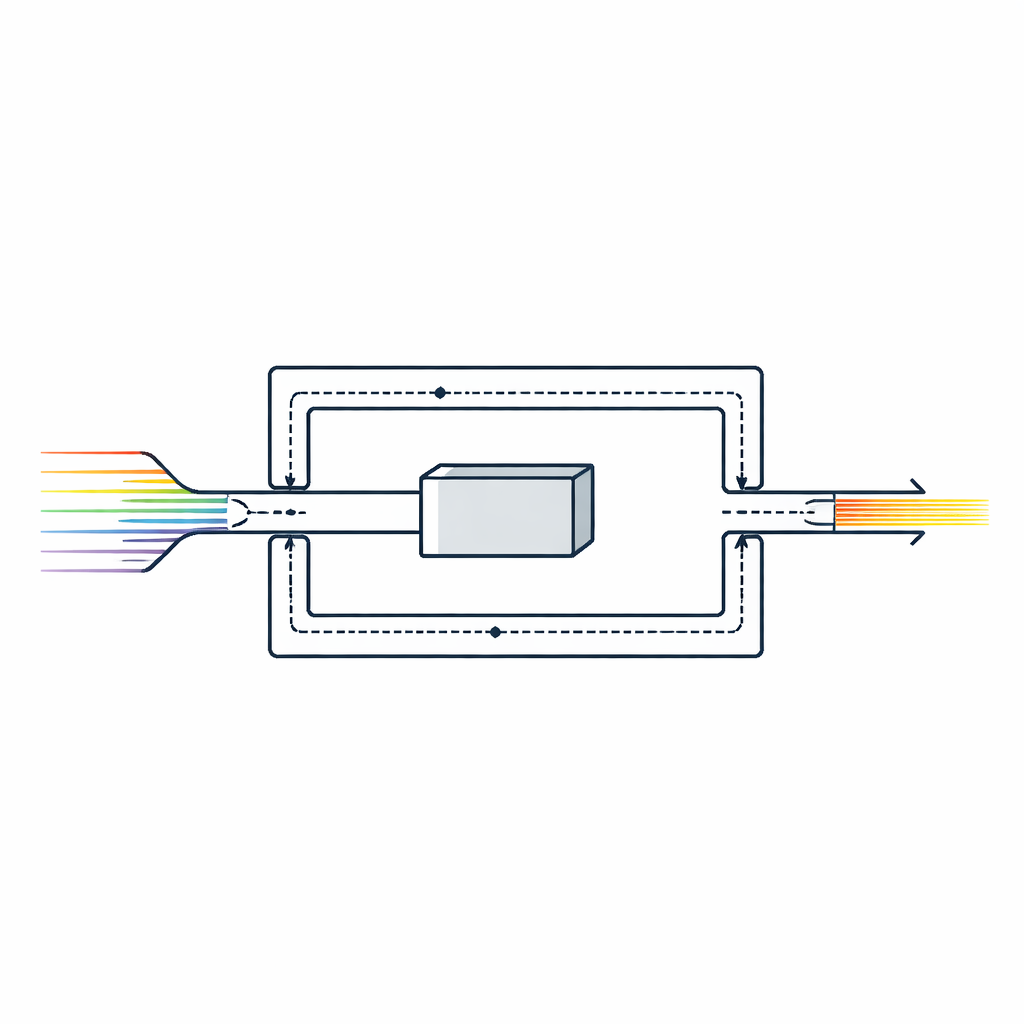
A loop and a side room for radio waves
The device studied here is a guided pathway for electromagnetic waves, similar in spirit to the hollow metal tubes used in radar systems or the tiny light channels on photonic chips. The main path is a straight rectangular guide. Around it, the researchers add a larger rectangular loop, and inside that loop they place a smaller “side room” called a resonator. Waves traveling down the main guide can either continue straight ahead or detour through the loop and interact with the resonator before rejoining the main path. The geometry—how long the resonator is, how wide it is, and exactly where it sits sideways—turns out to be the key to how the structure passes or blocks different frequencies.
Letting interference do the hard work
Because the waveguide and resonator form closed paths, certain frequencies set up standing waves, like specific notes on a flute. At those special frequencies, the wave can circulate many times, building up energy. At the same time, a portion of the wave continues along the direct route. When the detoured and direct waves meet again, they can either reinforce each other or cancel out, depending on their relative timing. The authors show that this arrangement naturally produces an asymmetric “Fano-like” line shape in the transmission: a very sharp dip right next to a narrow transmission peak. In plain terms, the filter can almost completely block a frequency that is only a hair’s breadth away from one it transmits nearly perfectly.
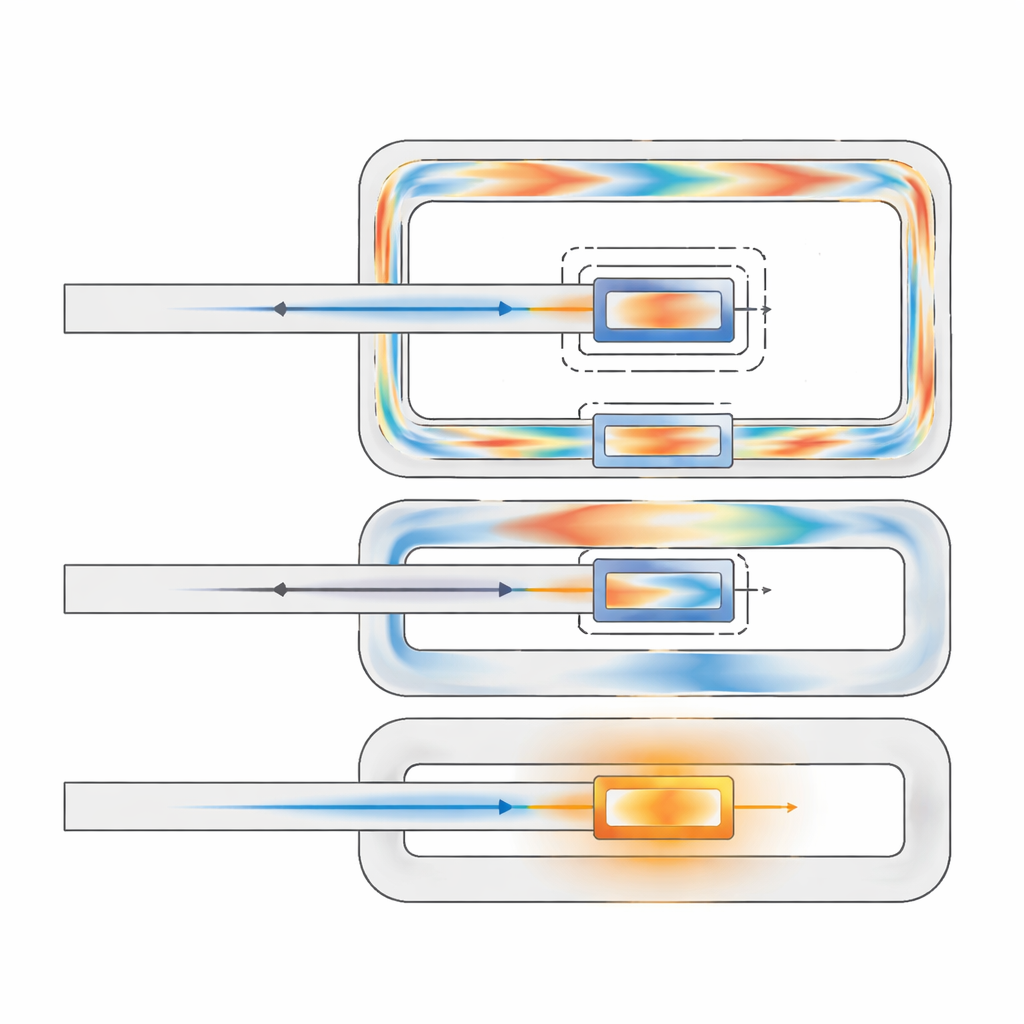
Tuning the filter with simple geometric knobs
To understand and optimize this behavior, the team combines two approaches. First, they build an analytical model using a mathematical tool called Green’s functions to describe how waves bounce and couple between the different paths. Then they run detailed computer simulations with the finite element method to check and refine the predictions. By sweeping through resonator length, lateral position, and width, they show how each geometric “knob” shifts the favored frequency, narrows or widens the passband, and changes how much power is transmitted. Making the resonator longer, for example, moves the selected frequency downward, while repositioning it sideways can turn a highly transmitting state into one where almost all the energy is trapped and hardly any gets through.
From big tubes to tiny on‑chip devices
The prototype dimensions studied are on the scale of tens of centimeters and operate in the megahertz range. However, the authors demonstrate that if all sizes are shrunk by a factor of 100, the same design works in the tens of gigahertz—suitable for microwave and millimeter‑wave technology. Importantly, the shape of the transmission curve, with its sharp peaks and deep notches, remains essentially unchanged under this scaling. When compared with a wide range of other resonator‑based filters reported in the literature, this relatively simple rectangular structure achieves an exceptionally high quality factor, meaning it isolates a frequency band with remarkable sharpness while using a straightforward geometry that should be easier to fabricate and integrate.
What the study shows in simple terms
Viewed from a lay perspective, this work shows how a carefully arranged loop and side room inside a waveguide can sculpt radio waves with extraordinary precision. By fine‑tuning just three geometric parameters, the device can either let a chosen frequency pass almost untouched, or trap it so effectively that almost nothing comes out the other side. Because the design scales from bench‑top sizes down to chip‑level dimensions while preserving performance, it offers a practical blueprint for future communication and sensing hardware that needs compact, robust, and sharply selective filters.
Citation: Mimoun, EA., Hennache, A., Youssef, BA. et al. Harnessing fano-like line shape resonance in a rectangular waveguide for filtering applications. Sci Rep 16, 8494 (2026). https://doi.org/10.1038/s41598-026-39467-7
Keywords: radio-wave filter, waveguide resonator, Fano resonance, microwave sensing, electromagnetic interference control