Clear Sky Science · en
Study on treatment of oil extraction wastewater by grounding electrode atomization corona discharge coupling flocculant
Why Cleaning Oilfield Water Matters
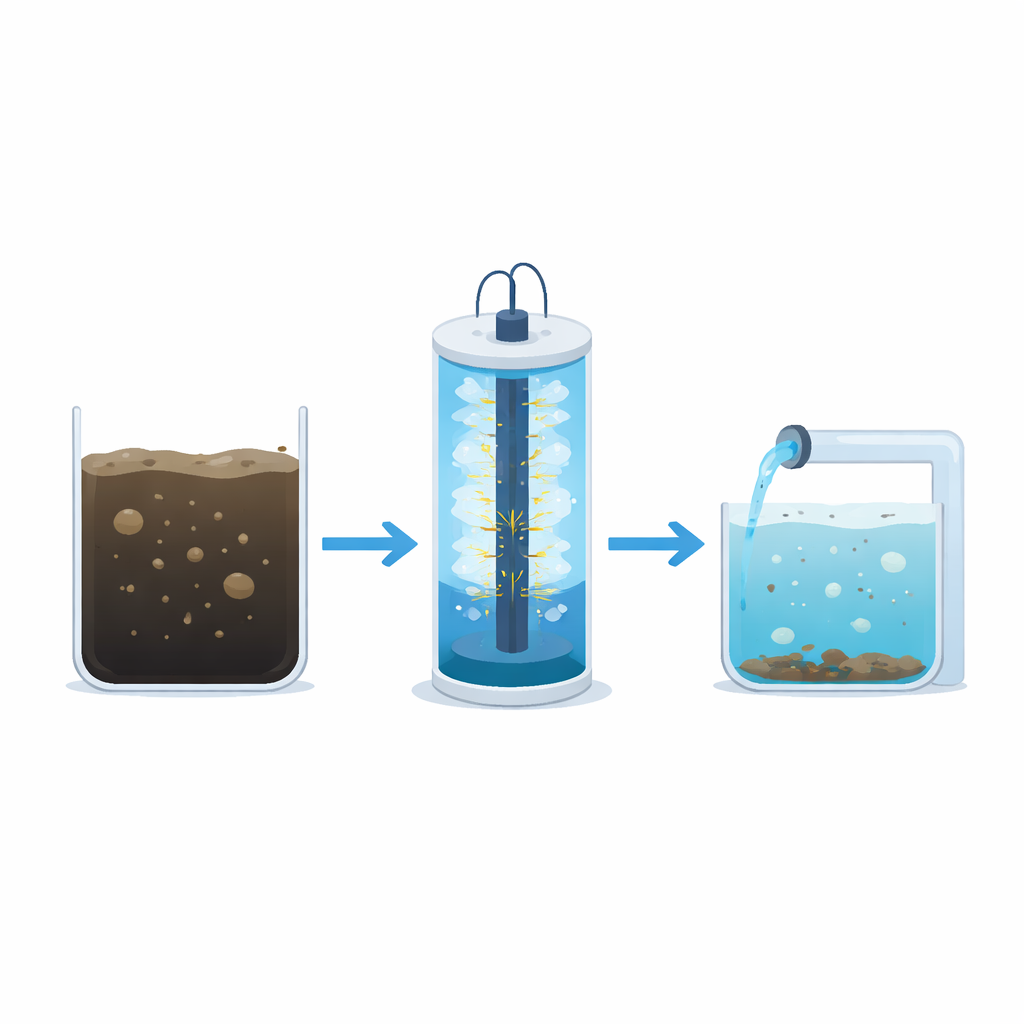
Modern life leans heavily on oil, but every barrel pumped from the ground brings up several barrels of dirty water loaded with oil residues and chemicals. This “produced water” is so hard to treat that much of it can’t safely be released or reused. The study in this article explores a new way to clean this stubborn wastewater using an electrical misting process combined with a common water-treatment aid, aiming to turn a difficult waste stream into water that biological treatment plants can handle much more easily.
A Tough Kind of Dirty Water
Oil extraction wastewater is not just oily—it is also packed with organic pollutants, suspended solids, and salts, and it breaks down very poorly in ordinary biological treatment systems. Globally, hundreds of millions of barrels of this water are produced every day, and the volume is expected to rise. If it is not properly treated, it can damage soils, rivers, groundwater, and even human health. Conventional methods often struggle with this mixture and can be costly or create new waste. Engineers therefore seek pretreatment methods that can strip out much of the pollution and, just as importantly, make what is left more “digestible” for bacteria in later treatment steps.
Turning Wastewater Into a Fine Electrified Mist
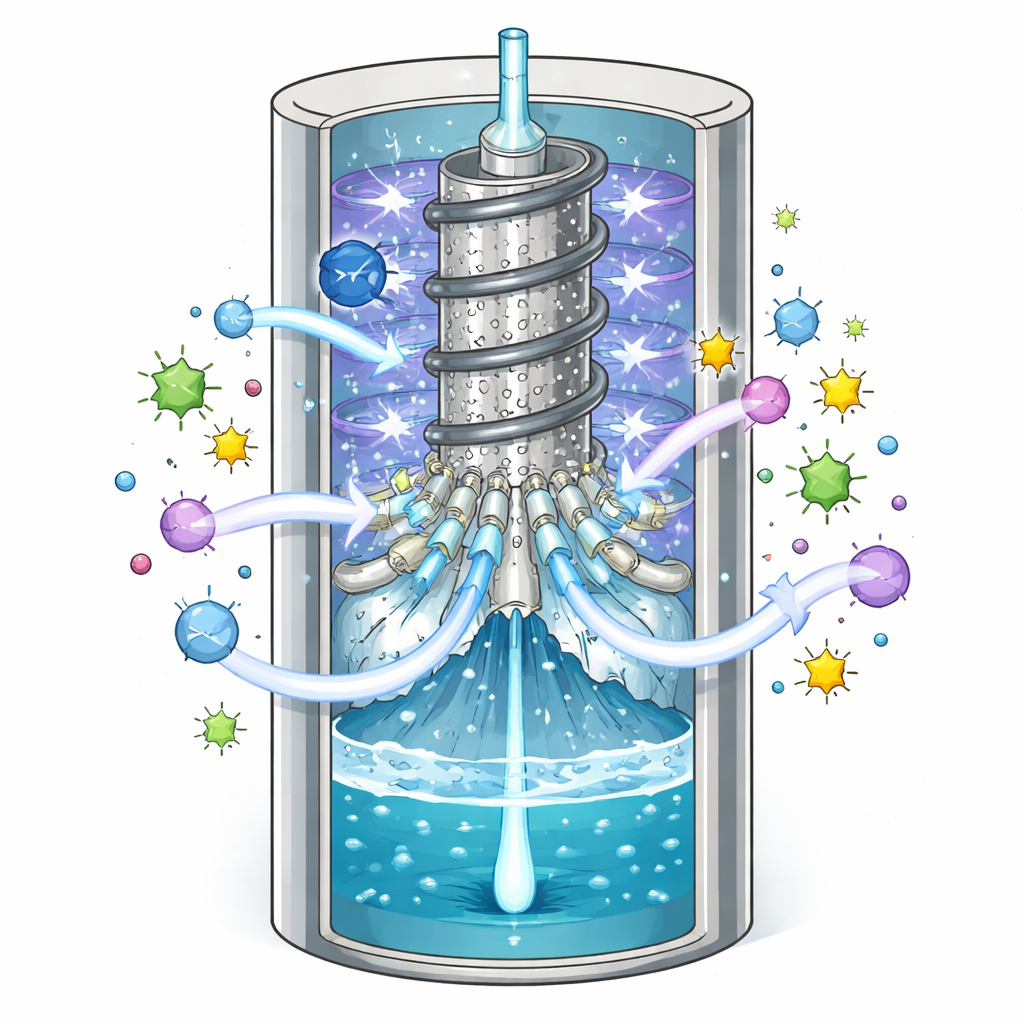
The research team focused on a type of low‑temperature plasma treatment called atomization corona discharge. In simple terms, they pump the wastewater over a high‑voltage metal rod inside a metal cylinder. The liquid spreads into a thin film and then, under the strong electric field, breaks into a fine mist. Around this mist, energetic electrons and reactive molecules form, which attack and break down the pollutants. A major weakness of earlier devices was that the liquid did not spread evenly across the electrode, producing patchy mist and weak treatment. To fix this, the authors designed a new “spiral‑hole” electrode: a perforated metal tube wrapped in absorbent fiber and a helical spring. This structure soaks up the water evenly, keeps a uniform liquid film, and stabilizes the electrical discharge, giving a consistent, fine spray throughout the reactor.
Finding the Sweet Spot for the Electric Treatment
The scientists systematically tuned key operating conditions. They compared positive and negative electrical polarities and found that negative discharge produced a stronger current and more energetic electrons, so they used it for all later tests. They then varied how fast the water flowed and how wide the gap was between the inner rod and outer cylinder. Too little flow starved the surface and weakened the mist; too much created a thick film that resisted breaking up. Too narrow a gap limited reaction space, while too wide weakened the electric field. By measuring when discharge started, when spark breakdown occurred, and how current responded to voltage, they identified an optimal combination: a gap of 30 mm, a flow of 40 mL per minute, and 26 kV applied voltage. Under these conditions, the new spiral‑hole design delivered very uniform atomization and strong discharge, even though the overall electrical current was similar to that of a simpler wire electrode.
Adding a Helper to Clump and Settle Pollutants
Electrical misting alone improved the water, but the team went further by adding polyacrylamide, a widely used powder that makes tiny particles and droplets clump together into larger “flocs” that can settle. They tested four doses of this helper chemical and then ran the treated water through the electrified reactor for up to five hours, tracking cloudiness, acidity, and measures of organic pollution. Moderate doses made the water much clearer and lowered the overall organic load more than discharge alone, while too little did not form enough flocs and too much actually worsened performance by stabilizing particles and consuming some of the reactive species from the plasma. A mid‑range dose of 0.4 grams per liter struck the right balance, giving the lowest cloudiness and highest removal of organic matter.
From Stubborn Waste to Bioreactor Feedstock
To a treatment plant operator, a crucial measure is how “biodegradable” the remaining pollution is. This is captured by the ratio of two standard tests, BOD₅ and COD. At the start, the oilfield wastewater was extremely hard for microbes to handle, with a very low ratio of 0.08. Using the electrical misting process alone raised this ratio to 0.56; coupling it with the optimized flocculant dose pushed it to about 0.76, while also cutting the chemical oxygen demand to 168 mg/L and sharply lowering turbidity. In practical terms, the process converts a recalcitrant waste stream into water that biological systems can treat much more readily and that is close to meeting reuse standards for oilfield operations. The work suggests that carefully engineered electrical reactors, paired with simple clumping agents, could offer oil producers a more efficient and environmentally friendly route for handling one of their largest and most troublesome waste streams.
Citation: Du, S., Gou, Y., Li, H. et al. Study on treatment of oil extraction wastewater by grounding electrode atomization corona discharge coupling flocculant. Sci Rep 16, 8747 (2026). https://doi.org/10.1038/s41598-026-39459-7
Keywords: oilfield wastewater, plasma water treatment, corona discharge, flocculation, biodegradability