Clear Sky Science · en
Comfort evaluation and vibration reduction nursing of patients in interhospital transport
Why a smoother ambulance ride matters
When a loved one is rushed between hospitals, most of us focus on speed and medical care, not the roughness of the journey. Yet every pothole and speed bump sends jolts through the stretcher, which can worsen symptoms like dizziness, nausea, and pounding heartbeats. This study asks a simple but crucial question: can we make ambulance transfers physically easier on patients by better understanding how their bodies vibrate during the ride—and by redesigning something as basic as the pillows they lie on? 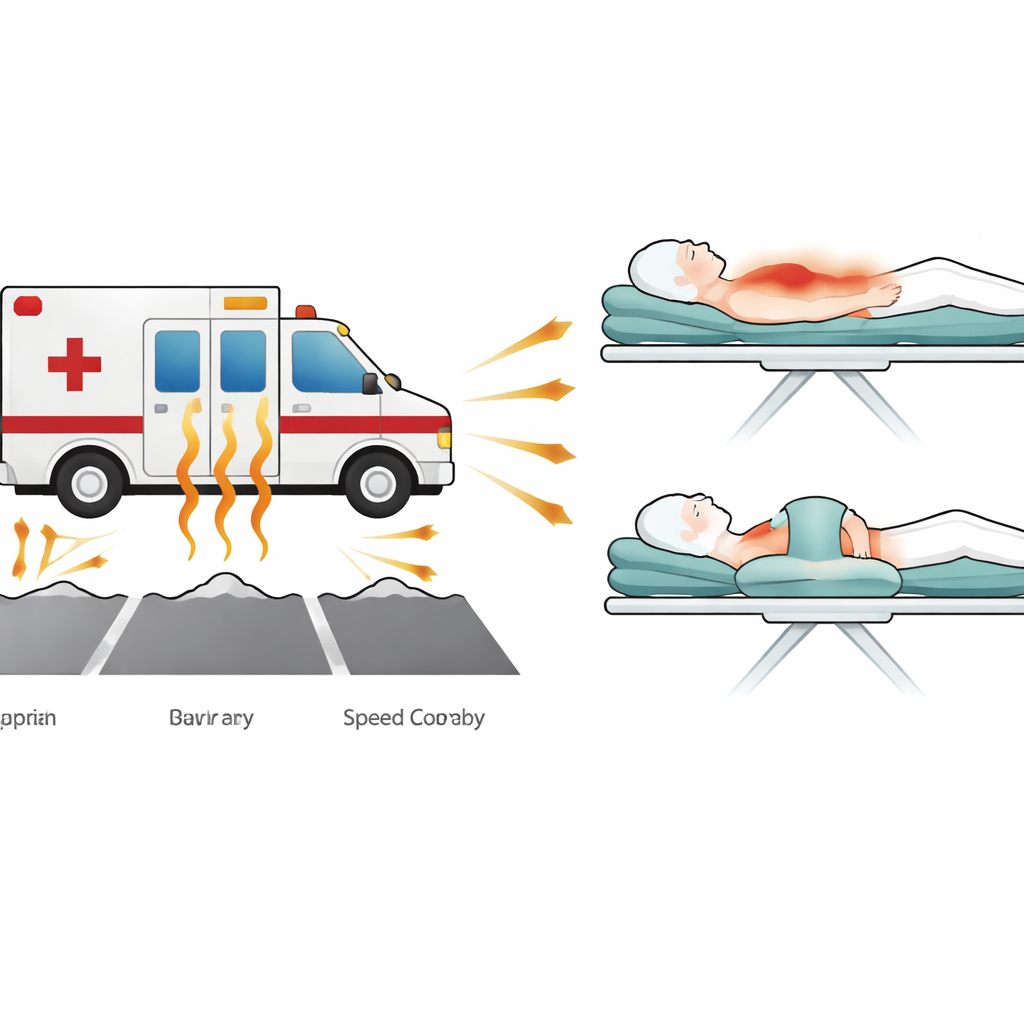
How bumps in the road reach the patient
Ambulances are usually adapted from regular vans or trucks whose suspension systems are already highly optimized. That means there is little room left to make the vehicle itself much softer without sacrificing safety. The authors instead focused on what happens once the shaking reaches the stretcher and the patient’s body. They tested vibrations on a standard dummy and collected ratings from 50 volunteers who rode over flat streets, bumpy sections, and speed bumps. Sensors at the shoulder, back, and buttocks recorded how strongly each body part shook, while riders scored how comfortable—or uncomfortable—they felt and which symptoms they experienced.
Which body parts and symptoms matter most
The measurements showed that not all parts of the body are equally bothered by a rough ride. On smooth roads, vibrations were mild and most volunteers reported little to no discomfort. But on bumpy sections, shaking increased sharply, and comfort scores plunged. The shoulder and back emerged as the most sensitive areas: even moderate shaking there led to complaints. Riders most often reported dizziness and a racing heartbeat, with some also experiencing nausea or even vomiting. By comparing the vibration data with people’s comfort scores, the researchers identified specific cutoff values above which discomfort becomes likely for each region of the body.
Designing smarter support pillows
Armed with this map of sensitivity, the team looked for ways to soften the ride right where it hurts most. They created two special foam supports: a saddle-shaped back pillow that cradles the spine and upper back, and a C-shaped head pillow that gently surrounds the head and upper neck. Both are built with a variable internal structure so they can flex differently under lighter or heavier patients. The goal is to tune these supports so that they do not “resonate” with the ambulance’s own bouncing, but instead absorb and spread out the jolts before they reach the most sensitive regions. Computer models linking the road, vehicle, stretcher, and human body showed that these pillows can significantly cut vibration peaks at the head, shoulder, and back. 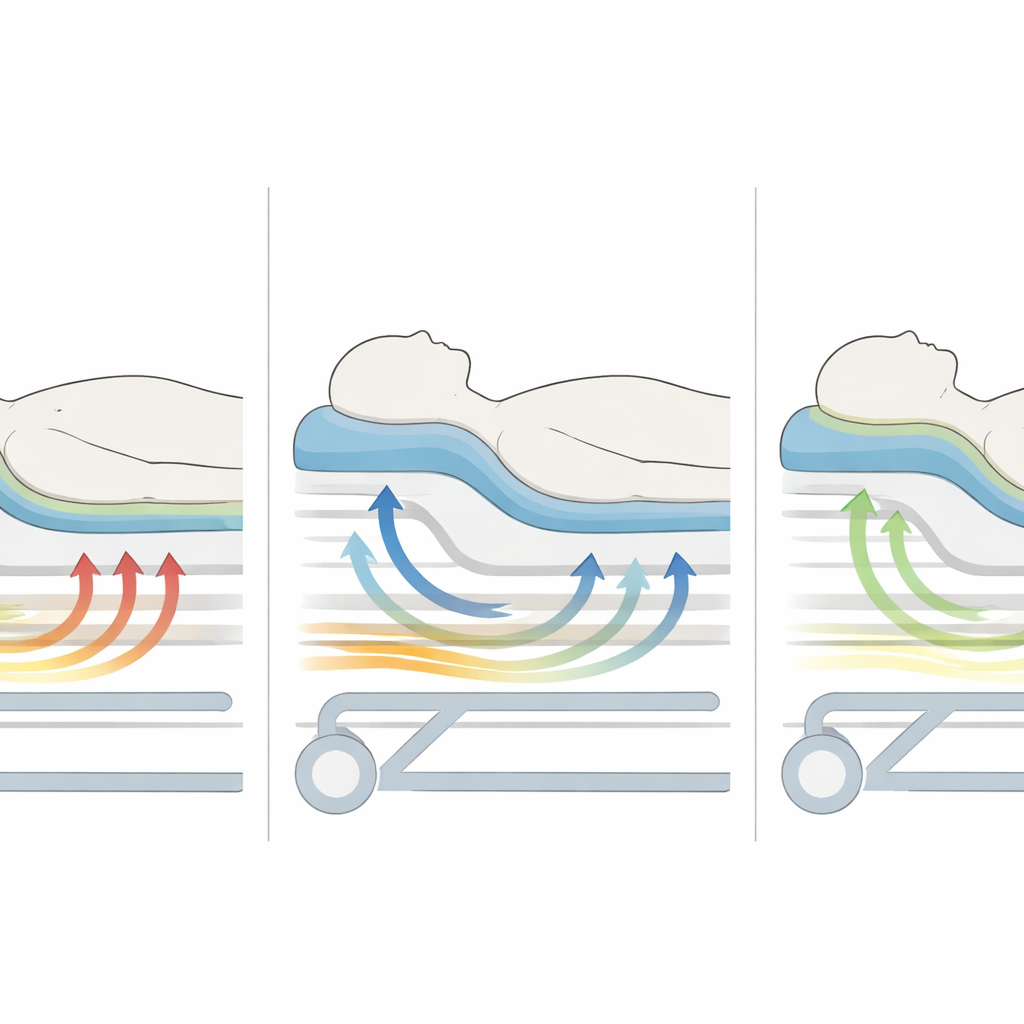
Putting the new supports to the test
To move beyond theory, the researchers tested real pillow prototypes in the lab and on the road. Mechanical tests confirmed that the foam structures had the intended springiness and damping behavior. Road trials over bumpy surfaces then compared rides with and without the new supports. With the pillows in place, the average shaking at the head, shoulder, and back dropped by roughly one-quarter to one-third. Follow-up measurements confirmed that shoulder and back vibrations now fell below the comfort thresholds that had been derived from volunteers’ earlier ratings, indicating that the supports were doing their job where it mattered most.
What this means for patient comfort
This work shows that improving comfort during ambulance transfers does not always require complex machinery or redesigning entire vehicles. By carefully measuring how people feel and how their bodies move, the researchers were able to pinpoint the back and shoulders as the main trouble spots and then create simple cushions that target those areas. Their saddle-shaped back pillow and C-shaped head pillow reduce vibrations by up to about 20% in real-world tests, easing symptoms like dizziness and palpitations. For patients already under stress, a smoother, gentler ride between hospitals could become an important part of better, more humane emergency care.
Citation: Yao, M., Wang, C., Kong, X. et al. Comfort evaluation and vibration reduction nursing of patients in interhospital transport. Sci Rep 16, 8436 (2026). https://doi.org/10.1038/s41598-026-39454-y
Keywords: ambulance transport, patient comfort, whole-body vibration, medical stretcher design, vibration-damping pillows