Clear Sky Science · en
Enhancement of essential oil yield and quality of basil (Ocimum basilicum L.) via intercropping system, AMF and PGPR
Why Better Basil Matters
Basil is far more than a kitchen herb. Its fragrant leaves contain essential oils that are used in foods, cosmetics, natural remedies, and antimicrobial products. As demand for such plant-based ingredients grows, farmers face a challenge: how to produce high-quality basil oil without relying heavily on chemical fertilizers that can harm soils and waterways. This study explored whether pairing basil with another medicinal plant, fenugreek, and adding helpful soil microbes could boost both the amount and the quality of basil essential oil in a more sustainable way.
Growing Two Crops Side by Side
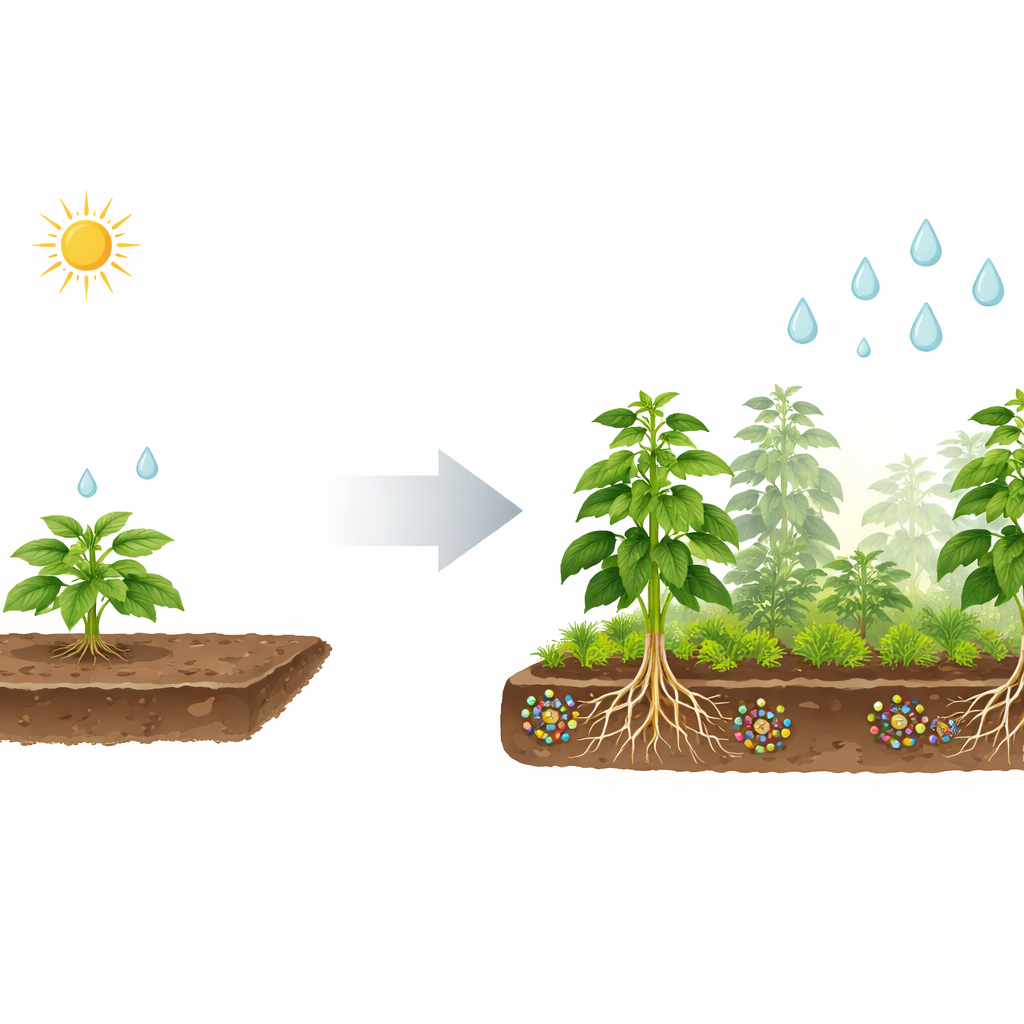
The researchers tested a classic idea in agriculture called intercropping, where two crops share the same field. They planted basil alone, fenugreek alone, and several patterns of mixed rows, such as two rows of basil with two rows of fenugreek, or five rows of basil with three rows of fenugreek. Fenugreek is a legume, meaning it can help enrich the soil with nitrogen, an important plant nutrient. Over two growing seasons in northwest Iran, the team compared how these planting patterns affected basil growth, focusing on plant height, number of branches, dried leaf yield, and essential oil production.
Teaming Plants with Helpful Microbes
Alongside planting patterns, the scientists also changed the way the crops were fed. One group received the locally recommended full dose of chemical fertilizer. A second group received half that amount plus a mixture of beneficial fungi and bacteria. A third group received only the beneficial microbes. The fungi (arbuscular mycorrhizal fungi) attach to plant roots and help them draw water and nutrients from the soil. The bacteria (plant growth-promoting rhizobacteria) can fix nitrogen from the air and produce natural growth hormones. Together, these living “biofertilizers” offer a way to support crop growth while cutting back on synthetic inputs.
More Oil, Different Fragrance
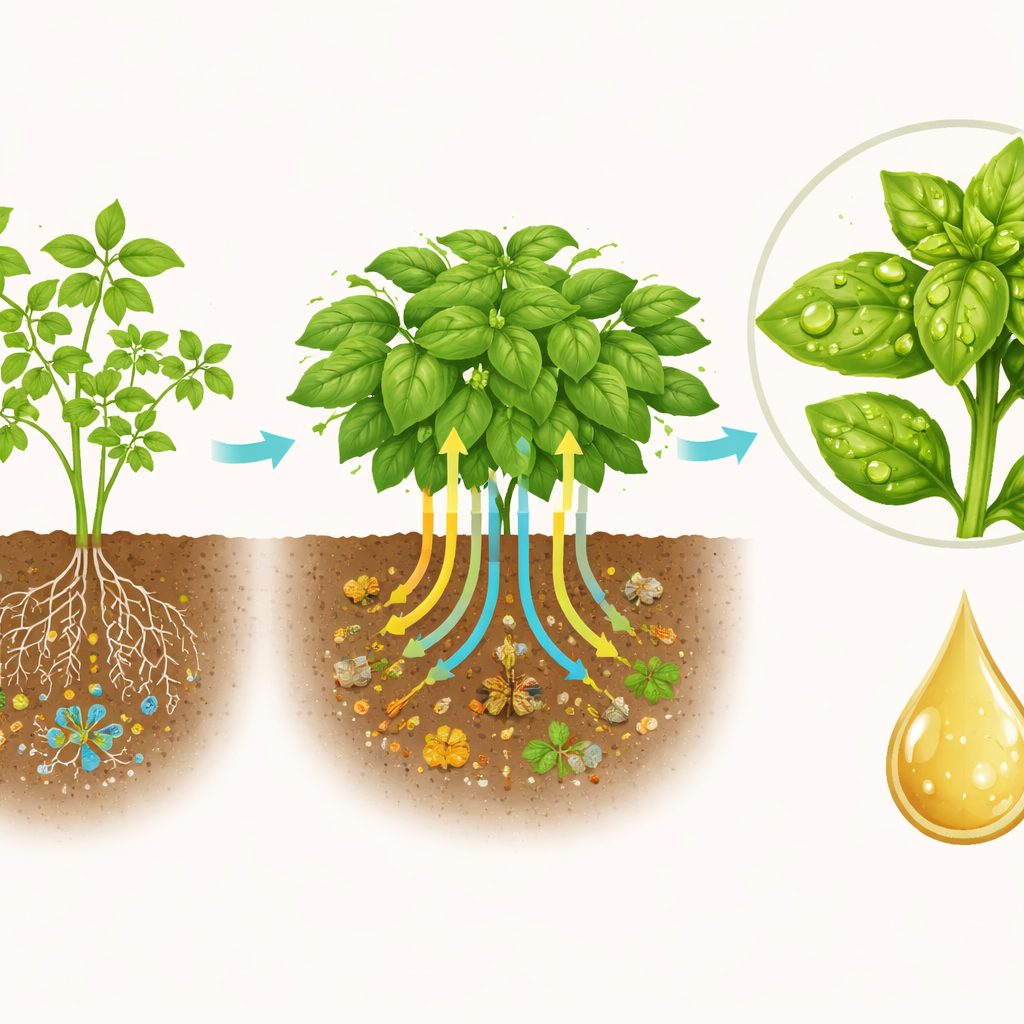
The results showed that the right combination of neighbors and microbes noticeably changed how basil performed. Basil plants grew tallest and had the most branches in the pattern with two rows of basil and two rows of fenugreek when they received half the usual chemical fertilizer plus biofertilizers. That same combination also produced the highest percentage of essential oil in the leaves. The total amount of oil per area was greatest when basil grew either alone or in a pattern with five basil rows and three fenugreek rows under the half-chemical-plus-microbe treatment. Beyond quantity, the chemical makeup of the oil shifted. Key components such as methyl chavicol and methyl eugenol—molecules that shape basil’s aroma and potential health properties—rose or fell depending on both the row pattern and the fertilizer treatment, showing that farming practices can fine-tune not just how much oil is produced, but what it contains.
Using Land and Resources More Wisely
To judge whether growing two crops together made better use of land than growing them separately, the team calculated a standard measure called the land equivalent ratio. In this study, all mixed plantings scored above one, meaning intercropping basil and fenugreek produced more combined yield per area than separate fields would have. The best-performing option was again the two-rows-by-two-rows pattern with half the usual chemical fertilizer plus biofertilizers. In practical terms, this means farmers could harvest more from the same plot of land while applying significantly less synthetic fertilizer, thanks to the supporting role of fenugreek and beneficial soil organisms.
A Greener Recipe for Fragrant Fields
For non-specialists, the key takeaway is straightforward: by cleverly arranging crops and feeding the soil with living helpers instead of relying solely on chemicals, it is possible to grow basil that is both productive and rich in valuable essential oils. The study suggests that a simple pattern—alternating short strips of basil and fenugreek, combined with half the normal dose of fertilizer plus friendly fungi and bacteria—can nearly double land-use efficiency, maintain or improve oil yield, and favor desirable fragrance compounds. This offers a promising, more eco-friendly recipe for farmers who supply basil to the food, cosmetic, and herbal medicine industries, and points the way toward more sustainable production of many other aromatic plants.
Citation: Ebrahimi, A., Amini, R. & Dabbagh Mohammadi Nasab, A. Enhancement of essential oil yield and quality of basil (Ocimum basilicum L.) via intercropping system, AMF and PGPR. Sci Rep 16, 8164 (2026). https://doi.org/10.1038/s41598-026-39446-y
Keywords: basil essential oil, intercropping, biofertilizers, fenugreek, sustainable agriculture