Clear Sky Science · en
Population genomics identifies Italian and North American origins of Popillia japonica in Switzerland
A Small Beetle With a Big Footprint
The Japanese beetle may look harmless, but this shimmering green insect is rapidly becoming one of Europe’s most worrying plant pests. It chews on leaves, flowers, and fruits of hundreds of crops and garden plants, and its spread can cost farmers and towns millions of euros each year. This study uses DNA clues from beetles collected across Switzerland and around the world to reconstruct how the insect arrived and how it is now moving through the country—insights that can help authorities close the doors on future invasions.
How the Beetle Became a World Traveler
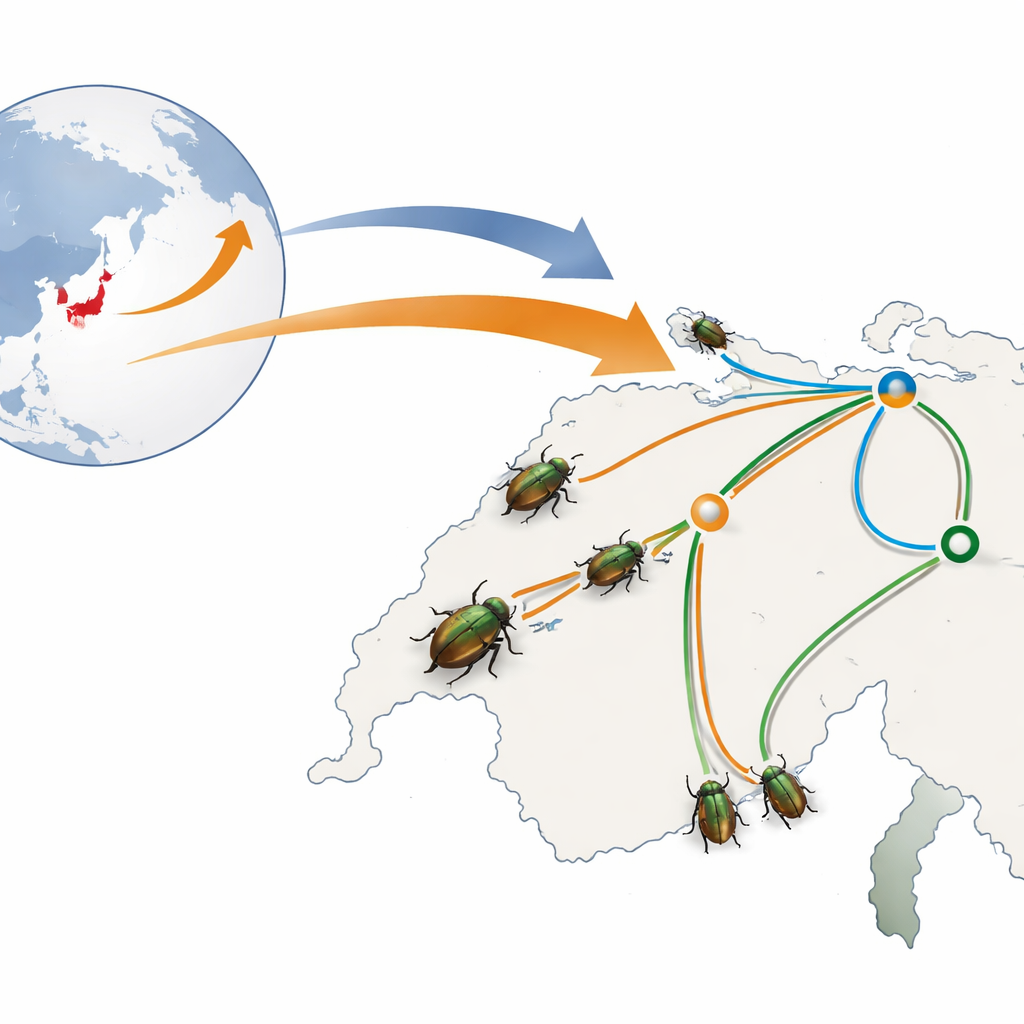
Originally, the Japanese beetle lived only in Japan. Over the last century, however, it has hitched rides with people and goods to North America, the Atlantic islands of the Azores, and mainland Europe. Once introduced, it thrives in lawns, vineyards, orchards, and fields, where adults skeletonize leaves and larvae feed on roots. Climate change is making large parts of Europe, including much of Switzerland, more suitable for this species. Authorities already list it as a priority pest, and predictions show that, without strong control, damage could rise into the billions of euros each year.
Tracking Invasions Through DNA
To understand how the beetle reached Switzerland, the researchers collected 42 beetles from 14 locations across the country and combined their data with DNA from 83 previously studied beetles from Japan, North America, the Azores, and Italy. Instead of looking at a few genes, they read large portions of each beetle’s entire genetic code and compared hundreds of thousands of genetic markers. Using statistical tools that group individuals by genetic similarity, as well as evolutionary “family trees” and models of population history, they could tell which Swiss beetles were closely related and where their ancestors most likely came from.
Two Separate Gateways Into Switzerland
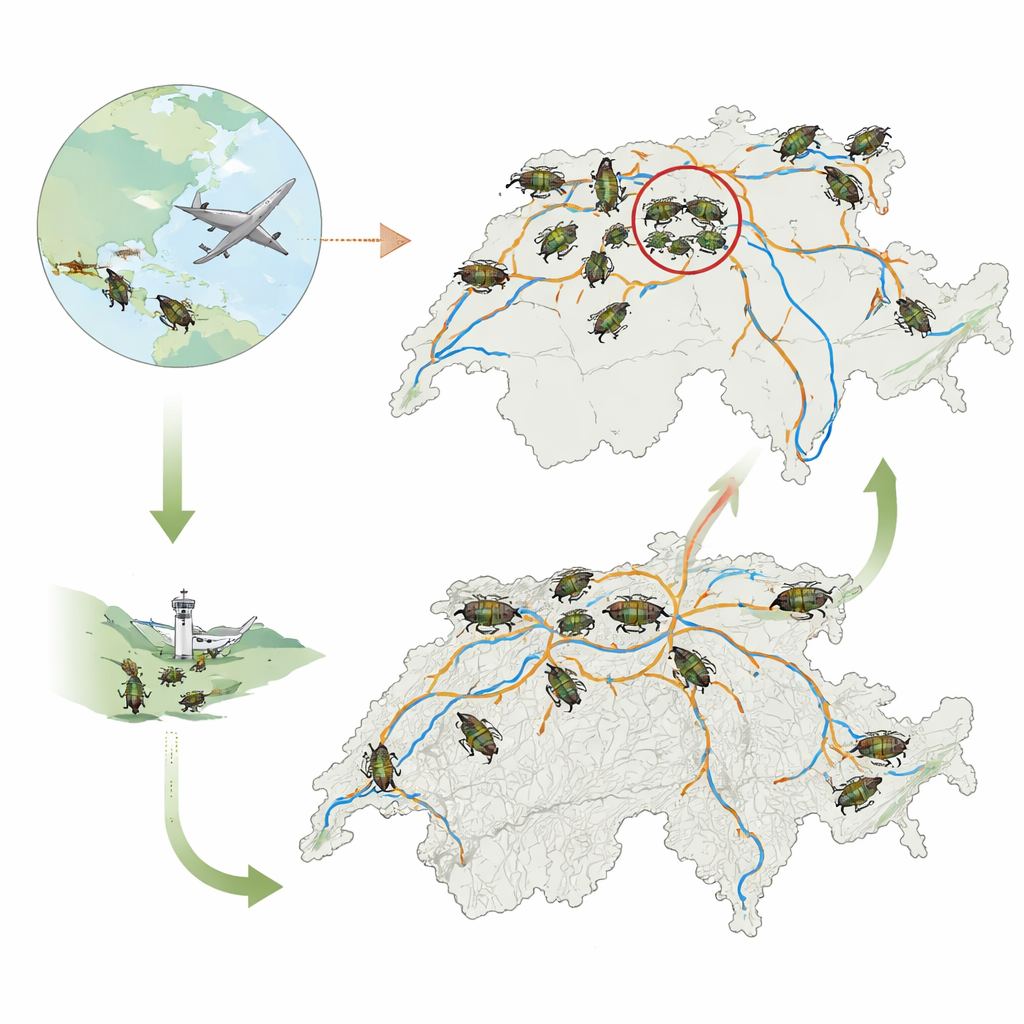
The genetic patterns revealed a clear split between two main routes of entry. Beetles from southern and central Switzerland—including Ticino, Valais, Luzern, Schwyz, Uri, and Basel—formed a tight cluster with beetles from northern Italy. This shows that these populations are part of a continuous spread that began when the insect first established in Italy near Milan’s airports and then moved north across the border. In contrast, beetles from Kloten, close to Zürich Airport, grouped with beetles from the United States and Canada, and not with those from Italy and Ticino. Demographic models, which simulate different invasion scenarios, strongly supported the idea that the Kloten population represents an independent introduction directly from North America.
Highways and Air Routes as Invasion Highways
The study also highlights how human transport networks shape the beetle’s march across the landscape. Single detections and new outbreaks in central Switzerland line up with the main north–south motorway and rail line connecting Ticino with Basel. This suggests that beetles, or their eggs and larvae in soil and plants, are being moved unintentionally on vehicles, construction materials, or traded plants. At the same time, the Kloten outbreak next to a major international airport underlines the role of long-distance air travel in seeding entirely new populations from overseas, despite existing inspection and quarantine measures.
What This Means for Protecting Crops and Landscapes
By showing that Switzerland’s Japanese beetle problem is fed by both regional spread from Italy and fresh introductions from North America, the study makes clear that control efforts must work on two fronts. Stronger checks and cleaning procedures at airports are needed to cut off new arrivals, while intensified monitoring along key roads and railways can catch satellite populations early, before they explode. Public awareness is crucial too, because travelers and gardeners may unknowingly carry the insect to new areas. The genetic roadmap produced here not only helps Switzerland fine-tune its defenses, but also offers a model for other countries facing the growing challenge of invasive insects in a warming, highly connected world.
Citation: Pedrazzini, C., Funari, R., Cucini, C. et al. Population genomics identifies Italian and North American origins of Popillia japonica in Switzerland. Sci Rep 16, 8445 (2026). https://doi.org/10.1038/s41598-026-39440-4
Keywords: Japanese beetle, invasive species, Switzerland, genetic tracing, pest management