Clear Sky Science · en
Characterization of Abelmoschus esculentus plant waste fiber for sustainable composite and biomedical applications
Turning Farm Leftovers into Useful Materials
Every okra harvest leaves behind heaps of tough, woody stems that usually go to waste or are burned. This study asks a simple question with big consequences: can those leftovers be turned into safe, sturdy, germ-fighting materials for everyday products and medical use? By carefully extracting and testing fibers from discarded okra stems, the researchers show how something once treated as trash can become a valuable building block for greener plastics, packaging, car parts, and even infection-resistant bandages.
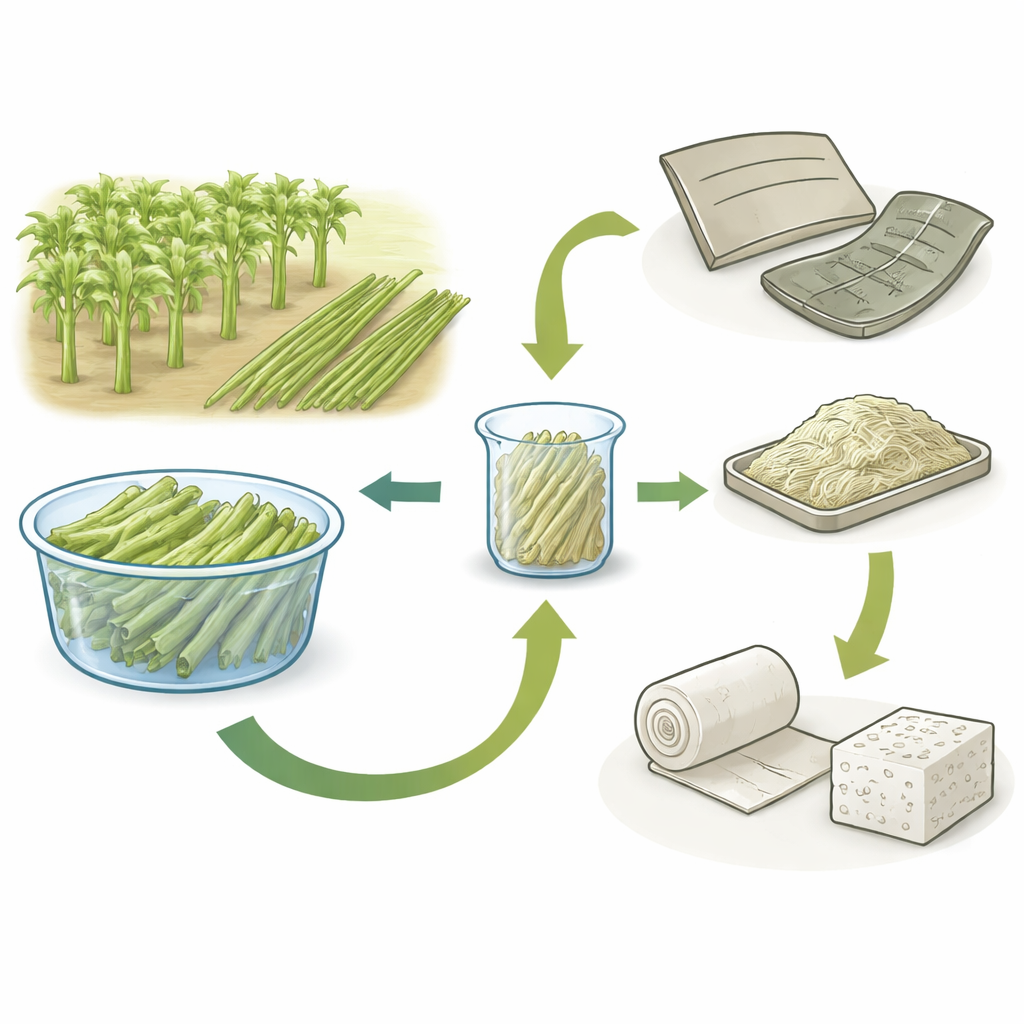
From Field Waste to Clean Fiber
The work begins on the farm. After okra pods are picked for food, the remaining stems were collected, washed, and cut into manageable pieces. To free the fibers hidden inside, the stems soaked in water for nearly two weeks, allowing natural microbes to loosen the glue-like substances that hold the plant tissue together. The softened stems were then scraped to pull out long fiber bundles, which were washed again and treated with a mild alkaline solution. This gentle chemical bath stripped away much of the plant gum, wax, and woody components, leaving cleaner, rougher fibers that can bond better to plastics. Finally, the fibers were thoroughly rinsed, neutralized, and slowly dried to preserve their internal structure while removing moisture.
How Strong and What Are They Made Of?
To understand how these okra fibers would behave in real products, the team probed both their inner makeup and their strength. X-ray tests showed that the fibers are partly ordered and partly disordered at the molecular level, a structure that balances stiffness with some flexibility. Infrared measurements confirmed that the fibers are rich in cellulose—the same natural polymer that gives cotton and paper their strength—along with smaller amounts of related plant components. When single fibers were pulled until they snapped, they showed moderate strength and very limited stretch. This level of performance is not meant to rival high-tech synthetic fibers, but it is well suited for biodegradable plastics, packaging, and lightweight parts where very high loads are not required.
A Closer Look at the Fiber Surface
Under an electron microscope, the okra fibers revealed a rough, layered exterior rather than a smooth, glassy one. Thin outer sheets were partly peeled back, exposing tiny sub-fibers and creating ridges, cracks, and pores. While this might sound like damage, such texture is actually an advantage for many uses. The nooks and crannies increase surface area and help the fibers grip surrounding plastic more firmly, much like Velcro hooks bite into loops. Measurements of fiber thickness and length showed they were long and slender enough to carry stress effectively when mixed into a plastic or rubber matrix. Together, these features make the okra fibers promising reinforcement agents for sturdy yet compostable composites.
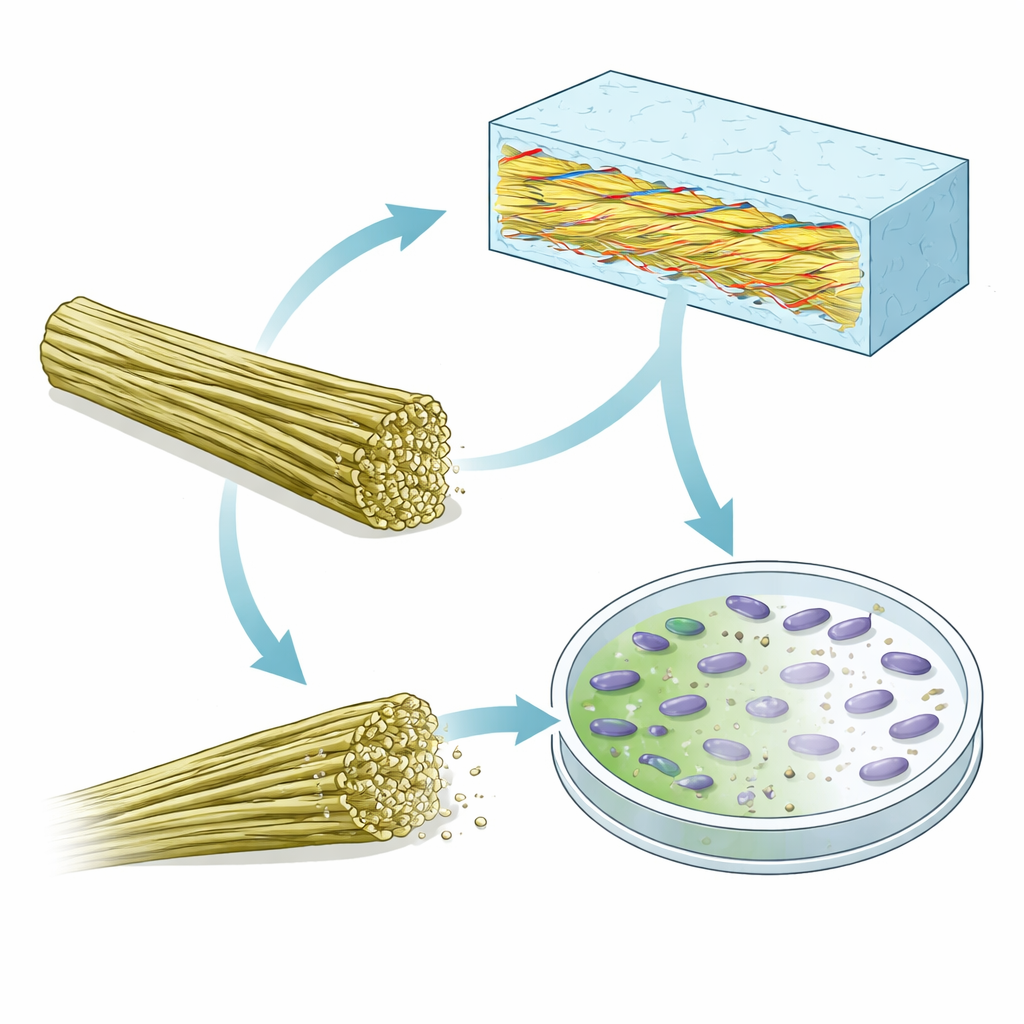
Natural Defense Against Harmful Germs
Beyond strength, the study explored whether extracts from these fibers could fight harmful bacteria. When a solution made from the fibers was placed into tiny wells on germ-coated lab dishes, clear rings free of bacterial growth appeared. At higher doses, these rings were almost as large as those produced by a standard antibiotic drug, showing strong germ-killing power. Microscopy of bacterial communities that had grown on glass surfaces told the same story: untreated samples formed dense, healthy layers of cells, while samples exposed to the fiber extract showed large areas of damaged or dead cells and a broken, patchy film. These findings suggest that naturally occurring plant compounds in the okra fibers can poke holes in bacterial defenses and disrupt their ability to form resilient coatings.
Why This Matters for Everyday Life
Overall, the research demonstrates that okra stem waste can be transformed into fibers that are not only mechanically useful but also naturally hostile to harmful microbes. For a layperson, this means that future car interiors, packaging, medical dressings, or reusable household items could be made from plant-based materials that are lighter, biodegradable, and help keep germs at bay—without relying solely on synthetic chemicals. By turning an abundant farm by-product into a multi-purpose ingredient, the study points toward a more circular economy where crop residues become high-value, health-conscious materials instead of waste.
Citation: Raja, T., Devarajan, Y., Kalidhas, A.M. et al. Characterization of Abelmoschus esculentus plant waste fiber for sustainable composite and biomedical applications. Sci Rep 16, 8763 (2026). https://doi.org/10.1038/s41598-026-39438-y
Keywords: natural fibers, okra plant waste, biodegradable composites, antibacterial materials, sustainable materials