Clear Sky Science · en
Predictive modeling for physicochemical properties of $$\beta$$ -lactam antibiotics through eigenvalue based topological indices and non linear regression techniques
Why this study matters
Antibiotics are cornerstones of modern medicine, yet bacteria are evolving resistance faster than new drugs are discovered. Designing better antibiotics increasingly depends on computer models that can predict how a candidate molecule will behave—how easily it evaporates, how bulky it is, or how it interacts with water and cell membranes. This paper explores a mathematically elegant way to make such predictions for a major drug family called β-lactam antibiotics, using tools from graph theory and statistics rather than expensive laboratory testing alone.
Turning molecules into networks
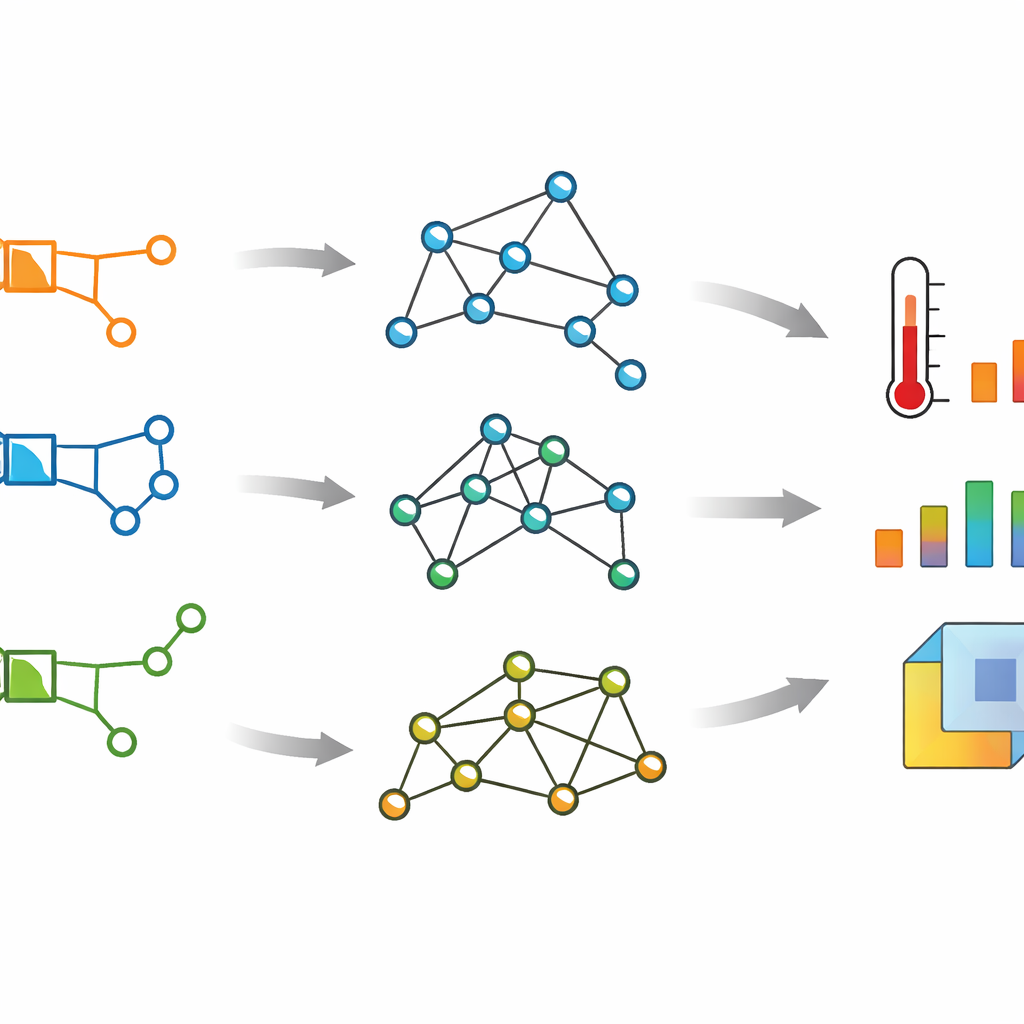
Instead of viewing a drug simply as a ball-and-stick structure, the authors treat each β-lactam antibiotic as a network: atoms become dots (called vertices) and chemical bonds become lines (called edges) linking those dots. From this network they build several mathematical tables that capture how the atoms are connected, how many bonds each atom has, and how far apart atoms are from one another along the bonding paths. These tables—known as adjacency, Laplacian, signless Laplacian, and distance matrices—provide different windows onto the overall “shape” and connectivity of the molecule.
Measuring hidden patterns in the network
Once these connection tables are in hand, the researchers calculate their eigenvalues, numbers that summarize deep structural patterns in the network. From these eigenvalues they construct a set of numerical scores called spectral descriptors, with names such as adjacency energy, algebraic connectivity, and distance energy. Each descriptor blends information from the entire molecular graph, capturing both local details around each atom and the global architecture of the molecule. Because β-lactam antibiotics can differ subtly in ring systems and side chains, such sensitive, whole-molecule measures are attractive for linking structure to behavior.
Linking structure scores to everyday properties
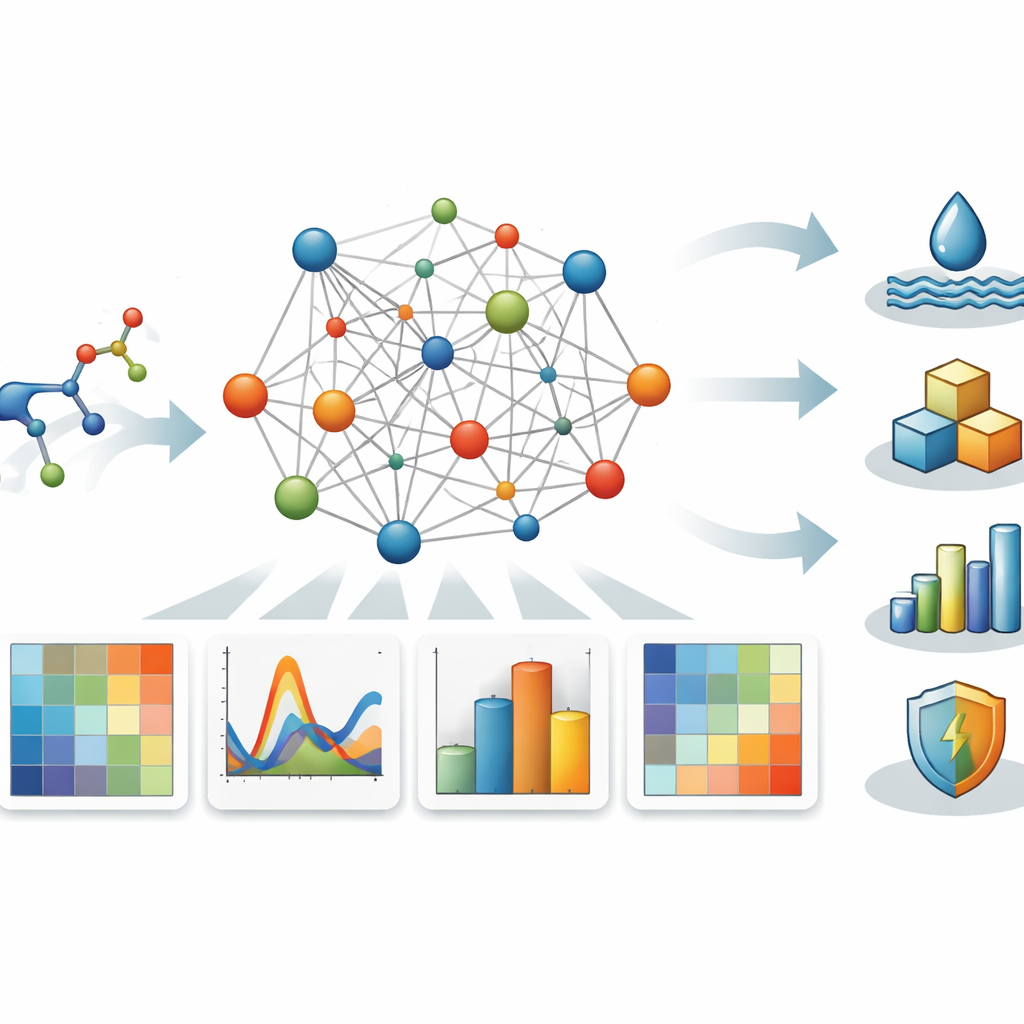
The study focuses on seven clinically important β-lactam compounds, including well-known drugs such as amoxicillin and imipenem, chosen to span a range of sizes and side-chain patterns. For each drug, the team gathers experimental data on practical physicochemical properties: boiling point, molar volume, how strongly the molecule bends light (molar refractivity), how much of its surface is polar, how easily its electrons are distorted (polarizability), and surface tension. They then test how well each single spectral descriptor can predict each property by fitting three types of curved relationships—quadratic, logarithmic, and power-law equations—using standard statistical software.
How well do the predictions work?
The results show that several descriptors correlate strongly with properties that are mainly governed by molecular size and how densely the atoms are connected. For example, algebraic connectivity, signless Laplacian energy, and distance energy often stand out as especially informative. Quadratic equations, which allow for a simple curved relationship between descriptor and property, usually perform slightly better than logarithmic or power-law formulas, yielding higher coefficients of determination and lower prediction errors. This suggests that the link between a molecule’s network structure and its bulk behavior is often gently curved rather than straight.
Where the approach falls short
The modeling is less successful for properties that depend strongly on how electrons are distributed over the molecule’s surface and how it forms specific interactions such as hydrogen bonds. Polar surface area and surface tension, for instance, show more scatter between predicted and measured values. Because the graph-based descriptors used here focus only on which atoms are connected to which, and how far apart they are, they do not explicitly encode detailed electronic effects or directional interactions with surrounding molecules. This limitation reflects the simplicity of the underlying representation, not a failure of the statistical methods themselves.
What this means for future antibiotic design
Overall, the study demonstrates that eigenvalue-based graph descriptors offer a compact and interpretable way to predict several key properties of β-lactam antibiotics without running a full battery of experiments. By capturing the overall layout and connectivity of atoms, these mathematical scores help forecast how hot a compound must be to boil, how much space it occupies, and how it interacts in bulk with its environment. While they cannot yet replace more detailed models for properties that hinge on fine electronic structure, they provide a solid foundation that can be combined with other descriptor families and larger datasets. For non-specialists, the takeaway is that smart mathematics applied to molecular blueprints can assist in screening and optimizing future antibiotics, potentially speeding the search for drugs that outpace bacterial resistance.
Citation: Yuvaraj, A., Kalaimurugan, G., Thamizhmaran, R. et al. Predictive modeling for physicochemical properties of \(\beta\)-lactam antibiotics through eigenvalue based topological indices and non linear regression techniques. Sci Rep 16, 9389 (2026). https://doi.org/10.1038/s41598-026-39436-0
Keywords: beta-lactam antibiotics, QSPR modeling, graph theory descriptors, physicochemical properties, drug design