Clear Sky Science · en
Energy-efficient wireless sensor network for urban groundwater level monitoring using machine learning and sink mobility
Watching Hidden Water Beneath Our Cities
Many cities quietly depend on the water stored beneath our feet. As populations grow and droughts become more common, knowing how fast this underground reserve is rising or falling is no longer a luxury—it is essential for planning wells, avoiding land subsidence, and keeping taps running. This paper introduces a smart way to monitor urban groundwater using wireless sensors, machine learning, and a roaming data collector, all designed to stretch tiny batteries so the system can run for years with little human attention.
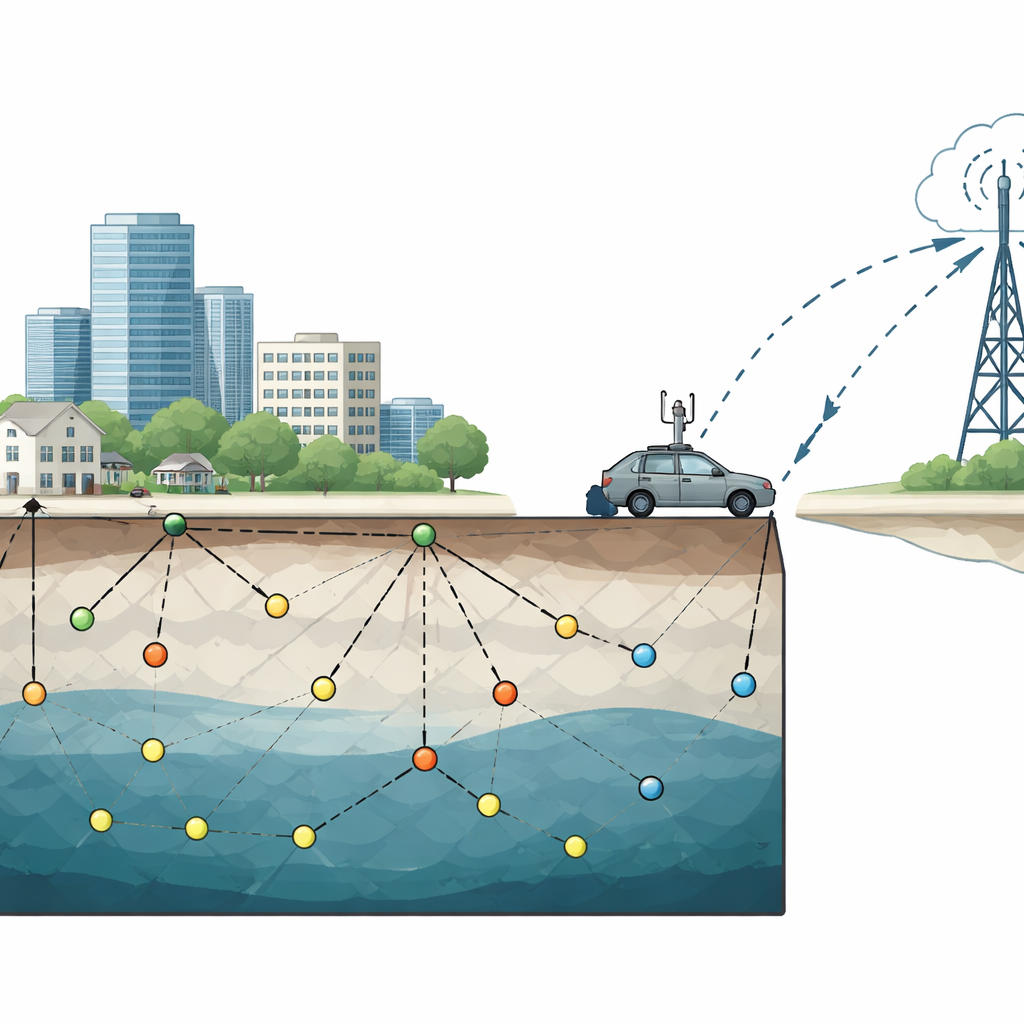
Why Underground Water Is Hard to Track
Groundwater does not flow through pipes we can easily meter; it seeps through soil and rock, changing slowly over wide areas. Traditional monitoring relies on a few wells that are manually checked, giving only a coarse picture. Wireless sensor networks promise something better: many small devices spread across a city, each measuring water levels or related conditions and sending readings back in real time. The catch is that these devices are usually buried, hard to reach, and powered by small, non‑rechargeable batteries. If they talk too much, they die early. Worse, sensors close to the main collection point must relay everyone else’s messages and run out of energy first, creating “dead zones” where no data can be collected.
A Smarter Network That Shares the Load
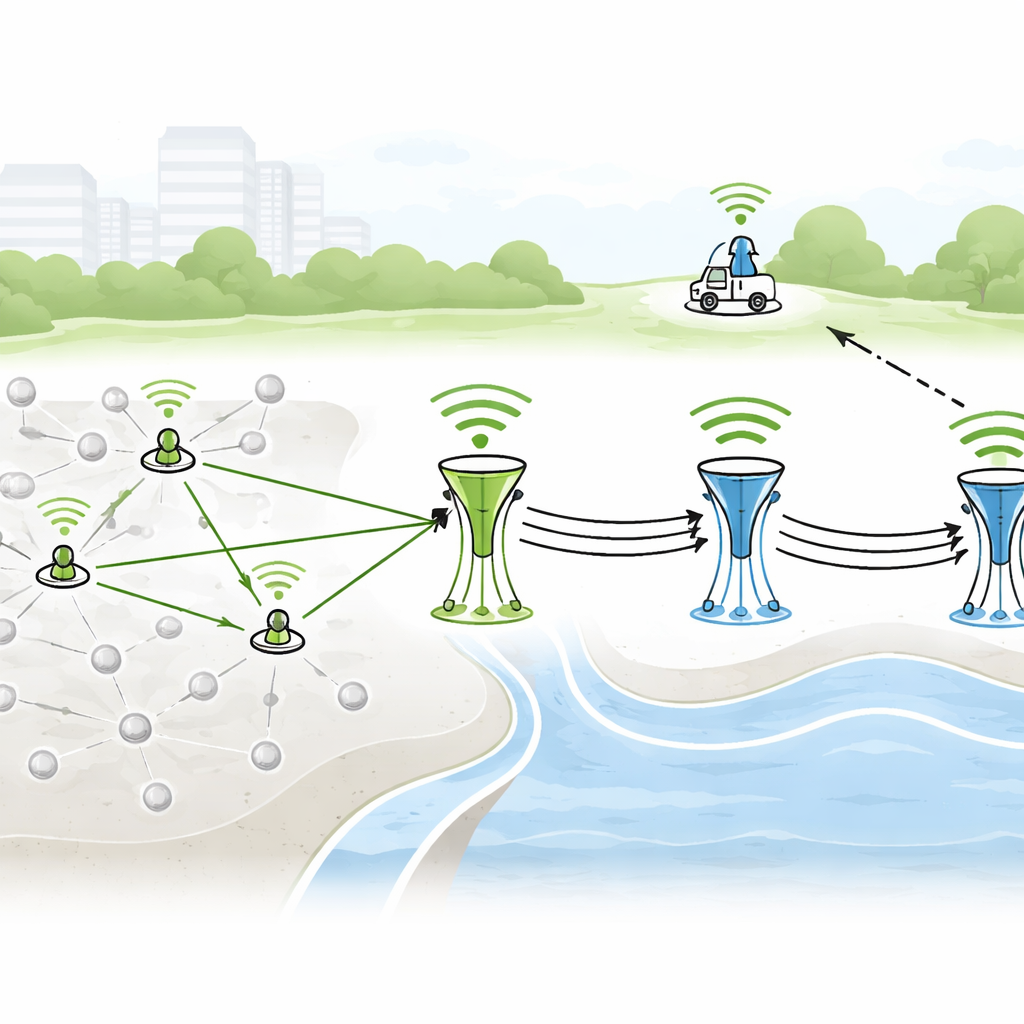
The authors propose a new protocol, called Sleep Scheduled Data Aggregation with Sink Mobility (SSDA‑SM), to keep such a sensor network alive and reliable for long periods. Instead of having every sensor talk directly to a central hub, nearby sensors form groups, and one node in each group acts as a temporary leader. This leader gathers readings from its neighbors and forwards a combined message toward a roaming “sink” device that collects all the data. A simple machine‑learning model helps pick which sensor should lead in each round by weighing how much battery it has left and how many neighbors it can serve, while also rotating the role so that no single device is overworked. Sensors that are very close together and see almost the same groundwater conditions take turns being awake, so the network still covers the area without wasting power on redundant measurements.
Packing Data Tightly Before It Travels
Sending radio messages is the costliest action for these underground devices, so SSDA‑SM works hard to shrink data before it leaves the ground. At each group leader, the system uses a mathematical trick known as compressive sensing. Instead of forwarding every raw reading, the leader blends many measurements into a much smaller set of coded values that still preserve the essential pattern. Later, at the sink with much greater computing power, those compressed values are unpacked to closely reconstruct the original signals. Because groundwater changes smoothly over space and time, its behavior can be captured accurately from far fewer numbers than there are sensors, allowing the network to send less while losing very little detail.
Letting the Collector Come to the Sensors
Another source of waste in classic designs is the fixed position of the data sink. Sensors nearest that point must forward messages from distant nodes again and again, draining their batteries first and carving an energy “hole” into the map. In SSDA‑SM, the sink is mobile: it moves across the monitored area along a planned route, pausing near groups of sensors in turn. Its path is chosen to shorten the average distance messages must travel and to favor groups whose leaders are running low on energy. Leaders temporarily store compressed data until the sink comes within range, then send it over a short hop. This motion, combined with careful group formation, spreads the communication burden more evenly across the network.
What the Tests Reveal About Performance
The researchers tested SSDA‑SM in detailed computer simulations and compared it with four recent methods that also try to save energy or use mobile sinks. Under the same conditions—100 mixed‑energy sensors in a city‑sized square—the new design kept the first sensor alive longer, delayed the point where half the sensors died, and extended the time until the entire network shut down. It consumed less energy per communication round, delivered more data packets successfully, and cut the average delay for information to reach the sink. The network’s groups remained stable for more rounds, and the compressive sensing step achieved higher data reduction while still allowing the sink to reconstruct groundwater patterns with over 97% accuracy.
What This Means for City Water Managers
For non‑specialists, the message is straightforward: by carefully deciding which sensors stay awake, which ones speak for their neighbors, how tightly data is packed, and where the data collector moves, we can build a monitoring network that watches hidden urban water for much longer on the same batteries. SSDA‑SM shows that combining simple machine learning, smart sleeping schedules, data compression, and a roaming sink can turn a scattered set of underground probes into a durable, city‑scale “nervous system” for groundwater. Such systems could give planners a far clearer picture of how quickly aquifers are being drained and help guide more sustainable use of this critical, but largely invisible, resource.
Citation: Manchanda, R., Lakshmi, A.V., Kaur, G. et al. Energy-efficient wireless sensor network for urban groundwater level monitoring using machine learning and sink mobility. Sci Rep 16, 9474 (2026). https://doi.org/10.1038/s41598-026-39435-1
Keywords: groundwater monitoring, wireless sensor networks, energy-efficient sensing, mobile data collection, compressive sensing