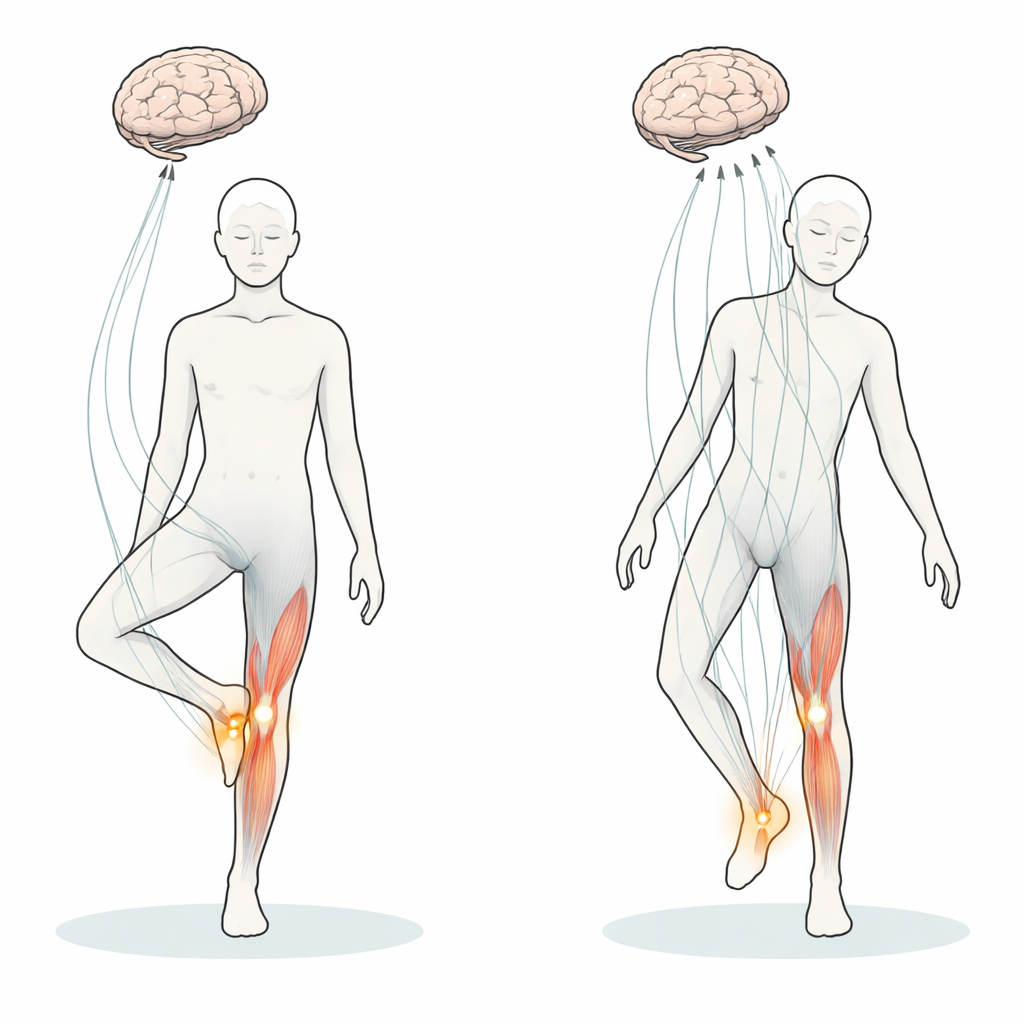
Rolling an ankle is so common that many people shrug it off. Yet for about half of those who sprain an ankle, the joint never quite feels the same again. This lasting problem, called chronic ankle instability, can make everyday tasks like walking on uneven ground or playing sports feel uncertain and risky. The study summarized here asks a simple but important question: when people with long-standing ankle instability balance on one leg—especially with their eyes closed—does the brain control their ankle muscles differently from people whose ankles fully recovered?
Balancing on one leg in the lab
To explore this, the researchers recruited 16 adults with chronic ankle instability and 16 similar adults with healthy ankles. Everyone was asked to stand barefoot on one leg—the injured side for those with instability, and the matching side for healthy volunteers. They repeated this balance task with eyes open and then eyes closed. While they stood, sensors recorded tiny electrical signals from four key lower-leg muscles that help control the ankle. At the same time, a force plate under the foot tracked the subtle shifts in pressure that occur as the body makes constant micro-adjustments to stay upright.
Listening in on muscle conversations Figure 1.
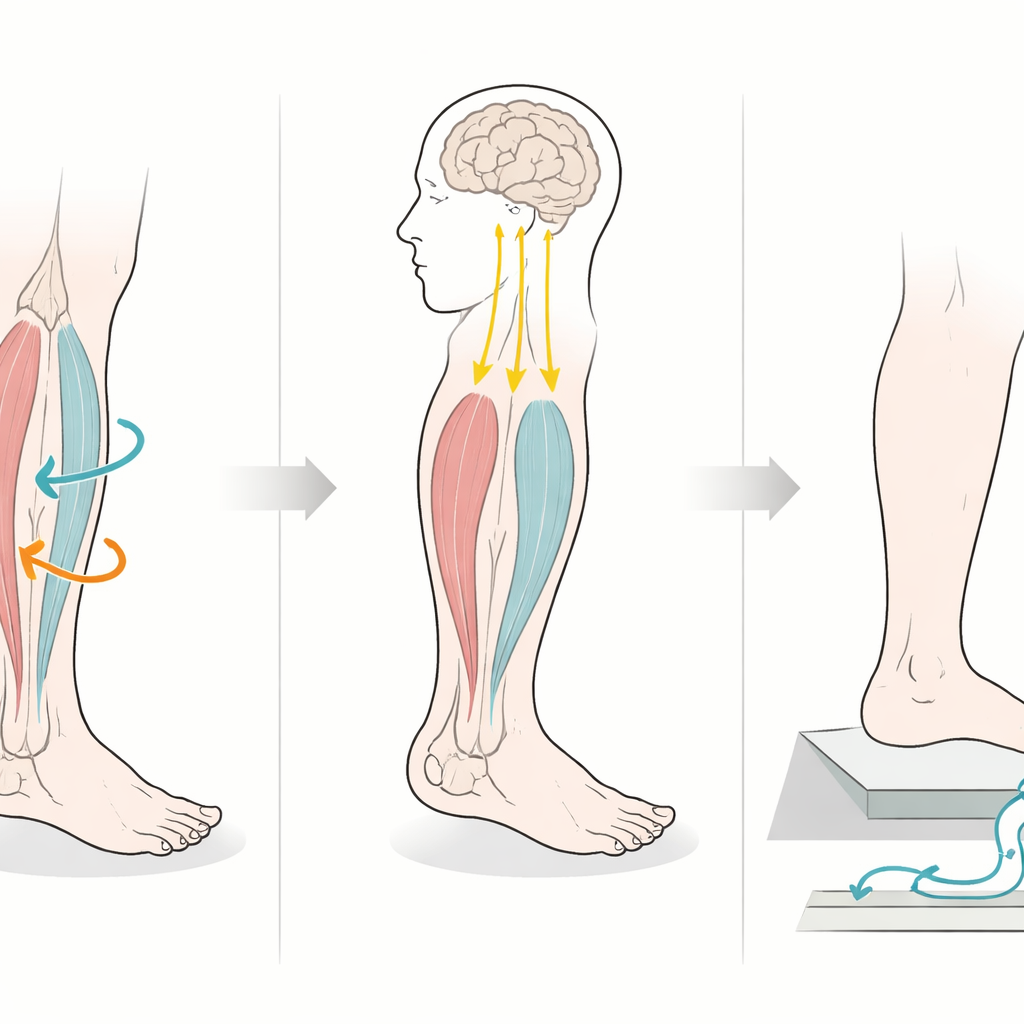
Instead of just measuring how strongly each muscle worked, the team focused on how muscles worked together. They used a technique that examines how similar the electrical activity is between pairs of muscles at different frequencies—essentially, how often muscles "talk" in sync. When two muscles, including opposing ones, fire together at specific frequencies, it suggests they are receiving a shared command from the nervous system. Low-frequency coupling tends to reflect general force control, while higher-frequency coupling is thought to signal direct, synchronized input from brain pathways that run down the spinal cord to the muscles.
What happens when you turn the lights off
When participants kept their eyes open, people with and without ankle instability showed broadly similar patterns of muscle coordination. The interesting differences emerged once vision was removed. With eyes closed, those with chronic ankle instability showed stronger high-frequency coupling between several pairs of muscles that normally oppose each other around the ankle. This pattern suggests that the brain was sending a more tightly synchronized, shared command to these opposing muscles, likely increasing joint stiffness through co-contraction. In contrast, healthy participants did not show the same jump in this kind of shared brain-to-muscle drive under the same eyes-closed challenge.
Rigid control and less adaptable sway Figure 2.
The researchers also examined how complex each person’s sway pattern was, using a mathematical measure that captures how rich and adaptable these tiny balance corrections are. More complex sway is generally thought to reflect a flexible system with many options for responding to small disturbances, while simpler sway may signal a more rigid and less adaptable strategy. Across both groups, higher high-frequency coupling between opposing muscles was linked to less complex sway. In other words, when the brain drove these muscle pairs in a more locked-together fashion, the body’s balance adjustments became simpler and potentially less able to adapt to sudden changes.
What this means for injured ankles
Altogether, the findings suggest that when visual guidance is removed, people with chronic ankle instability lean more heavily on a stiffening strategy driven by increased common signals from the brain to opposing ankle muscles. This may help them avoid falling in the moment, but it comes at the cost of reduced adaptability in their balance system. The authors propose that this pattern could serve as a non-invasive marker of lingering neuromuscular problems after ankle sprain, and that future rehabilitation might aim not only to strengthen muscles and improve joint stability, but also to retrain the nervous system so that ankle muscles can work together more flexibly rather than moving in lockstep.
Citation: Xu, X., Bowtell, J., Young, W.R. et al. Increased common corticospinal input during eyes-closed unilateral stance in people with chronic ankle instability.
Sci Rep16, 8525 (2026). https://doi.org/10.1038/s41598-026-39425-3