Clear Sky Science · en
Microscopic insight into the role of PVDF in improving the phototronic properties of a tin-derived perovskite in their nanocomposite
Harvesting More from Light and Motion
Solar panels and tiny power generators that run on movement promise cleaner energy and self-powered gadgets, but their core materials still have limits in how well they turn light and motion into electricity. This study explores a new pairing between a plastic called PVDF and a lead‑free crystal known as a tin perovskite, asking a simple question with big implications: can combining them at the nanoscale create smarter, more responsive materials for future sensors and energy harvesters?

Why This New Pair of Materials Matters
Modern renewable technologies do not only rely on sunlight. They increasingly try to tap into both light and mechanical motion, such as vibrations or pressure, in a single device. PVDF, a flexible polymer, is already famous for turning bending and pressing into electrical signals, which makes it useful in sensors, wearable devices, and mechanical energy harvesters. Metal halide perovskites, on the other hand, are crystalline materials that excel at absorbing light and moving charge, making them promising ingredients for solar cells, light detectors, and light‑emitting devices. Many of the best‑performing perovskites, however, contain toxic lead, and that raises concerns for large‑scale, real‑world use. The present work focuses on a safer, tin‑based perovskite, Cs2SnF3I3, and examines how it behaves when blended with PVDF into a nanocomposite.
Designing a Better Light and Motion Sponge
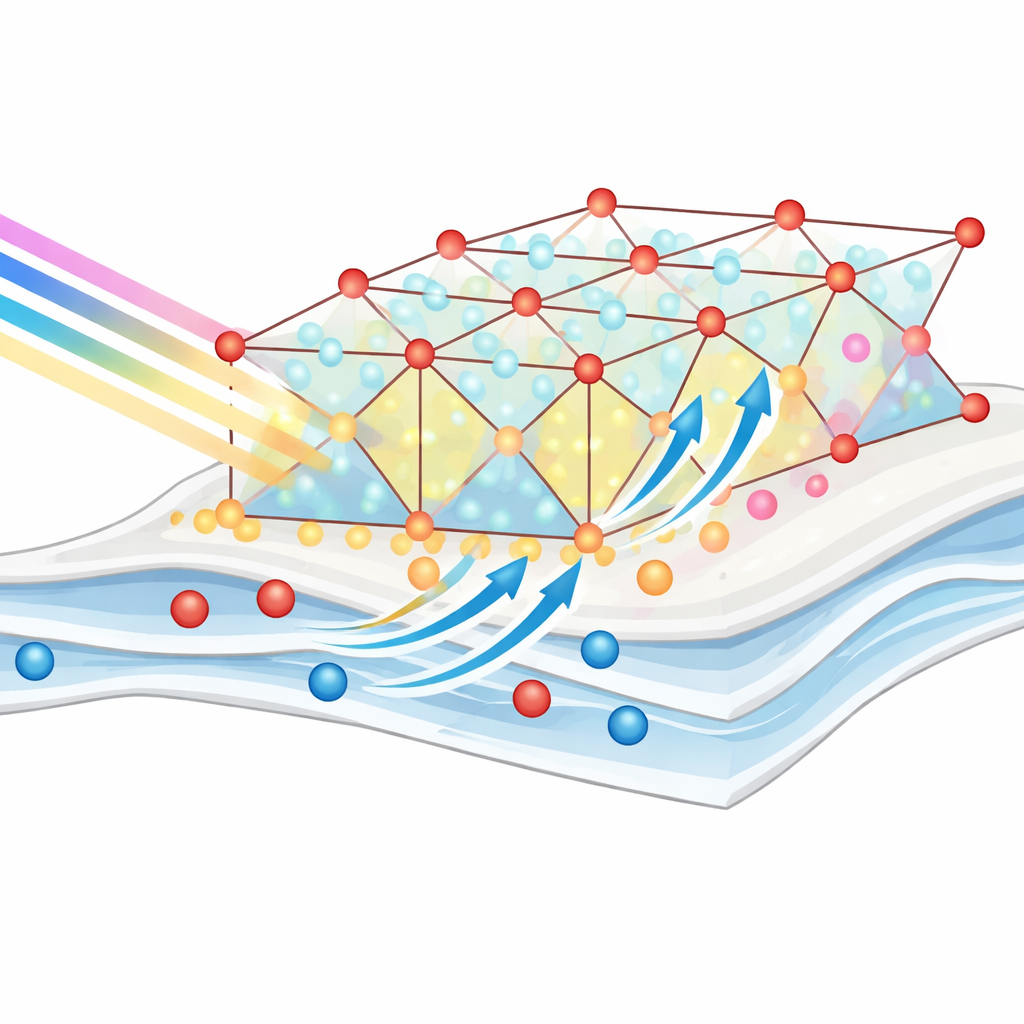
Instead of making the material in the lab, the authors first explored it on the computer using a powerful quantum‑level method called density functional theory. They built detailed molecular models of a short PVDF chain and the tin perovskite, then placed them together in several different starting arrangements. The calculations show that, in all cases, the perovskite naturally slides into a diagonal orientation alongside the polymer, forming several contact points where atoms on one component are attracted to atoms on the other. The computed energy changes are strongly negative, meaning that forming the composite is thermodynamically favorable rather than forced. At the same time, the type of attraction identified is mostly physical rather than full chemical bonding: a network of hydrogen bonds and electrostatic pulls that hold the two pieces together without permanently altering their identities. This suggests that the composite can be stable yet still flexible at the molecular level.
How the Composite Handles Light
The team then examined how this intimate contact changes the way the perovskite and PVDF handle incoming light. On its own, the tin perovskite absorbs high‑energy light in the near‑ultraviolet to violet‑blue region, a signature of its relatively large electronic band gap. When it is combined with PVDF, that band gap shifts slightly and, more importantly, the position and strength of the main absorption peaks move. In a composite with one perovskite unit, the peak shifts toward slightly longer wavelengths with a modest drop in intensity. When two perovskite units are attached to the polymer, the absorption peak shifts less but becomes noticeably stronger. These trends indicate that by simply tuning how much perovskite is mixed into the PVDF, one can dial in both the exact color range of light the material responds to and how efficiently it soaks up that light. Such control is particularly valuable for applications that rely on near‑UV or violet‑blue light, like specialized solar cells and UV detectors.
How the Composite Reacts to Electric Fields and Strain
Beyond light absorption, the authors probed how the composite’s internal charges respond to electric fields—a key part of its piezoelectric and phototronic behavior. The calculations reveal that when PVDF and the perovskite come together, the overall asymmetry of charge in the system increases: the dipole moment climbs from about 10 Debye in the perovskite alone to roughly 15 Debye in the composite. Measures of how easily the electron cloud can be distorted, known as polarizability and hyperpolarizability, also rise with the number of perovskite units attached. Graphs of the dipole moment versus applied electric field show nearly linear growth, but the slope becomes steeper as more perovskite is included. In practical terms, this means the nanocomposite should react more strongly when it is illuminated, bent, or pressed, allowing strain and light to modulate electric signals more effectively than in either material alone.
Toward Safer and Smarter Energy Devices
Taken together, the results paint a hopeful picture: a lead‑free tin perovskite can form a stable, physically bonded partnership with PVDF that improves both how the material absorbs high‑energy light and how it redistributes charge under stress. For device designers, this suggests a path toward flexible films that harvest ultraviolet and violet‑blue light while also responding sensitively to pressure or bending, all without relying on toxic lead. While these insights come from simulations rather than finished devices, they offer a microscopic roadmap for crafting safer, more tunable nanocomposites that squeeze more useful electricity out of both light and motion.
Citation: Heshmati Jannat Magham, A., Rezaei, A. & Ajloo, D. Microscopic insight into the role of PVDF in improving the phototronic properties of a tin-derived perovskite in their nanocomposite. Sci Rep 16, 8170 (2026). https://doi.org/10.1038/s41598-026-39421-7
Keywords: perovskite nanocomposites, PVDF polymer, lead-free photovoltaics, piezoelectric energy harvesting, UV light sensors