Clear Sky Science · en
Eye movement dynamics are a key factor for intra-saccadic motion perception
Why fast eye jumps matter for everyday seeing
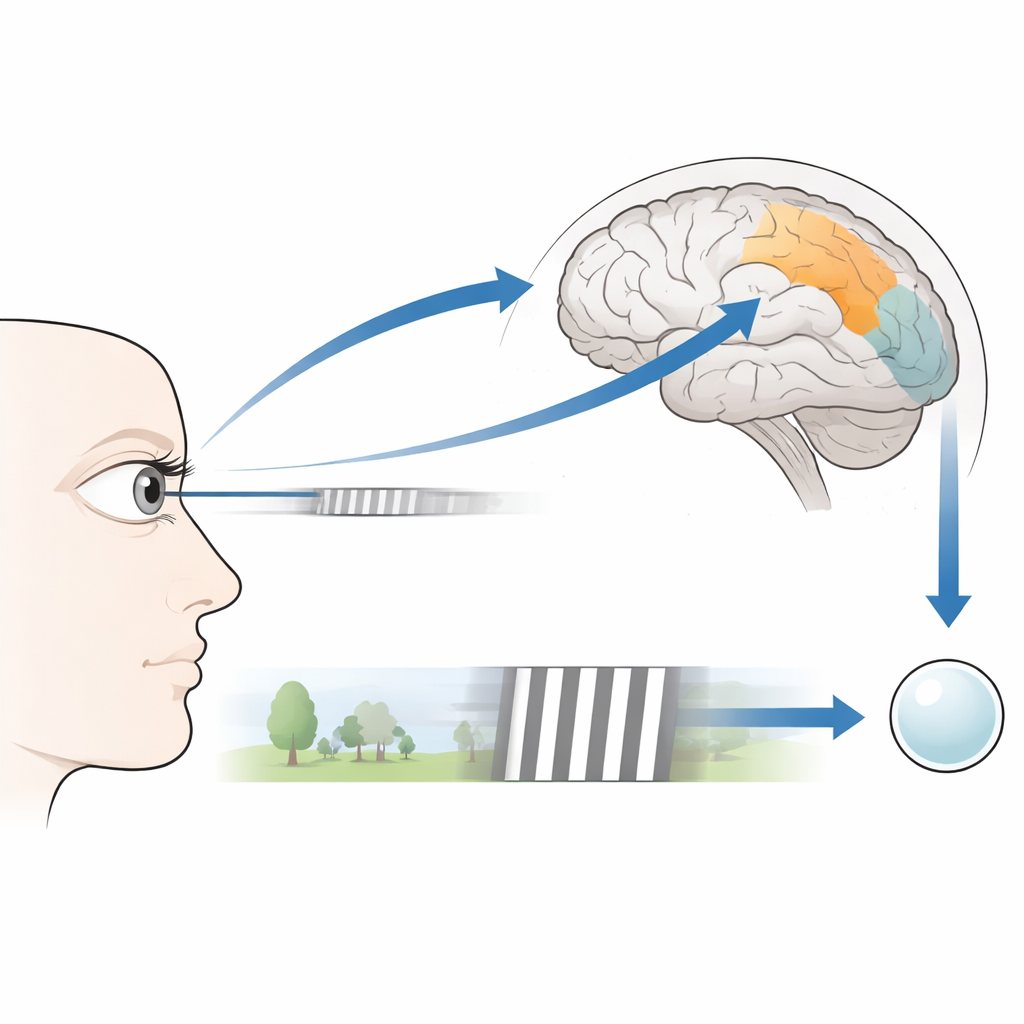
Every time you read a line of text or glance across a room, your eyes make lightning-fast jumps called saccades. During each jump, the image on your retina streaks across at high speed, yet you do not see the world blur or slip. This study asks a deceptively simple question with big implications: instead of the brain going "blind" during these jumps, could it be actively using the motion that occurs in mid-flight to help keep vision stable and guide future eye movements?
Seeing while the eyes are in motion
Classic theories held that the brain largely shuts down visual processing during saccades to avoid a confusing smear. More recent work suggests the opposite: under the right conditions, people can sense motion during an eye jump, and this "intra-saccadic" motion might play a functional role. In this experiment, volunteers moved their eyes quickly from a red point to a green point while a striped pattern swept across the screen. Sometimes the pattern moved in the same direction as the eye, creating a brief but potentially visible motion trace; other times it moved in the opposite direction, making that trace effectively invisible even though the eye movement itself was the same. After each jump, participants simply reported whether they had noticed motion during the eye movement.
Tracking brain signals and eye mechanics together
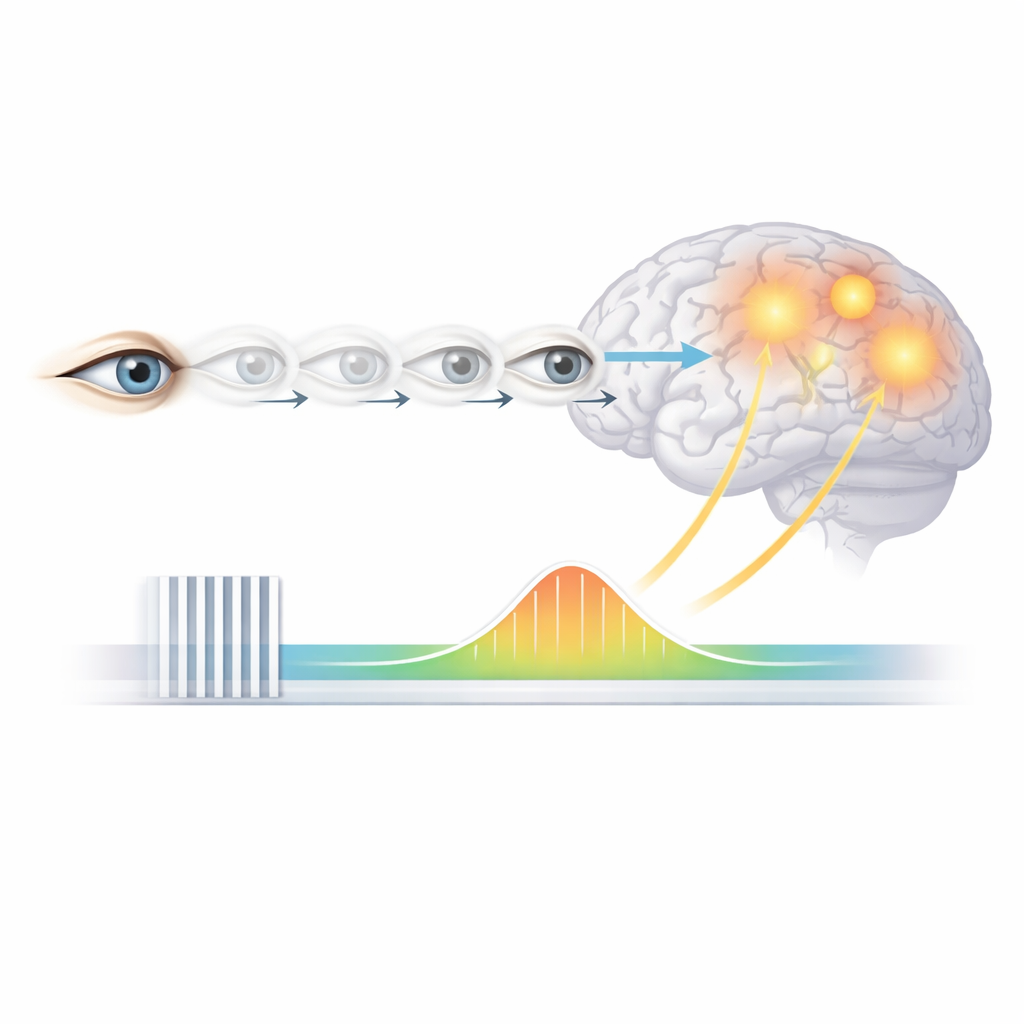
To uncover what the brain was doing during these events, the researchers combined three powerful tools: precise eye tracking to capture the speed and size of each saccade, high-density EEG to record rapid electrical activity over the scalp, and MRI-based brain maps to estimate which visual and eye-movement areas were active. A key quantity was the temporal frequency of the pattern on the retina—the rate at which the stripes swept past as eye and stimulus speeds combined or opposed one another. By carefully modeling how eye speed and pattern speed interacted on each trial, the team could relate a participant’s moment-to-moment perception of motion to specific ranges of retinal temporal frequency and to patterns of brain activation.
When motion and brain rhythms line up
EEG analyses revealed two key waves of activity tied to motion perception during saccades. An early response, peaking about one-tenth of a second after the eye landed, arose mainly over the back of the head and reflected the arrival of new visual information. A later wave, a classic P300 signal around three-tenths of a second, corresponded to higher-level evaluation and decision making about what had been seen. Source analysis showed that these responses were strongest when a specific network of regions was engaged: early visual areas (V1, V2, V3), a motion-sensitive patch known as MT/V5, and a parietal region called the intraparietal sulcus, which helps link vision and action. Crucially, the strength of this network’s activity depended on retinal temporal frequency. Motion perception during saccades was best within a fairly narrow frequency band that matches the tuning of fast, motion-sensitive pathways in the visual system.
Different eye styles, different motion experience
Not everyone moves their eyes in quite the same way. By examining how saccade size and peak speed related across individuals, the researchers identified two broad eye-movement profiles: people with faster jumps and more post-saccadic oscillations of the eye, and people with slower, smoother jumps. Even though these groups performed saccades of similar size, their peak speeds and subtle after-oscillations shifted the effective temporal frequency of the pattern on the retina. Those with faster saccades tended to bring the retinal motion into the optimal frequency range for the brain’s motion detectors, boosting intra-saccadic visibility and associated brain responses. Those with slower saccades experienced higher retinal frequencies, which may have produced a weaker or less vivid sense of motion even when they reported seeing it.
What this means for our sense of a stable world
Overall, the study shows that the brain does not simply mute vision during eye jumps. Instead, it actively processes the rapid, streak-like motion that occurs in mid-saccade, especially when that motion falls within a sweet spot of temporal frequencies tuned to fast motion-sensitive pathways. This processing draws on a coordinated network of early visual, motion, and parietal areas, and is strongly shaped by each person’s characteristic eye-movement dynamics. In everyday life, this means that the way your eyes move—how fast they jump and how they settle—helps determine how effectively your brain stitches together a stable, continuous world from a series of rapid, fragmented glimpses.
Citation: Nicolas, G., Kristensen, E., Dojat, M. et al. Eye movement dynamics are a key factor for intra-saccadic motion perception. Sci Rep 16, 8144 (2026). https://doi.org/10.1038/s41598-026-39420-8
Keywords: saccadic eye movements, motion perception, visual stability, magnocellular pathway, eye tracking EEG