Clear Sky Science · en
Optimization of mix proportions and hydration study of high-strength concrete incorporating corn stalk ash and silica fume as supplementary cementitious materials
Turning Farm Waste into Stronger Cities
Every year, mountains of crop leftovers are burned or dumped, while making the cement that holds our buildings together pumps huge amounts of carbon dioxide into the air. This study explores a way to tackle both problems at once: grinding the ash from discarded corn stalks and blending it with a very fine industrial powder called silica fume to create high‑strength concrete that is both durable and significantly cleaner to produce. 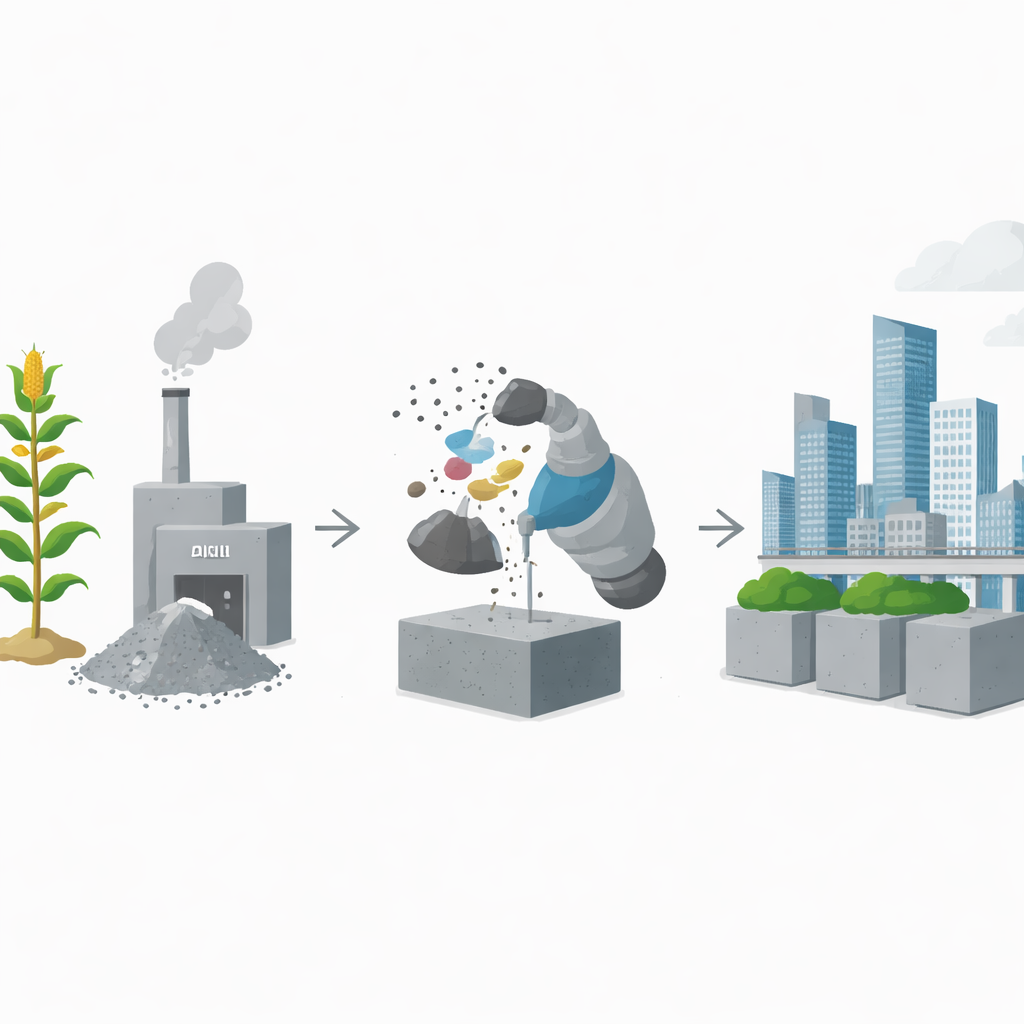
Why Traditional Concrete Needs a Makeover
Concrete is the backbone of modern construction, from bridges and skyscrapers to sidewalks and dams. But its key ingredient, cement, is one of the world’s major industrial sources of carbon emissions because making it requires heating limestone to very high temperatures. At the same time, agriculture generates huge amounts of waste—such as corn stalks—that are often burned in open fields, adding more pollution and wasting potentially useful material. Researchers have long suspected that certain crop ashes could stand in for part of the cement, but it has been unclear how far this substitution can go while still delivering very strong concrete suitable for demanding structures.
Building Concrete from Corn Stalks
In this work, the team burned corn stalks at carefully controlled temperatures to make a fine, silica‑rich ash and combined it with silica fume, another very fine industrial by‑product. Together, these powders replaced 20% of the normal cement in high‑strength concrete. The researchers systematically varied three things: how much of that 20% was corn stalk ash, how much water was added relative to the binders, and how much sand was used. Using a structured test plan, they produced sixteen different concrete recipes, cast small cubes, and measured how much pressure each cube could withstand after 7 days and after 28 days of curing.
Finding the Sweet Spot for Strength
The experiments revealed that not all combinations are equal. The strongest mix reached an impressive 28‑day compressive strength of about 110 megapascals—several times stronger than typical structural concrete. This top‑performing recipe used 15% corn stalk ash within the 20% replacement, a relatively low water content, and a fairly high sand content. When corn stalk ash was pushed up to 20% with no silica fume, the concrete became noticeably weaker, showing that the ash works best in partnership with silica fume rather than alone. Careful analysis showed that, at early ages, the amount of water had the biggest effect on strength, while at later ages the sand content and ash replacement level mattered more. 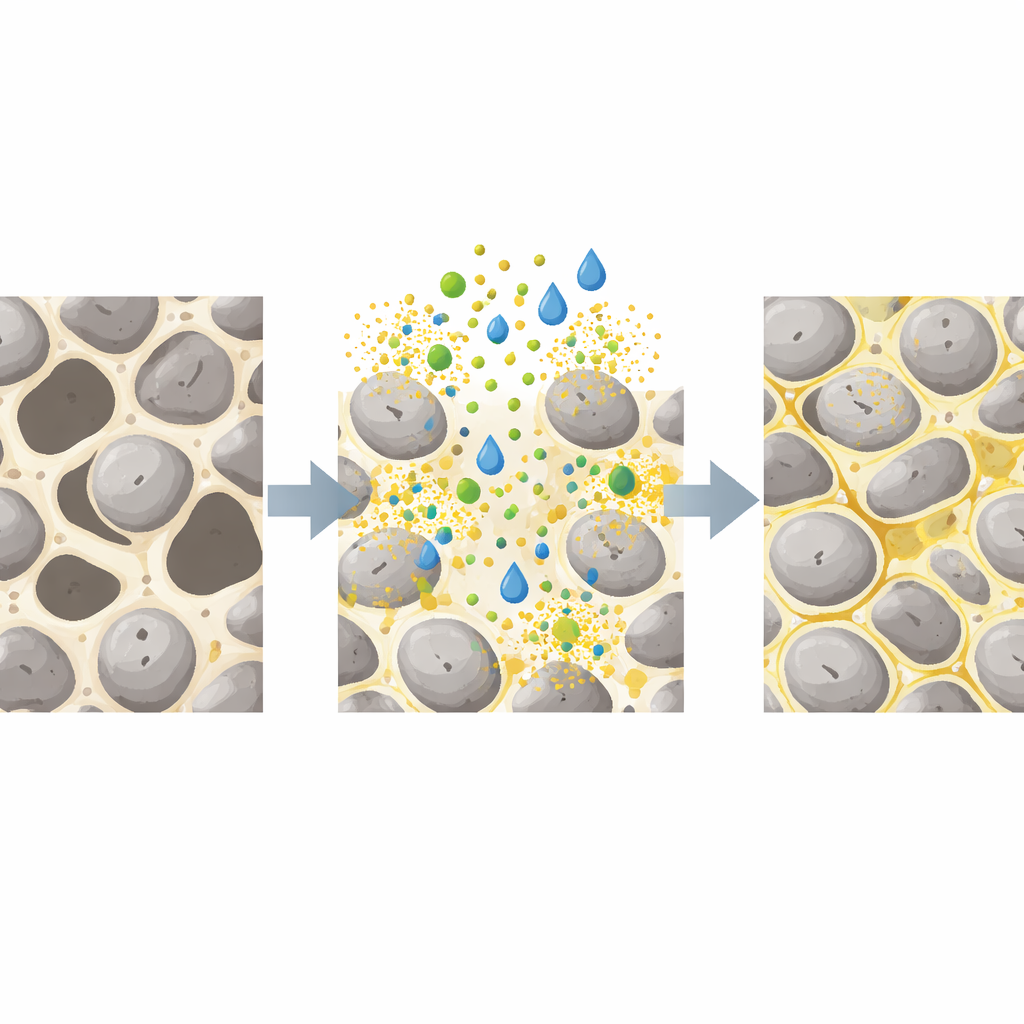
Looking Inside the Concrete
To understand why some mixes were stronger, the team zoomed in on the concrete’s inner structure using electron microscopes and X‑ray techniques. Early on, the material contained many pores and relatively few bonding products. As curing continued, the reactive silica in the corn stalk ash and silica fume triggered “secondary” reactions with calcium compounds released by the cement. These reactions produced extra gel‑like minerals that packed tightly into the pores, tying sand, stone, and cement particles together more firmly. Over 28 days, the pore space shrank dramatically, the internal structure became denser and smoother, and the measured strength rose accordingly. Steel fibers mixed into the concrete further helped it fail in a more gradual, ductile way instead of cracking suddenly and catastrophically.
Cleaner Concrete for a Lower‑Carbon Future
By replacing a fifth of the cement with corn stalk ash and silica fume, the optimized concrete mix cut carbon emissions from the binder by nearly one‑fifth compared with ordinary cement, while still delivering very high strength. In plain terms, the study shows that farm waste once treated as trash can become a valuable ingredient in robust, long‑lasting concrete, easing the environmental burden of both agriculture and construction. If adopted widely, such mixes could help cities grow upward and outward while treading more lightly on the planet.
Citation: Wang, R., Chen, Y., Wei, G. et al. Optimization of mix proportions and hydration study of high-strength concrete incorporating corn stalk ash and silica fume as supplementary cementitious materials. Sci Rep 16, 8318 (2026). https://doi.org/10.1038/s41598-026-39419-1
Keywords: sustainable concrete, corn stalk ash, high-strength concrete, supplementary cementitious materials, low-carbon construction