Clear Sky Science · en
Active inspection with knowledge distillation for cost-effective fault prediction in manufacturing process
Why catching bad products early matters
From smartphones to electric cars, we depend on complex products that are built from thousands of tiny parts. If just a few of those parts are faulty, the results can be expensive factory rework, product recalls, or even safety issues for customers. Manufacturers therefore run many tests to catch problems early—but the most thorough tests are also the slowest and most expensive. This paper explores how factories can use artificial intelligence to predict which products are likely to fail, while keeping testing costs under control.
Two kinds of factory checkups
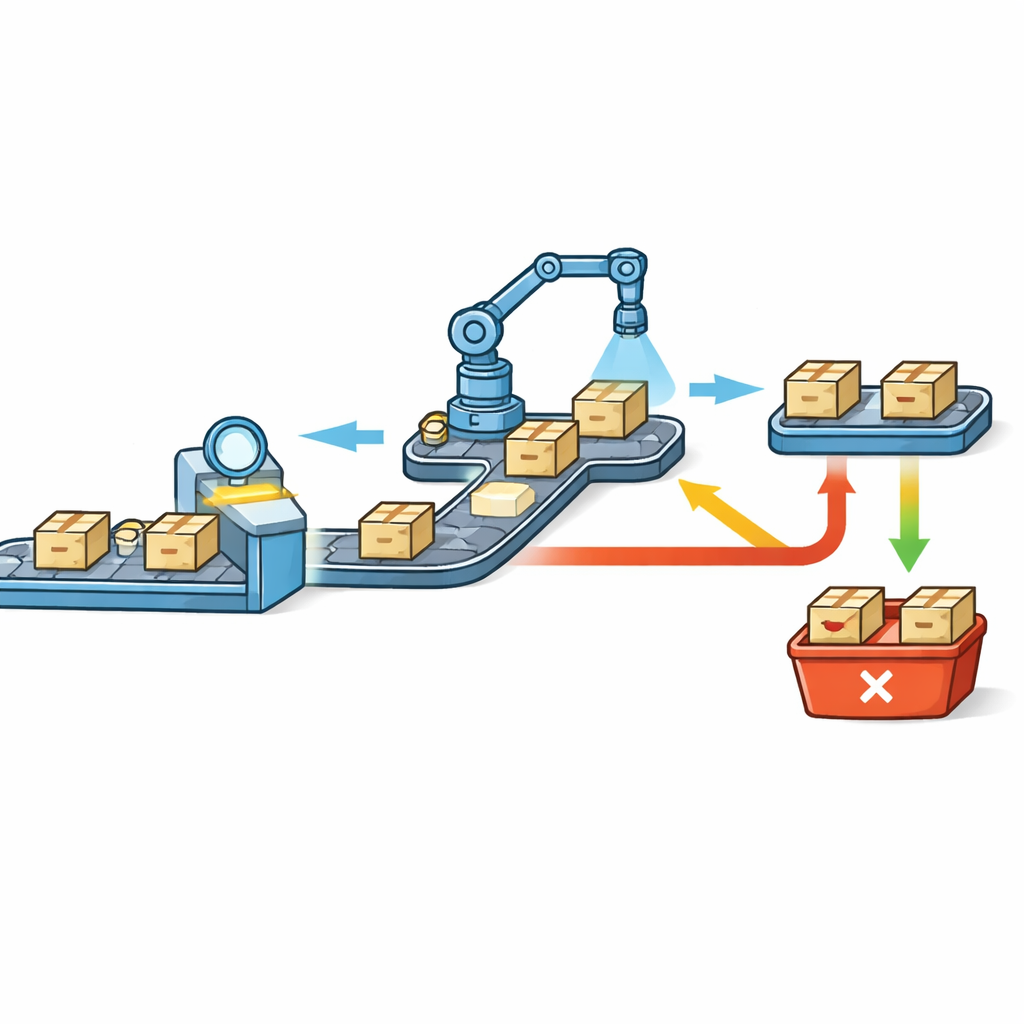
In modern production lines, not every item goes through the same level of scrutiny. Simple, fast tests are applied to every product; the authors call these basic inspections. More detailed tests, which may require special equipment or harsh conditions, are reserved for a smaller sample because they are costly and time‑consuming; these are advanced inspections. Computer models that predict future faults work better when they see both basic and advanced test results, but that means paying for more of the expensive inspections. Models that rely only on basic results are cheaper to use but usually less accurate.
Teaching a cheap test to think like an expensive one
The researchers adapt a machine‑learning idea known as knowledge distillation to this manufacturing setting. First, they train an advanced model that has access to both basic and advanced inspection data and learns to predict whether each product will eventually fail final testing. Next, they train a basic model that only sees the low‑cost tests—but they guide its learning so that its predictions imitate those of the advanced model. In effect, the basic model is taught to approximate the richer understanding of the advanced one, while still depending only on the inexpensive measurements when it is deployed on the line.
Deciding when to spend more on testing
Once the basic model has been improved in this way, the authors embed it in an active inspection framework. Every product first receives basic inspections and is evaluated by the upgraded basic model, which also produces a sense of how confident it is in its judgment. If the model is confident that an item is clearly good or clearly bad, the factory can skip the costly advanced tests. Only items with uncertain predictions are sent on for advanced inspection and evaluation by the advanced model. This selective strategy aims to reserve expensive checks for the products where they will make the biggest difference.

Testing the idea in chip manufacturing
To see how well this approach works in practice, the team analyzed real data from a semiconductor manufacturer. In chip production, wafers undergo many electrical tests; some are performed on every chip, while others under severe conditions are applied only to a subset. The authors built both basic and advanced prediction models using two different kinds of machine‑learning algorithms and compared models trained with and without knowledge distillation. They also examined several ways of measuring prediction uncertainty to decide which chips should receive advanced inspections, and evaluated performance using a standard score that reflects how well the models distinguish good chips from bad ones.
Better quality at lower cost
The experiments showed that the basic models trained with knowledge distillation were consistently more accurate than ordinary basic models, and in one dataset even slightly outperformed the full advanced model. When these enhanced basic models were combined with the active inspection strategy, factories could achieve nearly the same fault‑detection performance as testing every product with advanced inspections, while sending far fewer items through those costly tests. In plain terms, the method lets manufacturers catch more defects earlier and more reliably, without having to inspect everything at the highest level, offering a practical path toward higher quality and lower production costs.
Citation: Heo, J., Son, M. & Shim, J. Active inspection with knowledge distillation for cost-effective fault prediction in manufacturing process. Sci Rep 16, 8613 (2026). https://doi.org/10.1038/s41598-026-39412-8
Keywords: manufacturing quality, fault prediction, inspection cost, knowledge distillation, semiconductor production