Clear Sky Science · en
Fixations, blinks, and pupils differentially capture individual and interpersonal dynamics in role-asymmetric mutual gaze interaction
Why our eyes matter in silent conversations
Even when we say nothing, our eyes are constantly talking. They reveal where our attention goes, how hard we are thinking, and how connected we feel to someone else. This study asked a simple but powerful question: if you could only see someone’s eyes—no mouth, no body language, no sound—how much could you actually learn about what is going on inside them, and how do both people’s eyes coordinate during that exchange?
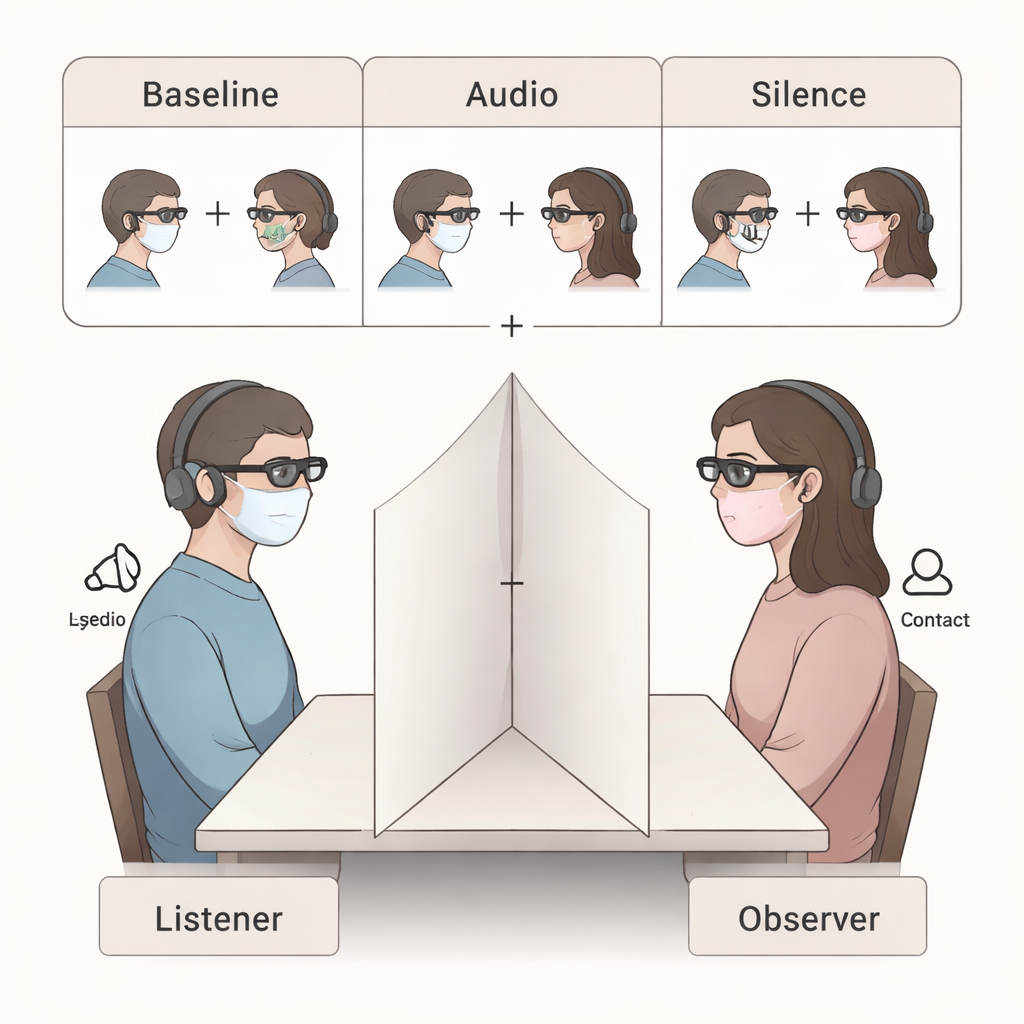
A stripped-down face-to-face encounter
The researchers created a highly controlled yet natural meeting between pairs of familiar people. Each pair sat face-to-face at a table, but a partition and face masks hid everything below the eyes. One person was the “listener,” hearing emotional sounds (neutral, pleasant, or unpleasant) through noise-canceling headphones. The other was the “observer,” who heard only steady background noise and tried to guess how the listener felt by watching their eyes. Every trial unfolded in three 30-second slices: first, both stared at a simple cross on the partition (baseline); next, they looked into each other’s eyes while the listener heard the sounds (audio); finally, they kept gazing at each other in silence while the listener reflected on the feelings (silence). Throughout, both wore eye-tracking glasses that recorded where they looked, when they blinked, and how their pupils changed.
Attention in the eyes: where and how we look
Eye fixations—the brief pauses our eyes make as we look at something—revealed how people’s visual attention shifted across phases. When both partners stared at the cross, they made fewer but longer fixations, showing steady, focused looking. Once they looked into each other’s eyes, their gaze became much more active: fixations became more frequent but shorter, as if both partners were scanning each other’s eye regions for subtle cues. Importantly, this pattern was similar for listeners and observers, suggesting that the act of mutual gaze itself creates a shared way of visually exploring the other person, regardless of who is hearing the emotional sounds.
Blinks as windows into inner and outer focus
Blinks turned out to be especially revealing about each person’s role. The listener, whose main job was to feel and evaluate the sounds, blinked more often and for longer, especially during the audio phase. This matches earlier work showing that people blink more when their attention turns inward, for example while thinking or daydreaming. The observer, who had to closely monitor the listener’s eyes, showed fewer and shorter blinks—likely a way to avoid missing fleeting signals. When the two roles were most different in their goals (during the audio phase), the timing of their blinks became less synchronized. Earlier studies had shown that people’s blinks often fall into step when they share attention and goals; here, synchrony dropped when their attentional priorities pulled them in different directions, then partially recovered in the silent reflection phase.
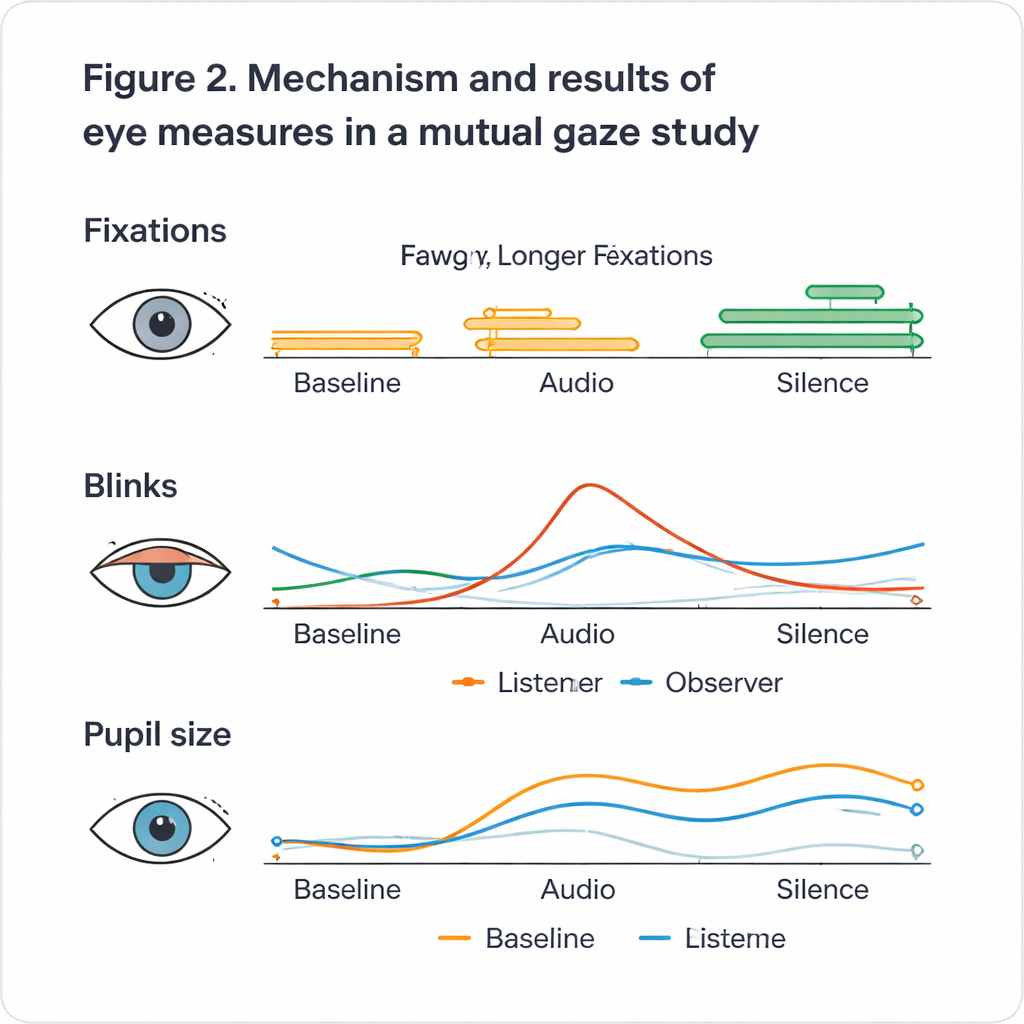
Pupil changes and silent mental effort
Pupil size, which grows with arousal and mental effort, also shifted with the phases. For both roles, pupils were smaller while staring at the cross, and enlarged when they looked at each other’s eyes during the audio and silence periods. This suggests that mutual gaze itself is more engaging and demanding than looking at a static target. Observers, however, showed bigger increases in pupil size than listeners. Their task—silently reading someone else’s feelings from tiny eye movements—appears to have required more effort than simply experiencing and judging the sounds. Interestingly, more refined measures, such as the count of very rapid dilation bursts and the degree to which partners’ pupil peaks lined up in time, did not change strongly with emotion or phase in this study, hinting that pupil-based coordination may follow different rules than blink synchrony.
What our eyes really tell each other
When the team compared eye behavior to emotion ratings, a striking pattern emerged. Listeners clearly felt the intended differences between neutral, pleasant, and unpleasant sounds, but observers were much less accurate in telling these emotional tones apart just from the eyes. At the same time, the eye measures themselves were strongly shaped by who was doing what and when: fixations tracked how attention was spread, blinks reflected whether attention was turned inward or outward, and pupil size signaled how intense and effortful the interaction felt, especially for the watcher. In everyday terms, this means that our eyes are excellent broadcasters of where our mind is working and how closely we are tuning into another person, even if they do not reliably label specific emotions like “happy” or “sad.” The study argues that to truly understand eye contact, we need to treat fixations, blinks, and pupils as parts of one integrated system that supports real-time social communication.
Citation: Çakır, M., Huckauf, A. Fixations, blinks, and pupils differentially capture individual and interpersonal dynamics in role-asymmetric mutual gaze interaction. Sci Rep 16, 6147 (2026). https://doi.org/10.1038/s41598-026-39411-9
Keywords: eye contact, social interaction, blink synchronization, pupil dilation, gaze tracking