Clear Sky Science · en
Future projections of glacier mass change in High Mountain Asia using GRACE and climatemodel data
Why Distant Glaciers Matter to Daily Life
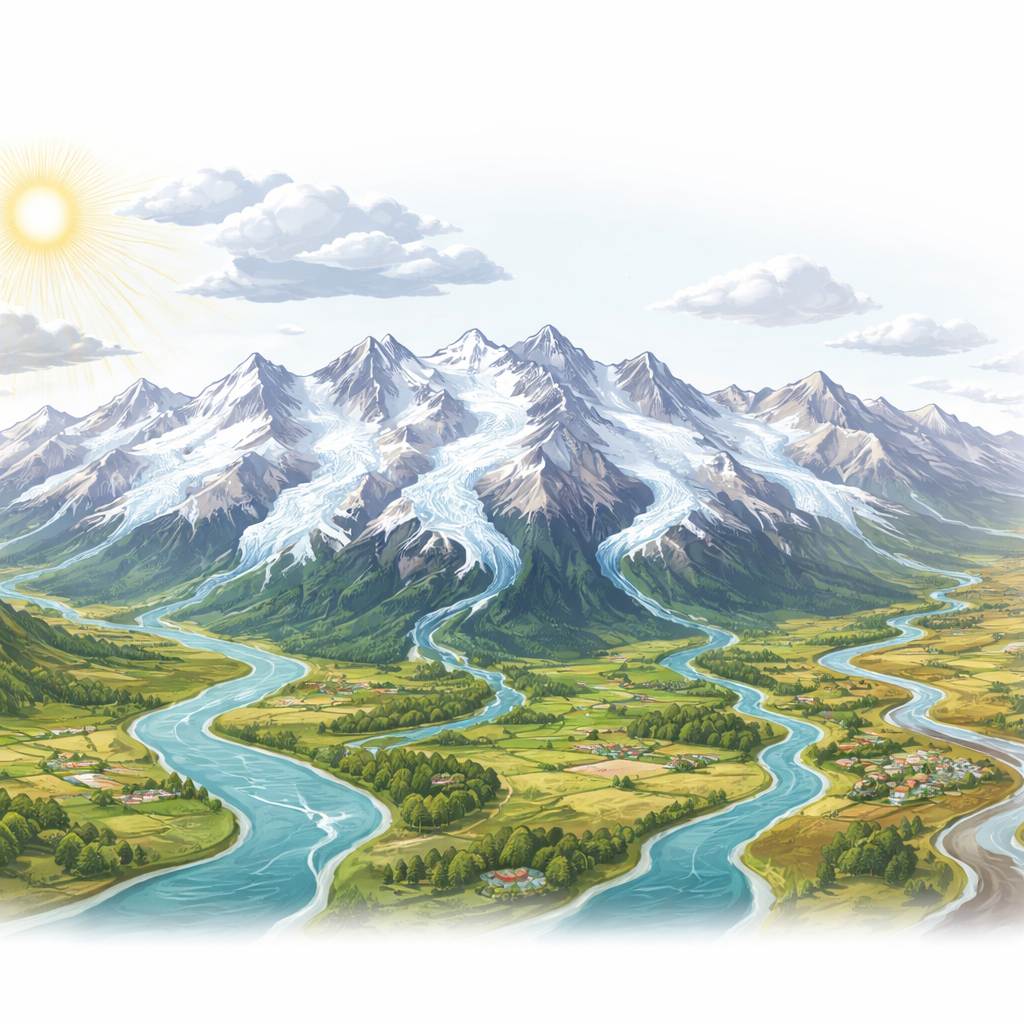
High Mountain Asia, stretching from the Himalayas to the Tien Shan, is often called the “water tower of Asia” because its vast glaciers feed many of the rivers that supply drinking water, irrigation, and hydropower to hundreds of millions of people. This study asks a simple but urgent question: how fast are these mountain ice reserves shrinking today, and what will happen to them under different future warming pathways? Using sensitive satellite measurements of Earth’s gravity field, combined with modern climate models, the authors track two decades of glacier change and project how much ice could be lost by the end of this century.
Taking the Pulse of Remote Ice
Measuring the health of glaciers scattered across enormous, rugged mountain ranges is not easy. Traditional field measurements provide detailed readings on individual glaciers but cover only a tiny fraction of the region. Optical and radar satellite images help map glacier area, yet often struggle with clouds and rugged terrain. In this study, the researchers instead rely on GRACE and GRACE Follow-On, a pair of satellite missions that detect changes in Earth’s gravity caused by shifts in water and ice mass. By comparing gravity-based estimates of total water with land-surface model estimates of soil moisture, snow, and vegetation, they isolate the signal of glacier mass change across High Mountain Asia.
Filling Gaps and Seeing the Pattern
The GRACE era contains a significant observational gap of nearly three years between the original mission and its successor. To create a continuous record from 2002/03 to 2022/23, the team uses a machine-learning method called MissForest to reconstruct the missing data from related climate variables, such as precipitation, temperature, humidity, and radiation. Tests show that these reconstructions agree closely with both observed gravity data and an independent land-surface model, giving confidence that the gap-filling is reliable. With the completed record, they calculate that High Mountain Asia’s glaciers have been losing about 13.9 billion tons of ice per year over the past two decades, with strong differences between subregions—some parts even show slight gains while others lose mass very rapidly.
Uneven Warming Across the Roof of the World
The authors then examine how rainfall, air temperature, surface temperature, humidity, and incoming solar and infrared energy have changed over the same period. They find a clear and widespread warming signal, along with increasing atmospheric moisture and rising levels of longwave (infrared) radiation reaching glacier surfaces. Shortwave (sunlight) tends to decrease in many areas, likely due to more clouds and aerosols, but the extra longwave energy more than compensates, adding heat to the ice even at night. Precipitation changes are patchy: some regions become wetter, others drier. Together, these patterns help explain why most subregions of High Mountain Asia show accelerating glacier losses, while a few, like parts of East Kunlun and Inner Tibet, manage to hold steady or even gain mass because of local climate quirks.
Peering Ahead Under Different Futures
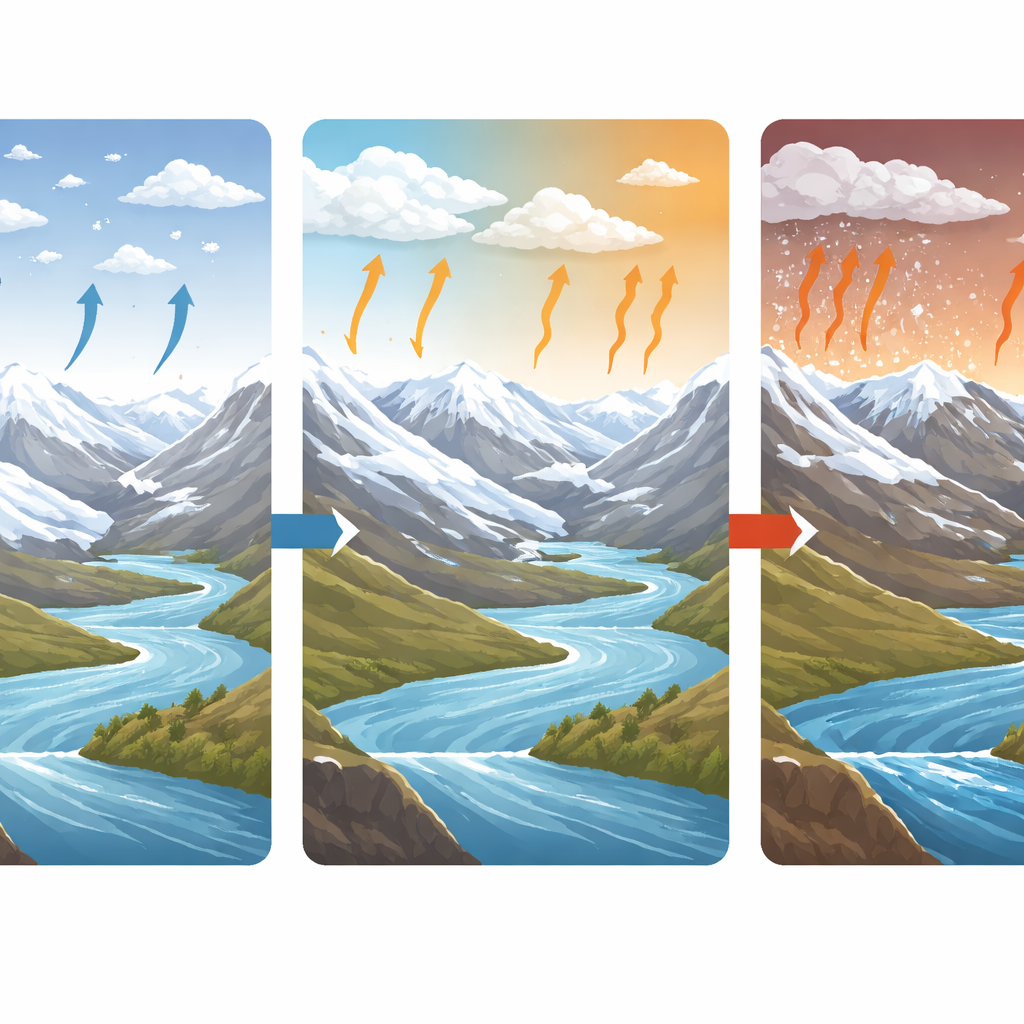
To understand what lies ahead, the researchers build a flexible statistical model that links observed glacier mass changes to five key climate and radiation variables. They then feed this model with future climate projections from a coordinated set of global models that have been adjusted to better match past observations. Two storylines are explored: a low-emission pathway (SSP126), in which strong action limits future warming, and a high-emission pathway (SSP585), in which greenhouse gas emissions remain large. Under the low-emission case, the rate of glacier loss gradually slows, and by late century the regional ice budget could even become slightly positive, suggesting a new but more stable balance between snowfall and melt. Under the high-emission pathway, however, ice loss accelerates, reaching an average decline of about 19.5 billion tons per year, with very large uncertainties and no sign of stabilization before 2100.
What This Means for Water and Hazards
For people living downstream, these projected changes carry serious consequences. In a warming climate, more precipitation arrives as rain instead of snow, and the added longwave heat from a moister atmosphere accelerates melt. In the near term, this can swell rivers and raise the risk of floods and sudden outbursts from glacier-dammed lakes. Over the longer term, as glaciers continue to shrink, the steady trickle of meltwater that many river systems rely on during dry seasons is likely to diminish. The study shows that choosing a low-emission future greatly reduces both the rate and the uncertainty of glacier loss, preserving more of Asia’s natural ice reservoirs. It underscores that what happens to these distant glaciers is not just a high-mountain story, but a central part of planning for water security, energy production, and disaster risk for vast populations downstream.
Citation: Dharpure, J.K., Howat, I.M. & Patel, A. Future projections of glacier mass change in High Mountain Asia using GRACE and climatemodel data. Sci Rep 16, 8785 (2026). https://doi.org/10.1038/s41598-026-39404-8
Keywords: High Mountain Asia, glacier melt, climate change, water resources, satellite gravimetry