Clear Sky Science · en
An observational case study for inorganic nitrogen dry deposition potential on sea-surface primary production in the subtropical, western North Pacific
Why the sky matters for ocean life
Far from rivers and coastlines, the open ocean still needs a steady trickle of nutrients to feed microscopic plants called phytoplankton, which support nearly all marine life and help absorb carbon dioxide from the air. This study asks a simple but important question: can invisible particles of nitrogen falling out of the atmosphere meaningfully boost this ocean plant growth in a remote, nutrient-poor stretch of the western North Pacific?

A quiet ocean short on food
The researchers focused on a subtropical region of the western North Pacific that is famously poor in nutrients, especially nitrogen compounds that phytoplankton need to grow. During a research cruise in March 2021, they collected surface seawater at three nearby sites. Measurements showed that dissolved nitrogen forms such as nitrate, nitrite, and ammonium were extremely scarce from the surface down tens of meters, while phosphorus was relatively more plentiful. Chlorophyll-a, a pigment used as a proxy for phytoplankton abundance, was very low near the surface and peaked deeper down, consistent with plants struggling in the sunlit surface layer because they lack nitrogen. The community was dominated by tiny picophytoplankton, typical of nutrient-starved waters.
Testing how fast ocean plants can grow
To see how active these surface phytoplankton were, the team ran controlled light experiments on the bucket-collected seawater. By adding a stable carbon tracer and exposing samples to different light levels, they built curves that describe how photosynthesis responds to light. From these, they calculated the maximum photosynthetic rate for each site. Even though all three sites were similarly nitrogen-poor and had comparable plankton communities, the maximum rate at the third site was about 30% higher than at the first, and the estimated potential daily carbon production near the surface was roughly double. This hinted that something other than deep-water nutrient supply, which was minimal, might be feeding the surface layer.
Tracing nitrogen that falls from the air
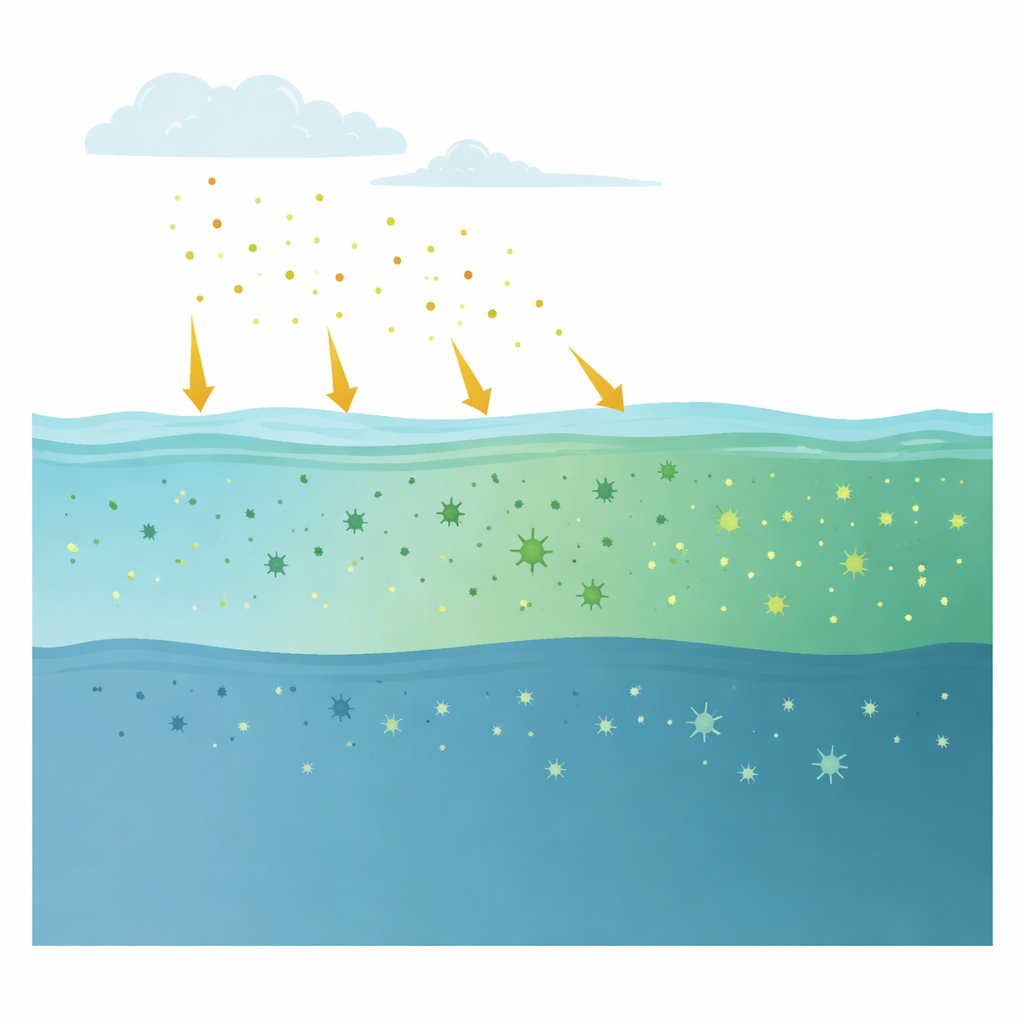
The team then turned to a high-resolution air-quality and weather model to estimate how much inorganic nitrogen from the atmosphere had settled onto the sea in the 24 hours before each water sample was taken. They accounted for several forms of nitrogen, including gaseous and particle-bound species, and distinguished between wet and dry deposition. During the study period, there was almost no rain, so dry deposition dominated. The model indicated that the third site received more than three times as much atmospheric nitrogen as the first site in the day before sampling, with the second site in between. Most of this input came from coarse nitrate particles formed from pollution transported from East Asia and reacting with sea-salt aerosols over the ocean.
Linking falling nitrogen to extra growth
Assuming that the deposited inorganic nitrogen was fully usable by phytoplankton, the authors converted the modeled nitrogen flux into an equivalent potential carbon production using a standard ratio of nitrogen to carbon in marine biomass. They then compared this nitrogen-driven production estimate with the potential surface production based on their measured photosynthetic rates and chlorophyll levels. Across the three sites, the two sets of numbers rose and fell together: where more nitrogen fell from the sky, the surface layer’s potential production was higher. A simple line fit between these quantities showed a strong correlation, implying that recently deposited atmospheric nitrogen could account for much of the observed differences in how productive the surface waters were, even though the sites were close together and similarly nutrient-poor at depth.
What this means for the changing ocean
For a lay observer, the takeaway is that the atmosphere is not just a passive ceiling over the sea; it is an active supplier of fertilizer that can noticeably influence how much life the surface ocean supports, at least in this part of the Pacific. As climate change strengthens the layering of the upper ocean and makes it harder for nutrients to rise from below, this airborne pathway may become even more important. While this study is based on only three locations and focuses on one type of nutrient and one mode of delivery, it provides rare, direct observational evidence that pulses of nitrogen drifting down from polluted continental air can help sustain microscopic ocean plants in otherwise starved waters. Understanding this link better will be crucial for predicting future marine productivity and the ocean’s role in taking up carbon from the atmosphere.
Citation: Taketani, F., Matsumoto, K., Sekiya, T. et al. An observational case study for inorganic nitrogen dry deposition potential on sea-surface primary production in the subtropical, western North Pacific. Sci Rep 16, 9068 (2026). https://doi.org/10.1038/s41598-026-39401-x
Keywords: atmospheric nitrogen deposition, ocean primary production, subtropical Pacific, phytoplankton, marine nutrients