Clear Sky Science · en
Investigating the influence of expanded perlite and lime mud on cement-bonded composites containing pulp sludge
Turning Paper Mill Waste into Useful Building Panels
Most of us think of concrete as heavy, solid, and anything but eco-friendly. This study asks a simple question with big implications: can some of the waste from pulp and paper mills, plus a lightweight volcanic mineral, be turned into strong, insulating wall panels that are kinder to the planet? By blending these leftovers with ordinary cement, the researchers aimed to create lighter building elements that keep heat and noise out, while still being safe and durable enough for everyday use in non‑load‑bearing walls.
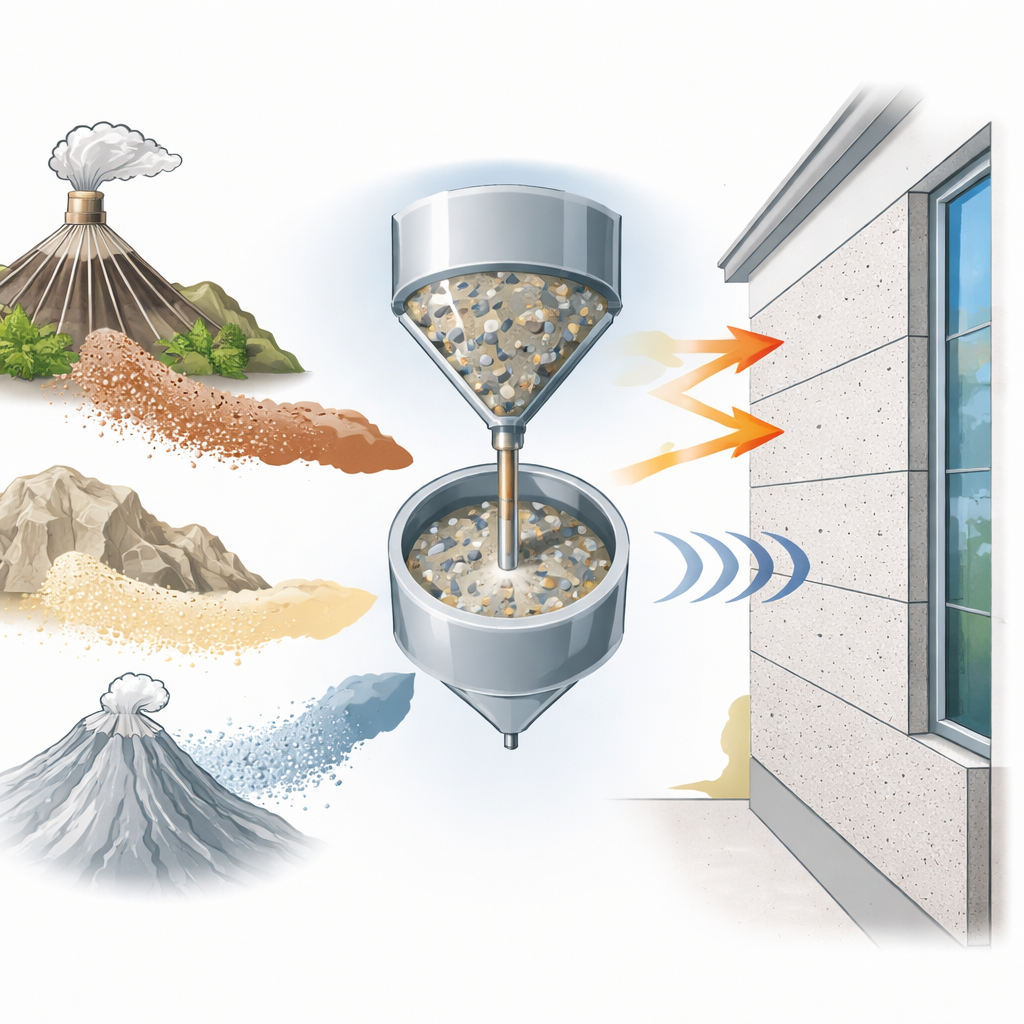
What Goes Into These New Building Blocks
The team focused on three main ingredients: pulp sludge, lime mud, and expanded perlite. Pulp sludge is a fibrous residue from paper production, rich in tiny wood‑like fibers and mineral fillers. Lime mud is a fine, chalky by‑product from the same industry, and expanded perlite is a puffed, glassy mineral formed when certain volcanic rocks are heated and “pop” like popcorn, trapping air inside. In the recipes tested, up to half of the cement was replaced by pulp sludge, and a small portion of the remaining cement (5–15 percent by mass) was swapped for either lime mud or perlite. The goal was to see how these substitutions affected weight, strength, heat flow, sound absorption, and fire behavior.
Peeking Inside at the Tiny Structure
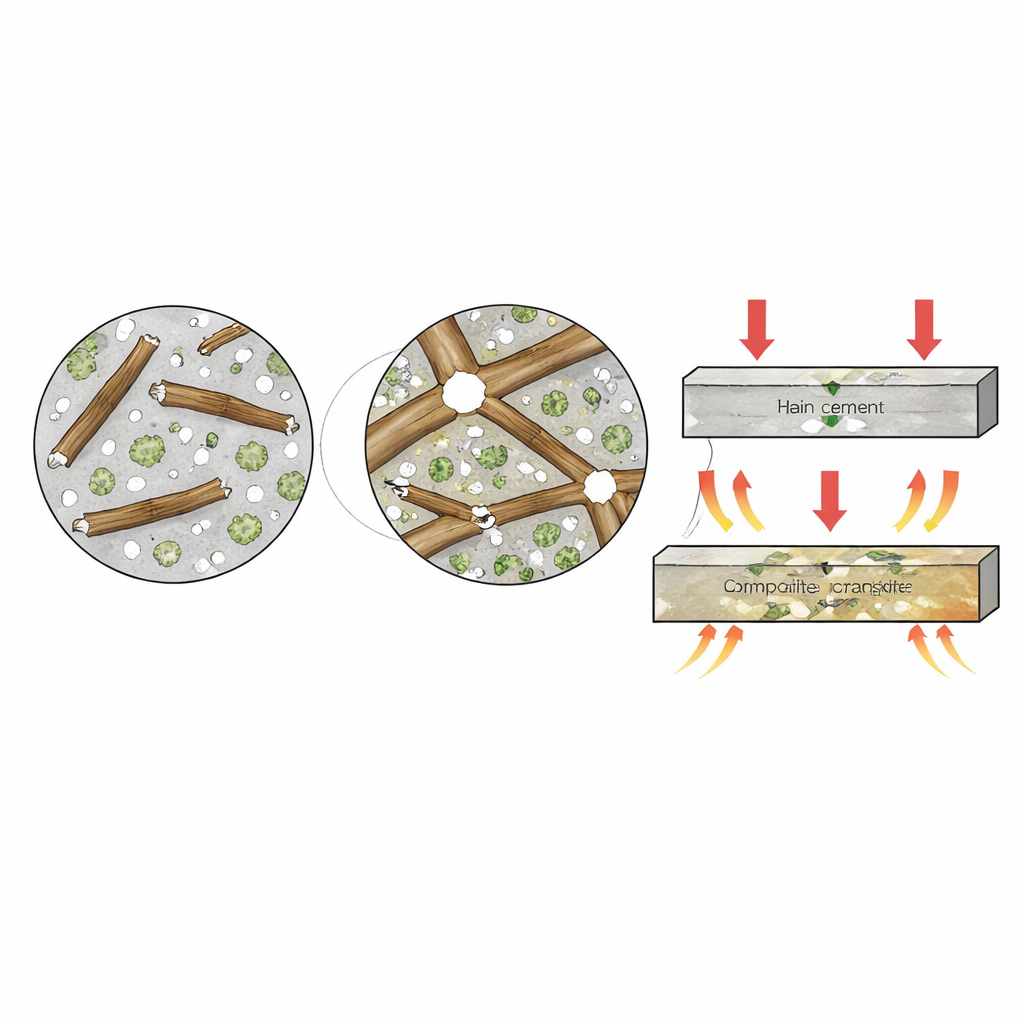
To understand how the new mixtures behave, the researchers used several laboratory techniques that reveal the internal make‑up of the material. X‑ray methods showed that lime mud and perlite particles nestle among the cement grains, helping to fill small gaps and, in some cases, react with cement hydration products to form extra binding gel. Electron microscope images revealed a porous, yet well‑connected network where pulp fibers span across small cracks, acting like tiny reinforcing bars. Lime mud, which is very fine and rich in calcium compounds, tended to pack the material more tightly and slightly boost strength. Perlite, thanks to its air‑filled structure, increased overall porosity, which is good for insulation but can reduce strength if used in high amounts.
Strength, Heat, and Sound in Everyday Terms
Mechanical tests showed that adding a small amount—about 5 percent—of either lime mud or perlite actually increased the bending and compressive strength compared with similar mixes that contained pulp sludge but no aggregate replacement. When the replacement level was raised to 15 percent, strength dropped, mainly because there was less cement to glue everything together. A camera‑based technique that tracks surface strain during compression revealed that the composites deform in a more gradual, spread‑out way than plain mortar, with the pulp fibers helping to hold the material together even after cracks start to form. Despite being significantly lighter (around 732–749 kilograms per cubic meter), the panels met European standards for non‑structural cement‑bonded boards, making them suitable for interior or exterior cladding rather than main structural elements.
Keeping Homes Warmer and Quieter
The lightweight nature and porous structure of the pulp‑based composites translated into clear benefits for building comfort. Thermal tests showed that these panels conduct heat about 30 percent less than standard cement boards, with typical values around 0.17 watts per meter‑kelvin compared with 0.25 for pure cement materials. This means they are better at slowing down heat loss, contributing to energy‑efficient walls. Sound tests found moderate absorption, with coefficients around 0.3 at mid to high frequencies, enough to help reduce echoes and everyday noise in rooms. Importantly, adding lime mud or perlite did not harm the acoustic performance already provided by the fibrous pulp network. Fire tests indicated low heat release and modest mass loss, reflecting the largely mineral makeup and suggesting that, unlike many organic insulation materials, these panels can maintain integrity under intense heat.
Why This Matters for Greener Buildings
Overall, the study shows that pulp sludge, combined with small doses of lime mud or expanded perlite, can be transformed into lightweight cement‑based panels that insulate against heat and sound while offering adequate strength and reassuring fire performance. A 5 percent replacement of cement with either additive emerged as the sweet spot, balancing strength and insulation. Beyond the technical results, this approach offers a way to recycle bulky industrial residues, cut down on the amount of energy‑intensive cement needed, and provide construction materials well suited for prefabricated wall panels and insulating boards. In simple terms, it points to a future where yesterday’s paper mill waste can help build tomorrow’s more sustainable, quieter, and better‑insulated homes.
Citation: Amiandamhen, S.O., Mai, C., van Blokland, J. et al. Investigating the influence of expanded perlite and lime mud on cement-bonded composites containing pulp sludge. Sci Rep 16, 7844 (2026). https://doi.org/10.1038/s41598-026-39390-x
Keywords: cement composites, pulp sludge, lightweight panels, thermal insulation, sustainable construction