Clear Sky Science · en
Efficient charging scheduling through coordination of electric vehicle platoons and charging stations
Why smarter charging matters for everyday drivers
As electric vehicles become more common, fast and convenient charging will matter as much as finding a gas station today. This study looks at what happens when not only individual electric cars but also tightly packed groups of them, known as platoons, share the same roadside chargers. By coordinating how these vehicles move and where they stop to refuel, the authors show that we can cut wasted time, avoid long queues at busy stations, and make better use of existing charging hardware.
Mixed traffic on tomorrow’s roads
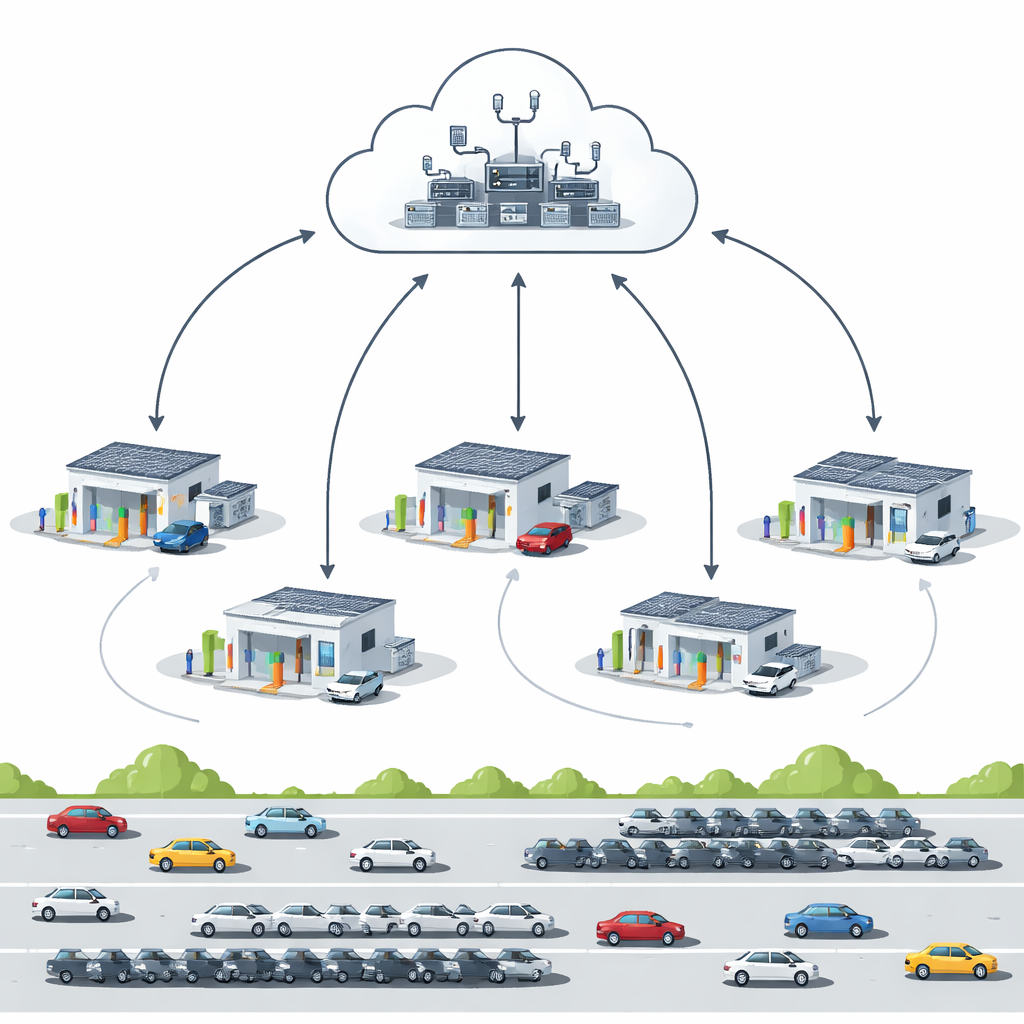
The work imagines near-future highways where two kinds of electric traffic travel side by side. One consists of regular, human-driven cars whose owners decide when and where to charge. The other consists of organized convoys of automated vehicles—delivery vans, robotaxis, or company fleets—that travel together at coordinated speeds. These platoons save energy and increase road capacity, but when they pull into a station they can occupy several charging points at once, quickly overwhelming local capacity. Traditional planning methods treat every vehicle as a separate, independent customer and rarely consider this clumping effect, which can turn a smooth network into a system plagued by bottlenecks.
A digital dispatcher for cars and chargers
To address this, the authors propose an intelligent dispatcher that sits in the network and communicates with both vehicles and charging stations. Using vehicle‑to‑infrastructure links similar to today’s cellular networks, cars and platoons periodically share simple information such as remaining battery energy, desired charge amount, and current position. The dispatcher also knows the road layout, how crowded each road segment is, and how much power each charging pile can deliver. With this combined data, it assigns every car or platoon to a specific station and suggests suitable travel speeds, aiming to minimize the total time each spends driving to and using a charger, while preventing any single station from being overloaded.
How the smart scheduling works
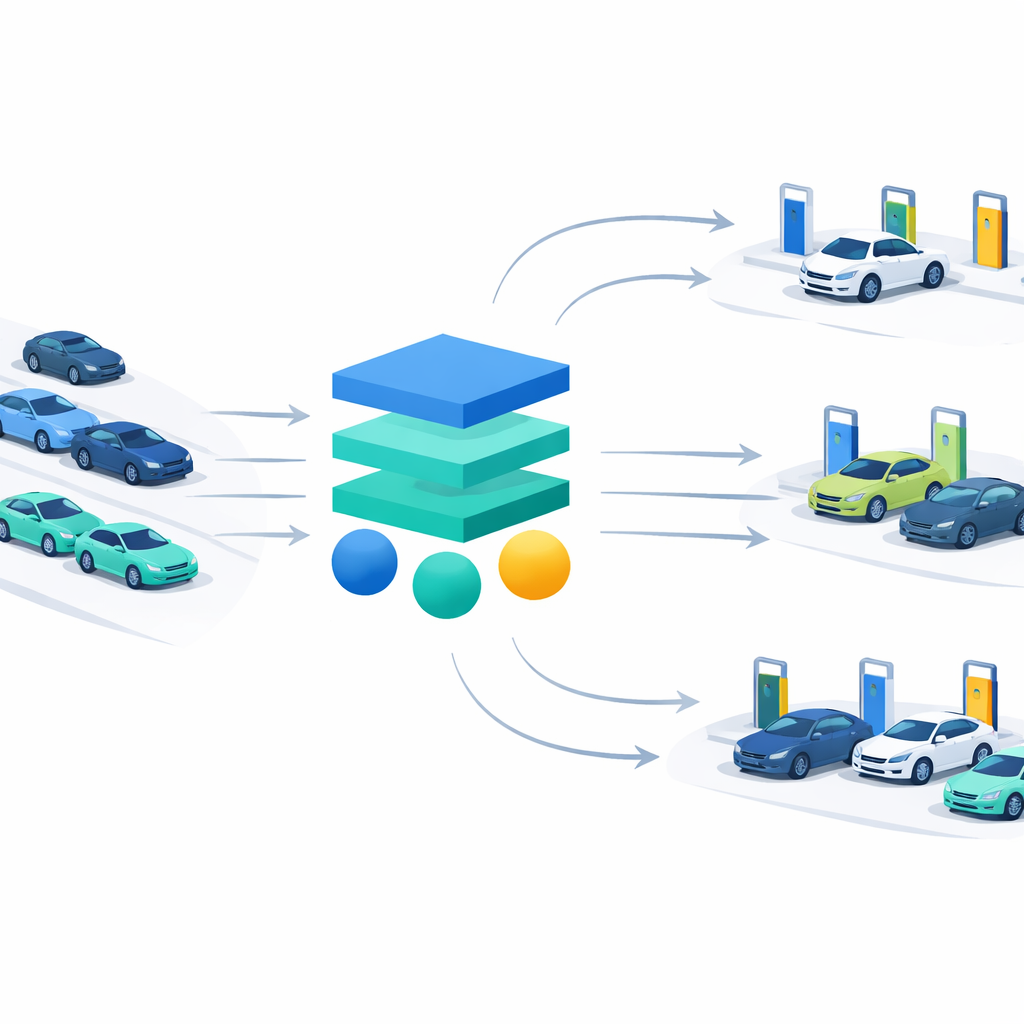
Behind the scenes, the system solves a complex puzzle: who should go to which station, and how fast should each vehicle or platoon travel so that it can reach that station without running out of battery. Because platoons consume several plugs at once, their assignments strongly influence everyone else’s options. The authors break this puzzle into two alternating stages. First, using a search method inspired by planning in stages, or a faster greedy shortcut, the dispatcher chooses station assignments under the rules that no station may exceed its number of plugs and every vehicle must pick exactly one stop. Second, holding those assignments fixed, a swarm-inspired optimization routine nudges vehicle and platoon speeds up or down within legal limits so that energy use, travel time, and charging time jointly improve. The process then repeats, gradually refining both choices until further gains are tiny.
What simulations reveal about better charging
Computer experiments explore how this coordinated strategy performs under a variety of realistic conditions. Compared with simple rules such as “always go to the nearest free station” or straightforward greedy choices, the proposed method consistently cuts total time spent driving and charging. The benefits become especially clear when there are many platoons or when nearby stations have limited capacity. The results highlight several design lessons: spreading the same total number of plugs across more stations usually reduces overall time because more drivers can find a reasonably close stop; increasing charging power predictably shortens sessions but works best when combined with smart scheduling; and very large platoons, while efficient on the road, can sharply increase delays at stations unless their charging is carefully coordinated.
What this means for future EV travel
In everyday terms, the study shows that smarter coordination—not just more hardware—can make electric travel faster and more reliable. By treating convoys of vehicles as first-class citizens in the charging plan and by tuning both where they stop and how fast they move, the proposed framework reduces crowding at popular stations and shortens the combined drive-and-charge experience. As EV use grows and commercial fleets adopt platooning, such joint planning could help cities and highway operators deliver smoother trips without endlessly adding new chargers, pointing toward a more efficient and user-friendly electric road system.
Citation: Qi, L., Wu, B., Li, S. et al. Efficient charging scheduling through coordination of electric vehicle platoons and charging stations. Sci Rep 16, 8773 (2026). https://doi.org/10.1038/s41598-026-39376-9
Keywords: electric vehicle charging, vehicle platooning, smart transportation, charging station planning, traffic optimization