Clear Sky Science · en
Assessment of toothbrushing, bleaching pen and bleaching mouthwash in removing stains from tooth structure and single-shade resin composite
Why your morning coffee matters for your smile
Coffee is a daily ritual for millions of people, but its dark pigments can slowly tint not only natural teeth but also modern tooth-colored fillings. This study explored a practical question many coffee drinkers and dentists care about: when stains build up, is regular toothbrushing enough, or do newer at-home whitening products like bleaching pens and whitening mouthwashes really make a difference—especially on the latest "single-shade" composite fillings designed to blend in with any tooth color?
Teeth, smart fillings and stubborn coffee stains
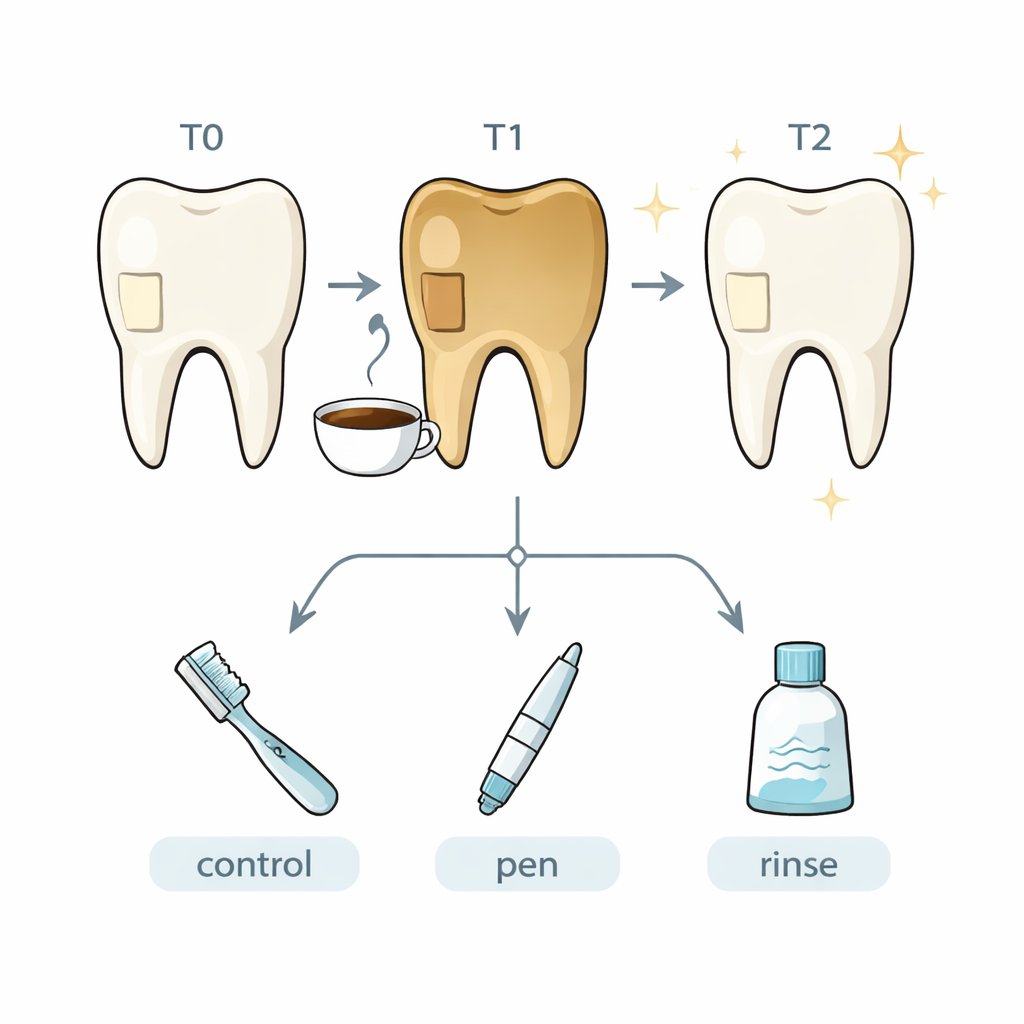
Dentists increasingly use single-shade resin composites, a type of white filling that can adapt visually to different tooth colors, simplifying the often tricky task of shade matching. But, like natural teeth, these materials age in the mouth and can pick up stains from drinks such as coffee, tea and red wine. To mimic a year of daily coffee exposure, the researchers filled standardized cavities in thirty extracted front teeth with a single-shade composite and then immersed the restored teeth in coffee at body temperature for 12 days. This controlled setup let them watch exactly how both the enamel and the filling material changed color under identical conditions.
How the whitening products were put to the test
After staining, the teeth were divided into three groups. One group underwent simulated ordinary toothbrushing with a non-whitening toothpaste, representing what most people do at home. The second group received a bleaching pen treatment: a thin film of low-concentration hydrogen peroxide gel was painted on, dried, and left on the teeth for eight hours at a time, as it would be overnight. The third group was treated with a whitening mouthwash containing a similar bleaching ingredient, used twice daily. All treatments lasted a week. At each stage—before staining, after coffee, and after one week of cleaning or bleaching—the researchers used a highly precise dental color-measuring device to record changes in both the tooth surface and the composite filling.
Measuring color beyond the naked eye
To move beyond simple “lighter” or “darker” judgments, the team used two complementary systems. One was the familiar dental shade guide, which arranges tooth colors from light to dark in numbered steps; by converting shades to “Shade Guide Units,” they could express changes as whole-number jumps along this scale. The other was a more technical color-difference formula called CIEDE2000, which quantifies how visible a change is and whether it crosses accepted thresholds for what patients can see and what they are likely to find unacceptable. Together, these methods allowed the researchers to compare how coffee darkened teeth and fillings, and how well each cleaning method brought them back toward the starting point.
What happened to teeth and fillings
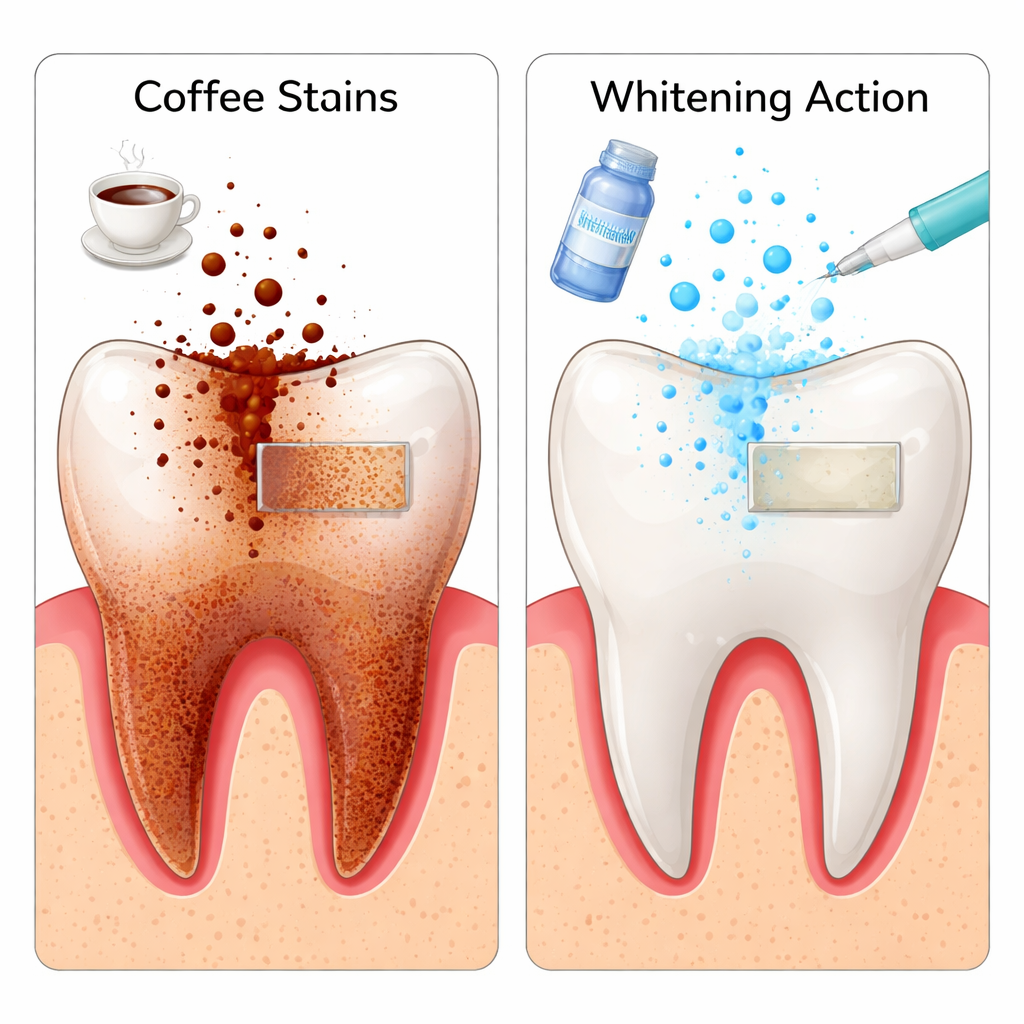
Coffee caused marked discoloration in both the natural tooth enamel and the composite fillings, with the teeth themselves staining more severely. Ordinary brushing with a non-whitening toothpaste only partly improved the situation. Tooth surfaces became slightly lighter but remained clearly darker than their original shade, and the stained fillings showed essentially no visible change, indicating that many pigments had penetrated deeper than surface scrubbing could reach. In contrast, both the bleaching pen and the whitening mouthwash were able to return teeth and fillings to their original measured shades. Statistically, the two whitening approaches performed equally well, suggesting that the active ingredient—low-dose hydrogen peroxide—was more important than the exact product format.
What this means for everyday coffee drinkers
For people who love coffee and want to keep their smile bright, these findings highlight an important point: regular brushing with a standard toothpaste helps control surface buildup but may not fully reverse deeper brown staining of teeth or modern tooth-colored fillings. At-home whitening products that use low concentrations of bleaching agents, such as pens and mouthwashes, can effectively break down these stubborn pigments without the high doses used in in-office treatments. In simple terms, while your toothbrush is essential for daily hygiene, gentle bleaching products offer an extra tool to restore the original color of both your teeth and your blended-in composite fillings after coffee has left its mark.
Citation: Hamdy, T.M., Zaki, Z.M. & Abdelraouf, R.M. Assessment of toothbrushing, bleaching pen and bleaching mouthwash in removing stains from tooth structure and single-shade resin composite. Sci Rep 16, 7948 (2026). https://doi.org/10.1038/s41598-026-39375-w
Keywords: tooth whitening, coffee stains, composite fillings, bleaching mouthwash, bleaching pen