Clear Sky Science · en
Multi-phase retreat of the Laurentide Ice Sheet and associated freshwater release from Hudson Bay during the last deglaciation
Why ancient ice still matters today
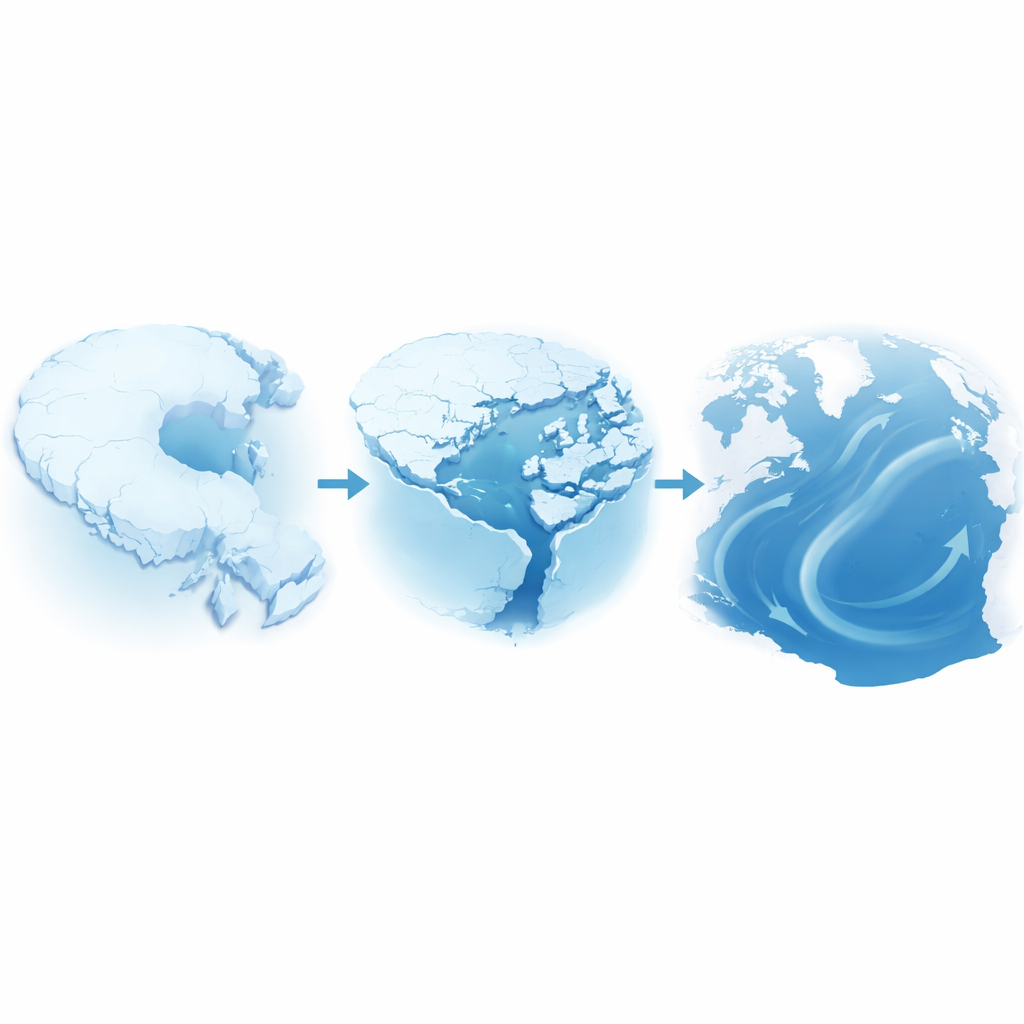
Thousands of years ago, the vast Laurentide Ice Sheet covered much of North America. As it melted and pulled back, huge amounts of fresh water poured into the North Atlantic Ocean and briefly cooled the planet. This study takes a close look at that ancient meltwater pulse from the Hudson Bay region, using seafloor mud as a time capsule. By untangling when, how, and for how long fresh water flowed to the ocean, the authors shed light on how modern ice loss and meltwater could affect today’s climate and ocean currents.
Reading climate history in seafloor mud
To reconstruct this story, scientists collected long cylinders of sediment from the floor of Hudson Strait, the natural outlet of Hudson Bay toward the Labrador Sea and the North Atlantic. Each layer in these cores is like a page in a history book, preserving grains of sand, tiny shells, and chemical fingerprints that record conditions at the time they were deposited. By measuring properties such as color, magnetic behavior, and the relative amounts of elements like calcium and titanium, and by dating shells with radiocarbon methods, the team divided the mud into six main units spanning roughly 9,000 to 8,000 years ago. They then matched these units to similar patterns seen in cores from Hudson Bay, the Labrador shelf, and nearby fjords, building a region-wide timeline of ice retreat and freshwater flow.
From steady melt to sudden change
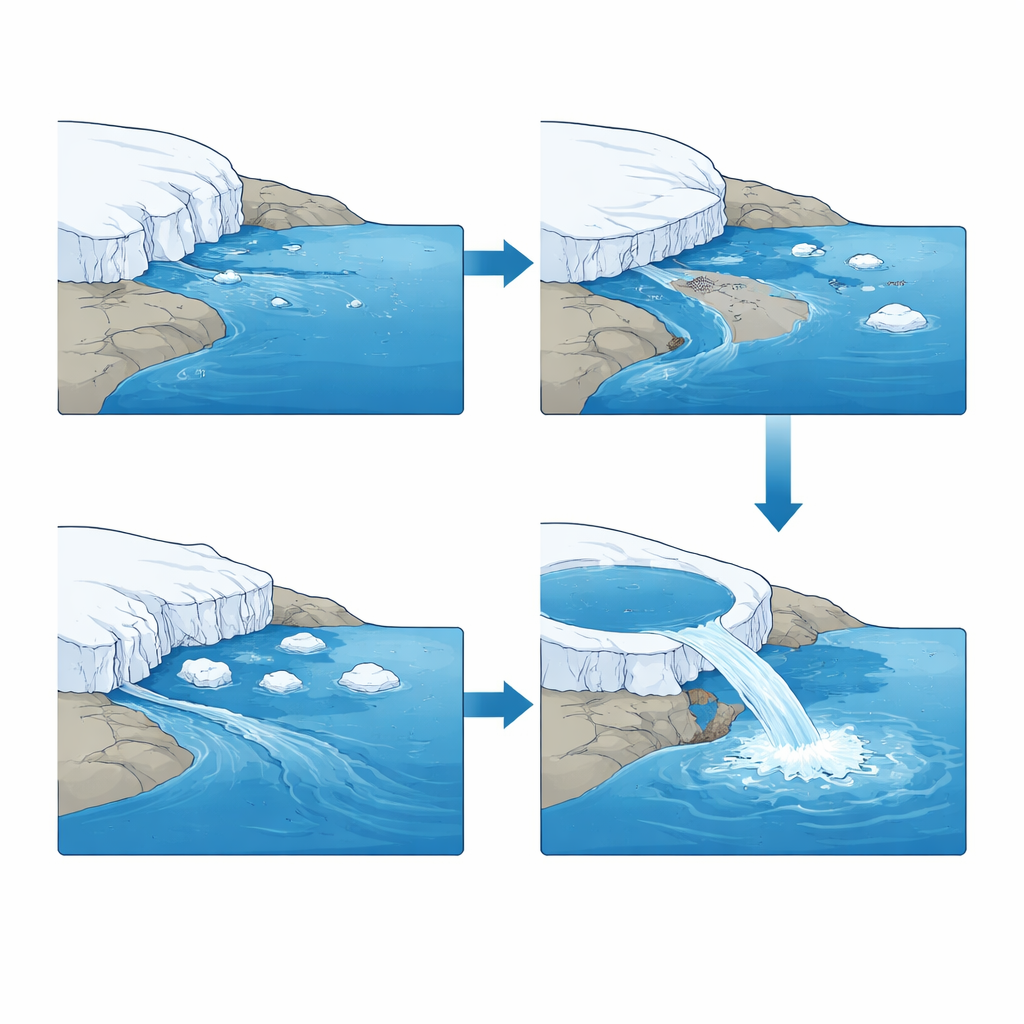
The earliest part of the record shows a relatively steady background of meltwater flowing from a shrinking ice sheet into Hudson Bay and on toward Hudson Strait. Icebergs were present, but their debris did not always reach the coring sites, suggesting that much of the fresh water and floating ice remained trapped in interior basins. Around 8.8 thousand years ago, however, the sediment suddenly turns markedly red and fine-grained. This “red bed” reflects intense erosion of iron-rich rocks in western Hudson Bay and a burst of fine sediment export, but with surprisingly few coarse ice-rafted grains. The authors interpret this as a brief episode when the ice front lifted off the seafloor to form a floating ice shelf. Seawater intruded beneath the ice, flushing out fine sediment while the buttressed shelf temporarily reduced iceberg production.
Ice-shelf breakup and a quiet pause
Following this short-lived marine intrusion, the record shifts to layers rich in coarse debris dropped by icebergs, but with relatively little associated carbonate material. This pattern points to a phase of intense calving and disintegration of the ice shelf, releasing debris already frozen into the ice rather than freshly eroded from the seafloor. In other words, the system moved from a hidden, submarine melting phase to a highly visible iceberg-release phase. After this upheaval, the cores show several centuries of calmer, low-energy sedimentation. Ice margins appear to have stabilized and retreated farther inland, and meltwater and sediment delivery became more uniform. During this time, the growing expanse of open water in Hudson Bay likely allowed a steady but more diffuse supply of fresh water to reach the Labrador Sea.
The multi-step flood that cooled the North Atlantic
The most dramatic chapter comes between about 8.2 and 8.0 thousand years ago. In this interval, the cores contain two pronounced pulses of carbonate-rich mud and iceberg debris. These dual peaks line up in time with evidence elsewhere for the final collapse of an ice saddle over Hudson Bay, the draining of the giant glacial Lake Agassiz–Ojibway, and the well-known “8.2 thousand–year event” — a roughly 160-year cold spell recorded in Greenland ice. The authors argue that this was not a single catastrophic outburst, but a multi-phase release of fresh water: first as the ice saddle failed and new pathways opened toward Hudson Bay, and then as the lake drained in stages and meltwater from different parts of the ice sheet was rerouted into the bay and out through Hudson Strait. This prolonged, structured forcing would have been particularly effective at weakening the Atlantic overturning circulation.
What this ancient event tells us today
In the final unit, after about 8.0 thousand years ago, the sediments become fine, uniform, and almost free of iceberg debris, signaling the disappearance of the Hudson Bay ice and the full establishment of normal marine conditions. Taken together, the six units show that early Holocene freshwater delivery from Hudson Bay was not a simple one-time flood but a sequence of linked stages: steady background melt, a brief episode of ice-shelf formation and breakup, and finally a multi-step lake drainage and rerouting of meltwater. For a lay reader, the key message is that the climate system responds not just to how much fresh water enters the ocean, but also to where it enters, how quickly, and for how long. As today’s ice sheets continue to shrink, this study’s detailed reconstruction of an ancient meltwater pulse offers a valuable analog for how future freshwater changes could ripple through ocean circulation and climate.
Citation: Duboc, Q., Brouard, E., St-Onge, G. et al. Multi-phase retreat of the Laurentide Ice Sheet and associated freshwater release from Hudson Bay during the last deglaciation. Sci Rep 16, 9931 (2026). https://doi.org/10.1038/s41598-026-39365-y
Keywords: Laurentide Ice Sheet, Hudson Bay, 8.2 ka event, meltwater pulses, Atlantic circulation