Clear Sky Science · en
Sharp Lyapunov inequalities and the emergence of chaos in discrete fractional systems
Why systems with memory can suddenly turn wild
Many processes around us—from materials that slowly relax to digital controllers in engineering—do not simply react to what is happening now. They “remember” their past. This paper shows how that kind of memory, described by a branch of math called fractional calculus, can quietly push a seemingly well-behaved system into unpredictable, chaos-like motion—and how carefully chosen control rules can pull it back from the brink. 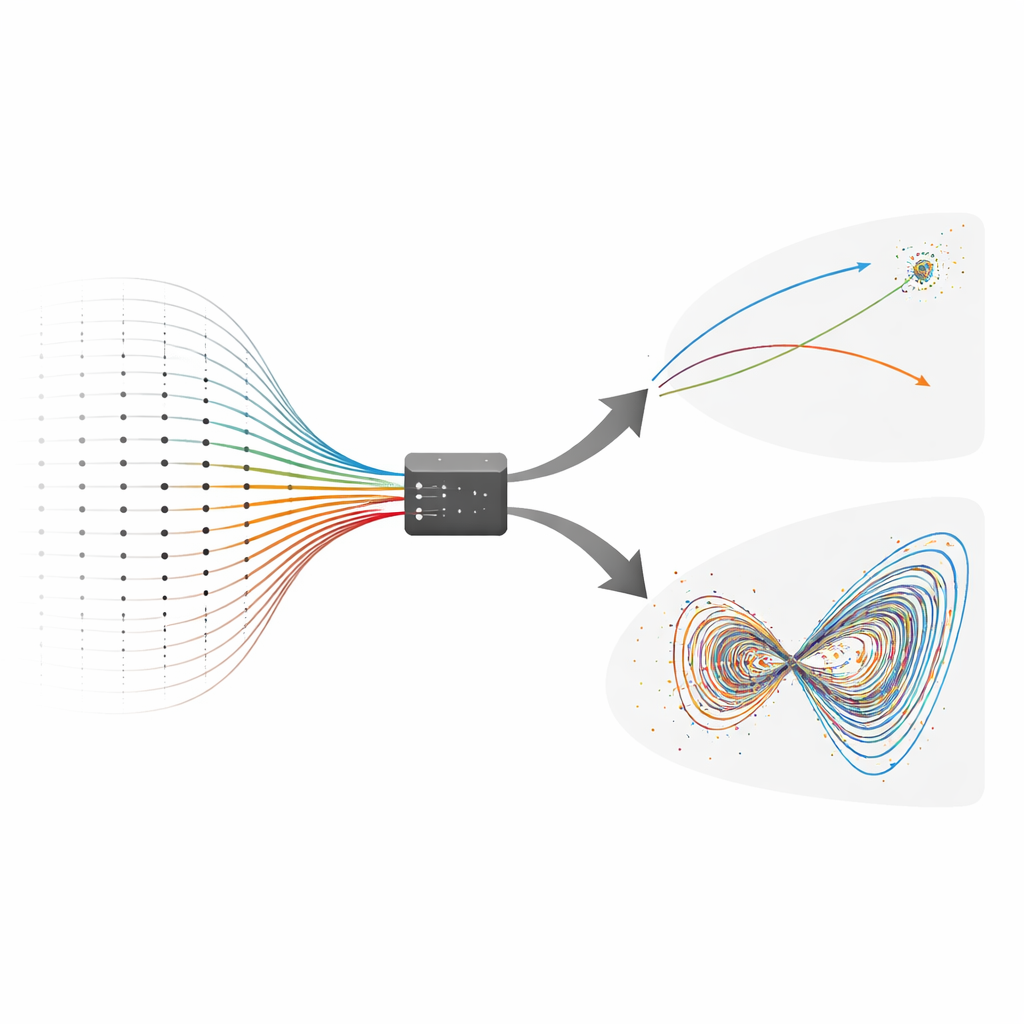
Adding memory to step-by-step models
Most textbooks describe change using smooth curves and ordinary derivatives. In contrast, the authors study systems that evolve in discrete steps—like clock ticks in a computer—but where each new value depends on many earlier values, not just the last one. This long-range influence is handled by “fractional” difference operators, which blend the present with a weighted history. The paper focuses on a particular setup with boundary conditions that tie together the behavior at the beginning and end of the time window, a situation common in engineering and physics models.
A sharp yardstick for stability
To understand when such memory-rich systems remain tame, the authors build on a tool called a Green’s function. It acts like a fingerprint of how a single impulse echoes through the system over time. By analyzing this fingerprint in detail, they identify exactly how large its peak response can be and how it changes with key parameters. From this, they derive a precise version of a classic stability test known as a Lyapunov inequality. Instead of a vague guideline, they obtain an explicit numerical lower bound involving the strength of internal forces in the system and the maximum size of the Green’s function. If the total “potential” in the system falls below this bound, only the trivial, steady behavior is possible; if it exceeds it, more complicated behaviors must exist.
From loss of balance to chaos
The story becomes most striking when the new inequality is broken. Mathematically, that violation means the simple, zero solution loses its uniqueness and stability—opening the door to other, more restless motions. The authors then explore a class of discrete fractional systems driven by a piecewise linear rule, a standard playground for chaos. They prove that, under reasonable conditions on the slopes and jumps of this rule, the system shows sensitive dependence on initial conditions: start two trajectories almost together, and they soon fly apart. Computer experiments confirm this picture, revealing rapidly diverging paths and strange attractor shapes when the fractional order is small and the instability threshold has been crossed. In this way, the Lyapunov inequality becomes a crisp marker for the onset of complex, chaos-like dynamics. 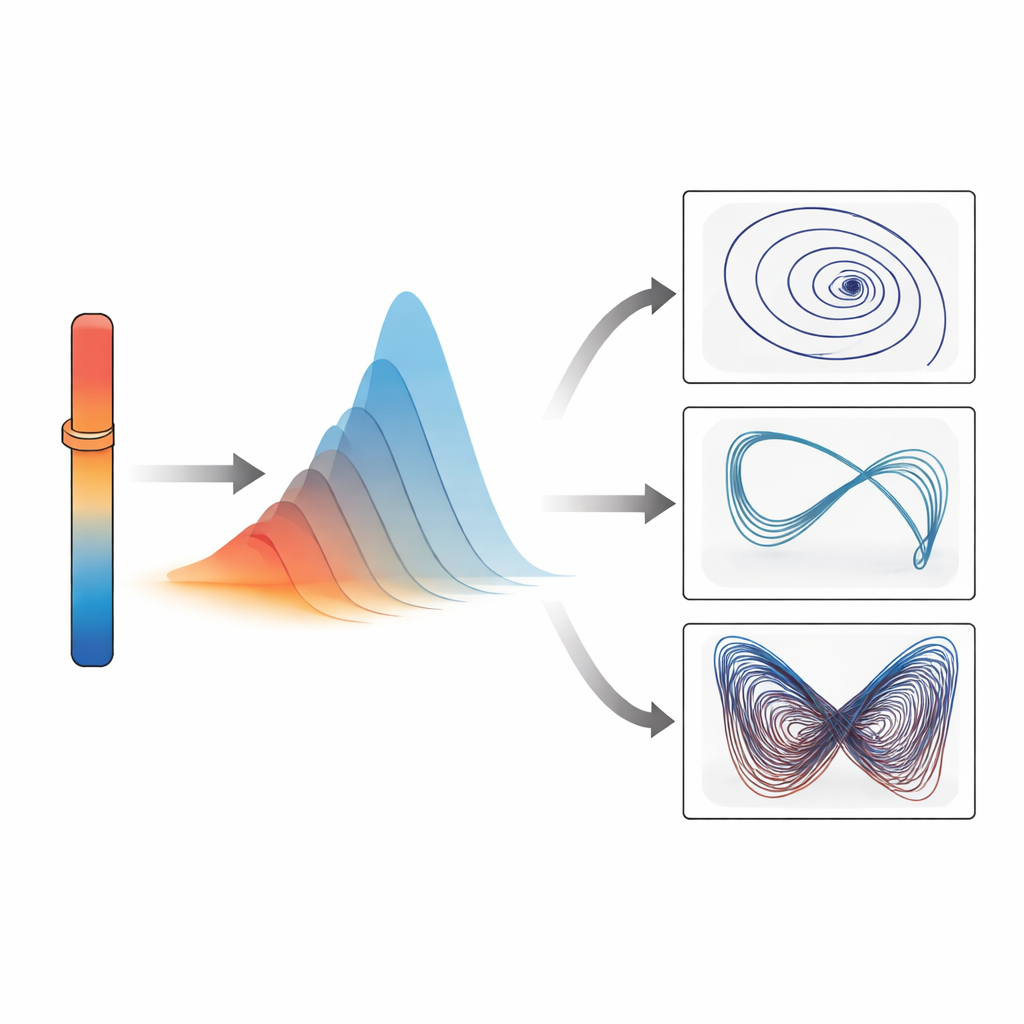
Taming unpredictable systems with feedback
Chaos is not the end of the story. The authors turn their theoretical yardstick into a design tool for control. They consider systems whose internal parameters are uncertain, as is typical in real engineering devices. Using their Green’s-function bounds, they derive conditions under which a simple linear state-feedback law—feeding a scaled version of the system’s current state back into its input—can guarantee that all trajectories shrink over time, despite memory effects and parameter variations. Numerical examples show how an initially unstable, slowly decaying fractional system can be steered so that its key variables converge smoothly toward zero, even in the face of uncertainty.
What this means for real-world models
For non-specialists, the main message is that “memory” in discrete-time models can both enrich and endanger system behavior. The new inequality offered here works like a warning gauge: it tells us when a design is safely in the stable regime and when it is flirting with instability and possible chaos. At the same time, the work demonstrates that standard control ideas, carefully adapted to account for history-dependent effects, can still provide robust, reliable performance. This blend of sharp theory and practical control design offers a path toward safer and more accurate models of complex phenomena in materials science, signal processing, and other fields where forgetting the past is not an option.
Citation: Arab, M., Mohammed, P.O., Baleanu, D. et al. Sharp Lyapunov inequalities and the emergence of chaos in discrete fractional systems. Sci Rep 16, 8198 (2026). https://doi.org/10.1038/s41598-026-39364-z
Keywords: fractional difference systems, Lyapunov inequality, chaos, robust control, Green’s function