Clear Sky Science · en
DBH-Chain: a decentralized blockchain-enabled healthcare framework for end-to-end delay optimization
Why faster, safer digital care matters
Anyone who has waited for test results or worried about who can see their medical records has brushed up against a basic problem of modern healthcare: our digital systems are powerful but often slow, fragile, and hard to secure. This study introduces “DBH-Chain,” a new way to move and protect health data using ideas from blockchain and smart scheduling, with the goal of giving doctors the information they need in real time while keeping patients’ data safe.
The trouble with today’s connected hospitals
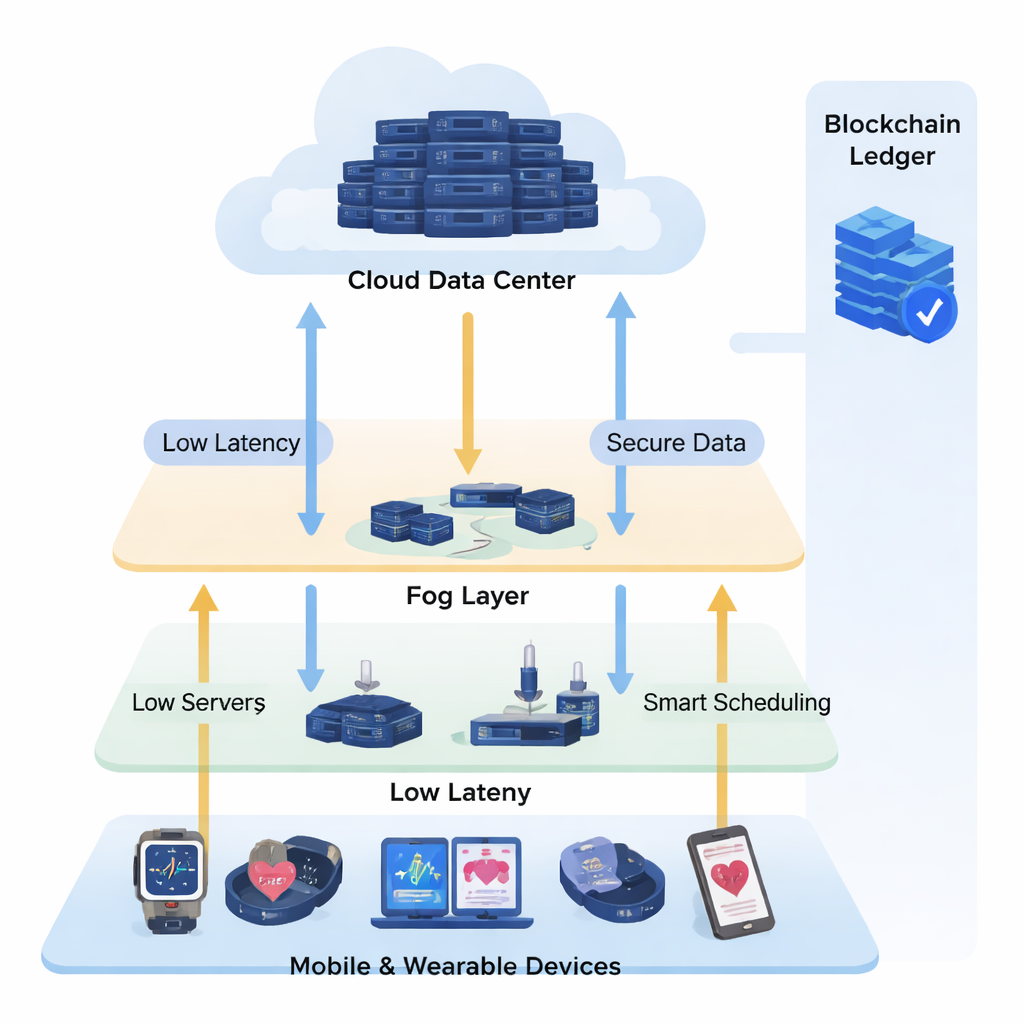
Modern hospitals and clinics increasingly depend on a web of phones, wearables, bedside sensors, local gateways, and distant cloud servers. These tools support telemedicine, home monitoring, and emergency care, but most are still tied to old, central servers. That centralization creates single points of failure, long waits for data to cross the network, and attractive targets for hackers. Different record systems often cannot talk to one another, so a patient’s history may be scattered across institutions. Strict privacy rules, while essential, add further friction when systems are not designed for secure sharing from the start.
Delays that add up across the network
The authors focus on a specific kind of slowdown they call “hybrid delay.” Rather than coming from a single weak link, this delay builds up as data hops from a patient’s device to a nearby gateway, then to fog servers and finally up to the cloud. Each step adds waiting time for communication and processing. In time‑critical cases—such as remote monitoring of heart rhythms or support for urgent diagnoses—even modest delays can reduce the usefulness of data. Existing blockchain-based medical systems, while strong on transparency and tamper-resistance, often make this worse because their security mechanisms demand heavy computation and long confirmation times.
A new digital backbone for health data
DBH-Chain reimagines this digital plumbing as a lightweight, decentralized framework. It connects phones, wireless sensors, fog nodes, and cloud servers through a carefully organized chain of queues and schedules. At its core lies a distributed ledger similar to a private blockchain, which records medical tasks—such as storing a test result or updating a record—in a way that can be checked but not secretly altered. To keep things fast, the system relies on a custom validation method called “Proof of Validation” instead of energy-hungry methods like those used in cryptocurrencies. This approach aims to authenticate each action with far less computation, making it suitable for small devices and busy gateways.
Smart timing for medical tasks
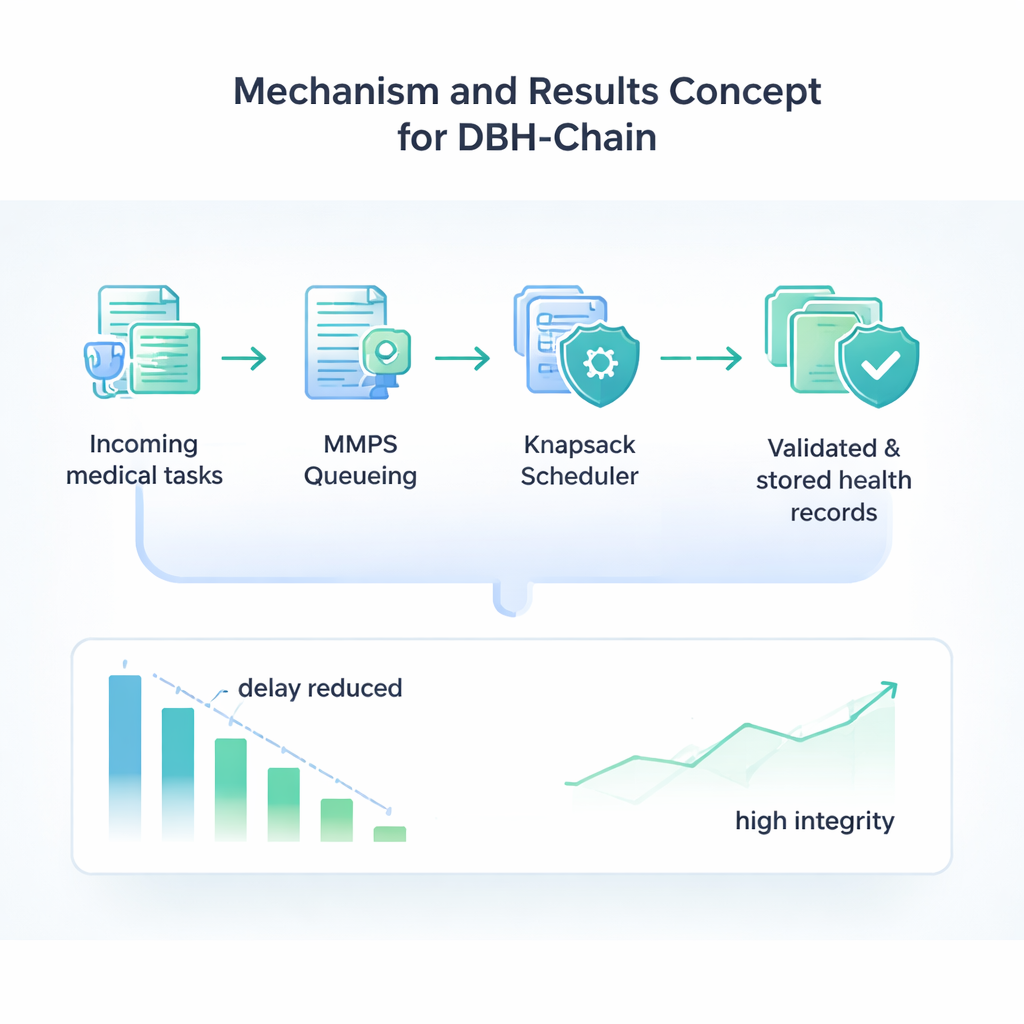
To manage the flood of incoming health data, the framework models traffic using a statistical tool that captures bursts and lulls in activity. On top of this, it uses a scheduling method inspired by the classic “knapsack” puzzle: given limited computing resources and many tasks of different urgency and size, which ones should be handled first? By prioritizing life‑critical or time‑sensitive tasks and assigning them to the most appropriate node—whether a nearby fog server or the cloud—the system seeks to keep waiting times within strict bounds while still processing less urgent work in the background. Every scheduled and completed task is then checked and recorded on the ledger using Proof of Validation.
What the experiments suggest
The researchers tested DBH-Chain in detailed simulations that mimic realistic hospital and Internet-of-Medical-Things workloads. Compared with several existing healthcare architectures, their design improved how efficiently tasks were scheduled, cutting overall end‑to‑end delays by roughly half in many cases. At the same time, the ledger kept data correctness above 98 percent in their integrity checks, suggesting that the faster performance did not come at the cost of trust. The system also handled networks made up of many kinds of devices, from phones to cloud servers, better than more traditional blockchain health platforms.
What this means for future care
In plain terms, DBH-Chain is a proposal for a faster and safer “circulatory system” for digital health. By combining a leaner form of blockchain with smart ways to time and route medical tasks, it shows that it may be possible to get near real‑time performance without weakening privacy or security. While the work is still at a simulation stage and raises new questions about scaling up and adding advanced privacy tools, it outlines a practical foundation on which future smart hospitals and home‑care systems could build.
Citation: Ali, M., Kumar, R., Tunio, M.Z. et al. DBH-Chain: a decentralized blockchain-enabled healthcare framework for end-to-end delay optimization. Sci Rep 16, 7496 (2026). https://doi.org/10.1038/s41598-026-39363-0
Keywords: blockchain healthcare, medical data security, low latency monitoring, smart hospitals, Internet of Medical Things