Clear Sky Science · en
Enhanced interhemispheric functional connectivity in elderly anxiety patients with long-term benzodiazepine use: an fNIRS study
Why this matters for everyday medicine
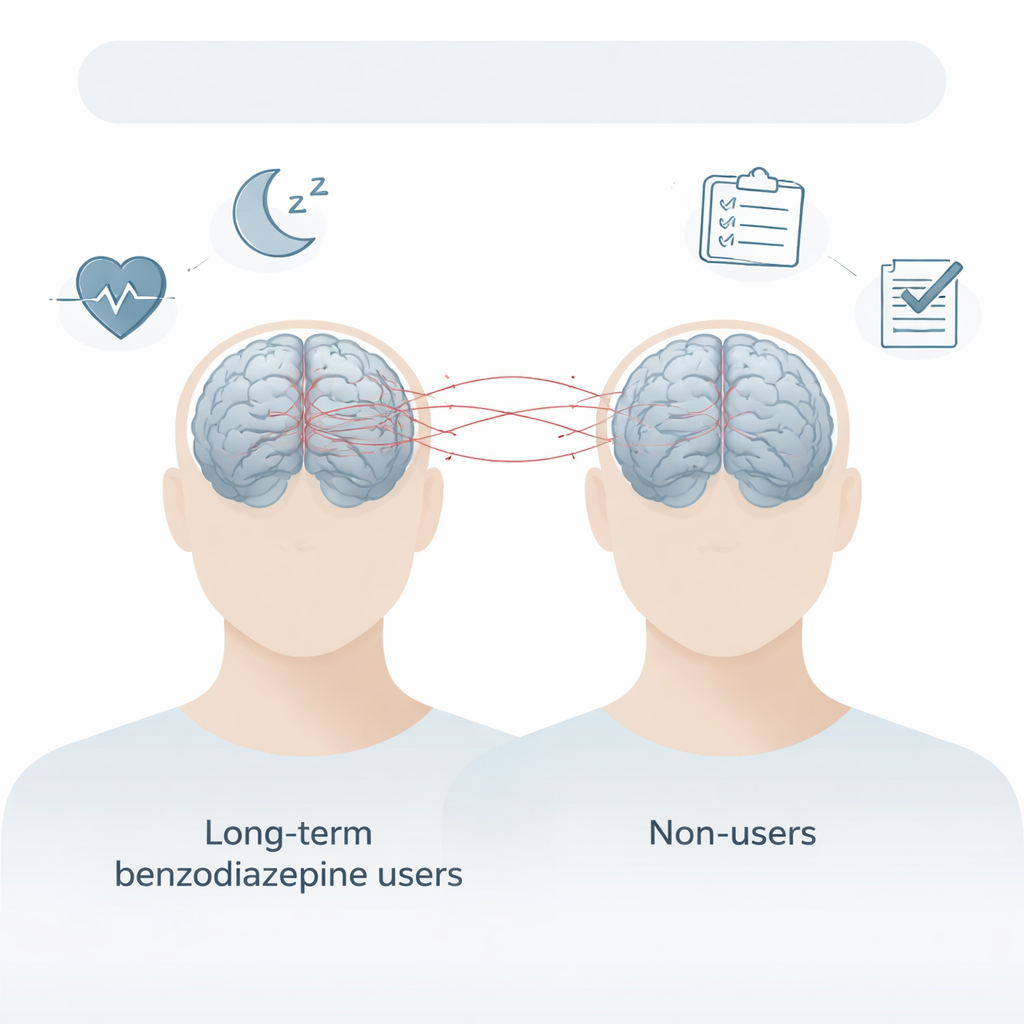
Benzodiazepines—common drugs prescribed for anxiety and insomnia—have long been caught in a tug-of-war between benefit and risk, especially in older adults. Many people rely on these medicines for years, yet doctors worry they might quietly erode memory and thinking. This study explores what actually happens in the brain of older adults with anxiety who take benzodiazepines long term, using a light-based brain scan to see how different regions "talk" to each other during a word-finding task.
Who was studied and how the brain was tested
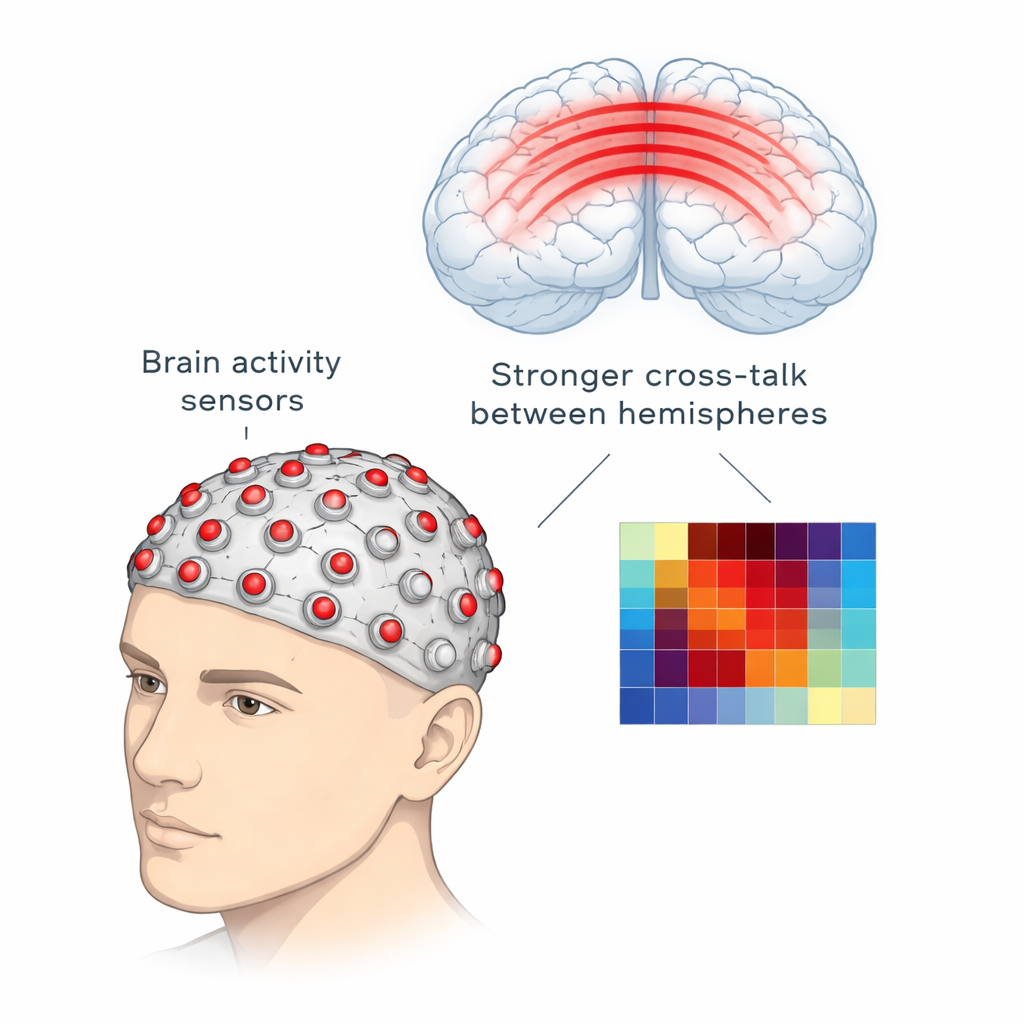
The researchers enrolled 50 adults aged 50 to 75 with diagnosed anxiety disorders. About two-thirds had been taking benzodiazepines continuously for at least three months, while the rest had never used them. The two groups were carefully matched for age, education, mood, sleep problems and other medications, so the main difference was benzodiazepine use. Participants completed a series of standard paper-and-pencil tests of memory, attention and thinking, and then performed a verbal fluency task in which they rapidly generated words starting with simple Chinese syllables. During this task, the team monitored blood flow changes in the front part of the brain using functional near-infrared spectroscopy, or fNIRS—a portable technique that shines harmless light through the skull to track brain activity.
What stayed the same: thinking skills and brain activation
On the surface, the two groups looked remarkably similar. Long-term benzodiazepine users did not score worse on global memory and thinking tests, nor did they perform differently on the word task. When the researchers examined how strongly specific regions in the prefrontal cortex lit up during the task, they again saw no reliable differences. Both groups showed comparable changes in oxygenated blood in key areas involved in planning, focus and language, such as the dorsolateral prefrontal cortex and Broca’s area. Even when the scientists took into account how much medication each person had taken over time, there was no clear link between total dose and how strongly these regions activated.
What changed behind the scenes: brain communication
The more striking finding emerged when the team examined communication patterns among brain regions rather than how strongly any single spot activated. By calculating how closely the fNIRS signals in different channels rose and fell together, they mapped a network of functional connections. Here, older adults who used benzodiazepines long term showed many more significant links between the left and right sides of the brain than non-users. This stronger “cross-talk” was especially centered on the dorsolateral prefrontal cortex, a hub that coordinates high-level thinking and emotional control and connects to motor, language and temporal areas on both sides of the brain.
Network strength without obvious weakness
Despite these extra bridges between hemispheres, the overall architecture of the brain networks looked stable. Measures that describe how efficiently information flows across the whole brain, and how central each node is within the network, did not differ significantly between groups. In other words, while the wiring diagram showed more cross-hemisphere links in benzodiazepine users, the brain’s global communication capacity and robustness appeared preserved. The authors suggest that these enhanced connections may represent a compensatory adjustment—an internal rebalancing act that helps maintain normal thinking performance in the face of long-term exposure to drugs that dampen neural activity.
What this means for patients and clinicians
To a layperson, the takeaway is that in this carefully selected group of older adults with anxiety, long-term benzodiazepine treatment was not associated with obvious thinking problems or reduced frontal brain activation during a demanding word task. Instead, the main change was more intense cooperation between the two halves of the brain, possibly an adaptive response that helps keep the system stable. This does not settle the broader debate about benzodiazepines and dementia—larger, long-term studies are still needed—but it suggests that the brain may partly reorganize its internal communication to preserve function in people who continue these medications under medical supervision.
Citation: Chang, Y., Liu, M., Liu, Y. et al. Enhanced interhemispheric functional connectivity in elderly anxiety patients with long-term benzodiazepine use: an fNIRS study. Sci Rep 16, 7804 (2026). https://doi.org/10.1038/s41598-026-39359-w
Keywords: benzodiazepines, anxiety, brain connectivity, older adults, functional near-infrared spectroscopy