Clear Sky Science · en
Excitatory GABA receptors shape locomotor circuit organization in C. elegans
How a tiny worm rewrites a textbook rule
In biology classes, a brain chemical called GABA is usually introduced as a brake: it quiets neurons and helps keep activity in check. This study of the tiny roundworm Caenorhabditis elegans turns that rule on its head. The authors show that in this simple animal, GABA can also act like an accelerator for movement, pushing certain motor neurons to drive precise backward crawling. By tracing which cells make which receptors and how those cells are wired together, they reveal an unexpectedly clever way a small nervous system squeezes more flexibility out of a limited set of parts.
A rich cast of channels in a simple nervous system
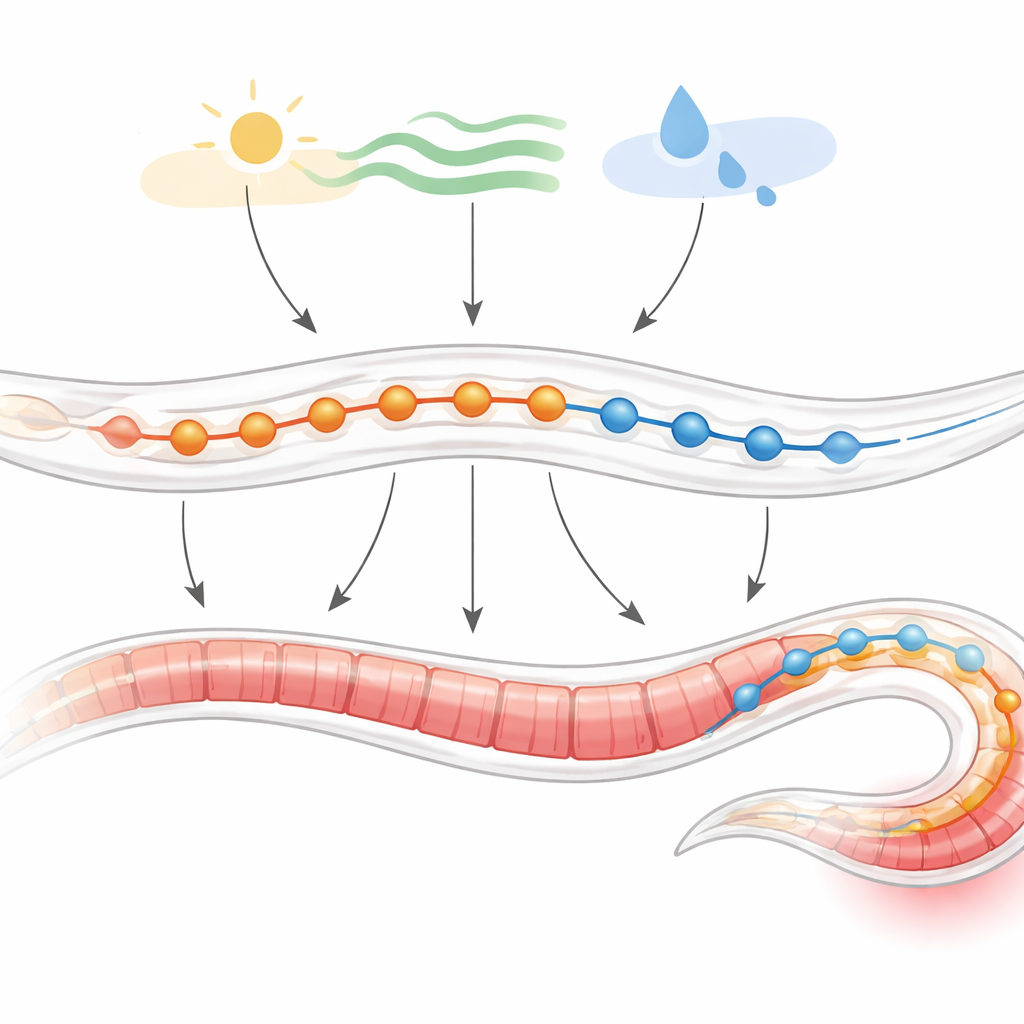
C. elegans has only 302 neurons, yet can perform a surprising variety of behaviors, from exploring and escaping to coordinating feeding and egg-laying. A major part of this versatility comes from ligand-gated ion channels—tiny protein pores that open when they bind chemicals such as GABA or acetylcholine. Compared with humans, the worm has an outsized collection of these channels: 102 lgc genes in total. Many are unusual, responding to unexpected chemicals or allowing positive rather than negative charges to flow. Among them are rare GABA receptors that excite, rather than silence, the cells they sit on. Until now, it was unclear where these special receptors are deployed within the motor circuits that control the worm’s body bends.
Finding the hotspots for movement control
The researchers mined large single-cell RNA sequencing atlases that catalog which genes are active in individual neurons across the worm’s nervous system. They discovered that the lgc family as a whole is especially active in motor neurons, and most strongly in those that generate rhythmic body undulations for crawling. Within these locomotion-related motor neurons, genes encoding GABA receptors stood out. A closer look using a high-resolution map of motor neuron subtypes showed that GABA receptors are found across three key groups: A-type neurons that drive backward movement, B-type neurons that drive forward movement, and D-type neurons that provide GABA signals. More than half of the cells in these classes carried at least one GABA receptor gene, indicating that GABA has a broad and nuanced role in shaping movement.
Excitatory GABA concentrated in the tail
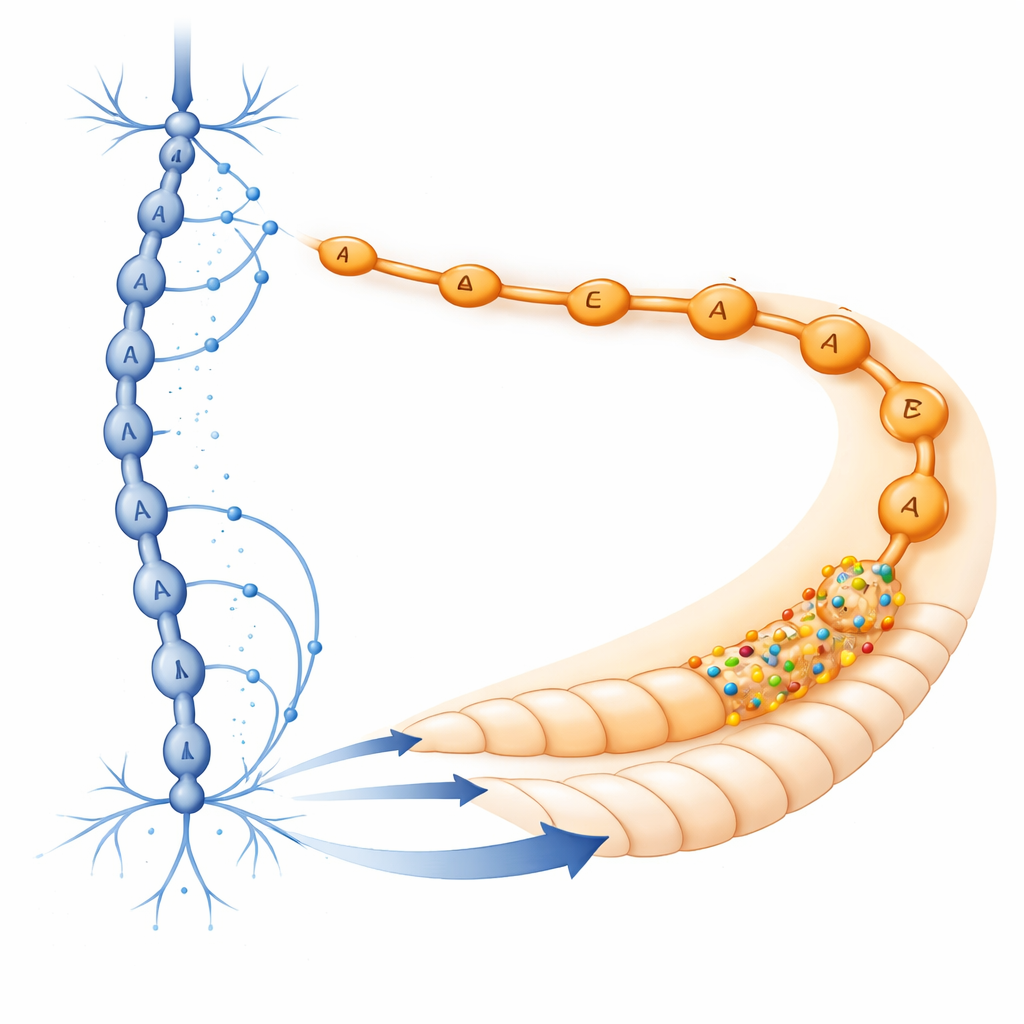
Not all GABA receptors behave the same way. Most in the worm are traditional inhibitory receptors, but two, called EXP-1 and LGC-35, allow positive charge to flow and thereby excite neurons. By classifying each motor neuron by which GABA receptor genes it expressed, the team found that many A- and B-type neurons mix inhibitory and excitatory receptors, potentially allowing GABA to both dampen and boost activity depending on context. A striking pattern emerged within A-type neurons, which power backward crawling: the further toward the tail a neuron sits, the more likely it is to carry excitatory GABA receptors. In particular, LGC-35 and, in the very last cells, EXP-1, were enriched in these posterior neurons, while often avoiding the same cells as each other. This creates a spatial gradient of excitability along the body, with the tail wired to be especially responsive to GABA.
Rewiring the classic picture of GABA
To understand how this molecular pattern ties into the actual wiring diagram of the worm, the authors turned to the full electron-microscope-based connectome. They focused on D-type neurons, the main GABA-releasing cells in the locomotor system. These neurons form orderly chains of synapses onto A- and B-type motor neurons along the body, with dorsal D-type cells connecting mainly to A-type neurons. When this anatomical map is overlaid with the receptor expression data, a clear picture appears: D-type neurons send GABA to A-type neurons in the tail region that are packed with excitatory receptors. Earlier work suggested that LGC-35 can also pick up GABA that spills out from synapses, further broadening its reach. Together, these findings imply that what was long thought to be a purely inhibitory GABA system actually carries a built-in excitatory component that is deployed in specific locations.
What this means for how movement is steered
For a non-specialist, the key message is that direction of movement in this tiny worm is not controlled by simple on–off switches, but by a carefully arranged pattern of chemical "dials" along the body. The same signaling molecule, GABA, can slow some motor neurons while speeding others, depending on which receptors each cell displays and where it sits along the head-to-tail axis. By concentrating excitatory GABA receptors in the tail’s backward-driving neurons, the worm seems to give extra punch and fine control to tail-first movements, such as rapid retreats. This work suggests a broader principle: even very small nervous systems can achieve sophisticated, directionally precise behavior by reusing common chemicals in different ways, simply by varying which receptors are placed where.
Citation: Wang, X., Mizuguchi, K. & Hashimoto, K. Excitatory GABA receptors shape locomotor circuit organization in C. elegans. Sci Rep 16, 9407 (2026). https://doi.org/10.1038/s41598-026-39358-x
Keywords: C. elegans locomotion, GABA receptors, motor circuits, single-cell transcriptomics, neural connectome