Clear Sky Science · en
A novel human acute myeloid leukemia cell line SDEY-AML1 with KMT2A: MLLT3, IKZF1: EVX1 fusions exhibits high tumorigenicity in NSG mice
Why this research matters
Acute myeloid leukemia (AML) in children and adults can still be deadly, especially when the cancer cells carry certain high‑risk genetic changes and resist standard drugs. This study introduces a new laboratory leukemia cell line, called SDEY‑AML1, grown from the bone marrow of a teenage boy with particularly aggressive AML. Because these cells keep the key features of his disease, they offer scientists a powerful new model to understand why some leukemias are so hard to treat and to test new, more precise therapies.
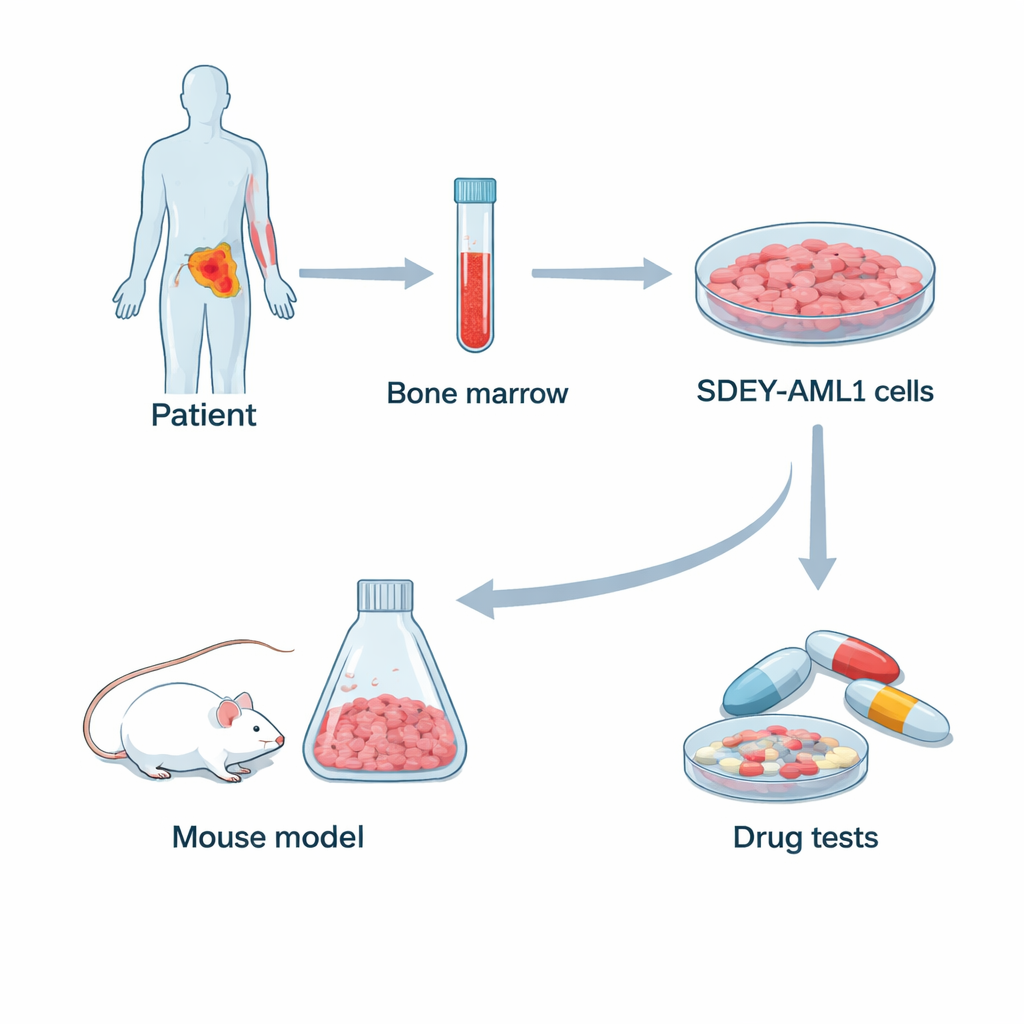
From patient to lab model
The researchers cared for a 14‑year‑old boy whose leukemia involved extremely high white blood cell counts, swollen lymph nodes and spleen, and repeated fevers. Despite several rounds of intensive chemotherapy and newer drug combinations, his disease never went into complete remission and he died from complications of the cancer. During his treatment, doctors collected bone marrow and isolated leukemia cells. In the lab, they carefully nurtured these cells in nutrient‑rich liquid and gradually weaned them off added growth factors. After about three months, the cells began to grow steadily on their own and could be kept going for more than a year, proving that a stable, self‑renewing cell line had formed.
How the new cells behave
Under the microscope, SDEY‑AML1 cells show the hallmarks of monocytic leukemia: irregular but recognizable cell shapes, folded nuclei with visible nucleoli (the "cores within the core" of the cell), and a gray‑blue outer layer dotted with tiny granules. Chemical stains confirmed that the cells fit this leukemia subtype and lacked signals typical of other blood cell types. Using flow cytometry—a technique that tags cell surface features with glowing antibodies—the team found that SDEY‑AML1 cells carry the same myeloid markers as the boy’s original leukemia cells, indicating that the lab line faithfully mirrors the disease in his body.
Hidden genetic troublemakers
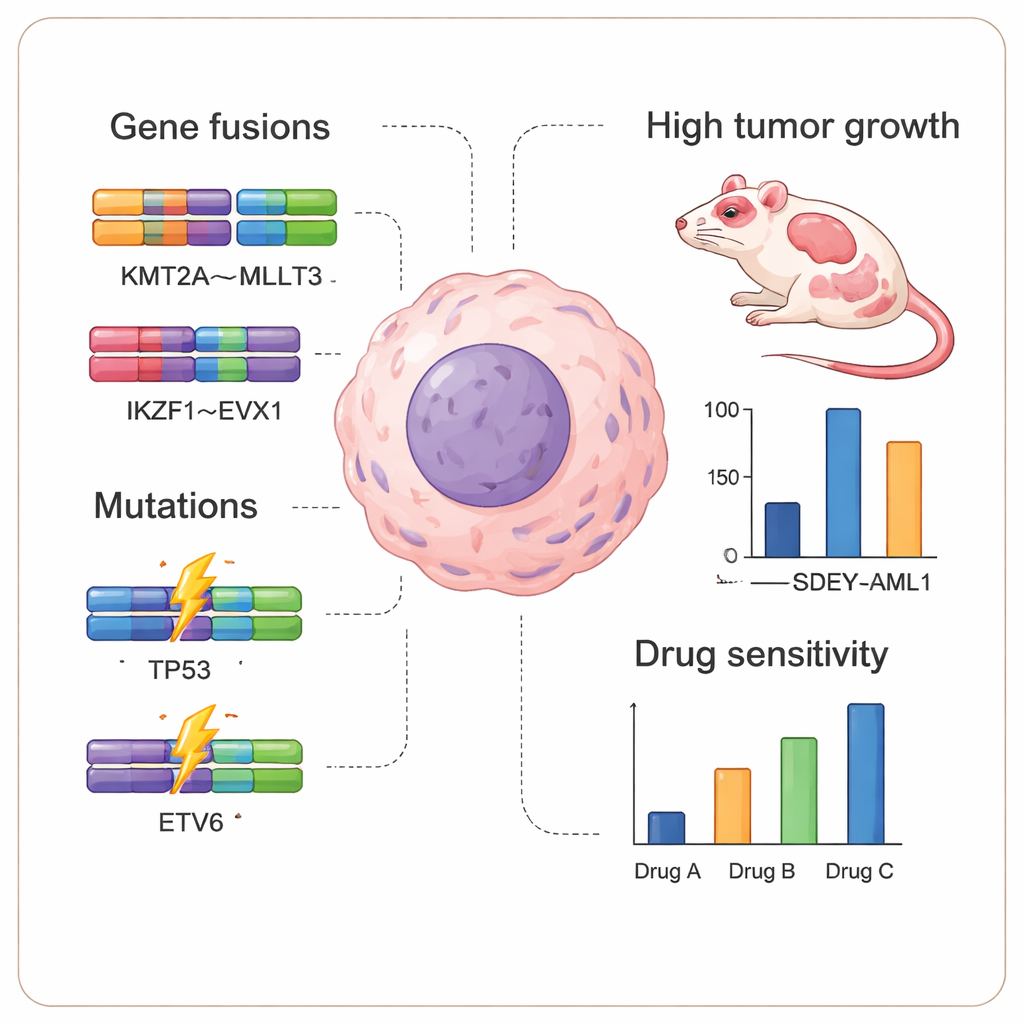
Modern sequencing tools revealed why this leukemia was so aggressive. The SDEY‑AML1 cells contain two major gene fusions, where parts of different genes have been abnormally stitched together: KMT2A::MLLT3 and a newly described fusion IKZF1::EVX1. Both involve genes known to control how blood cells develop and are frequently linked to poor‑risk blood cancers. On top of these, the cells also carry two damaging mutations in TP53—the famous "guardian of the genome" tumor suppressor—and a truncating mutation in ETV6, another gene important in blood formation. Together, these complex changes likely drove rapid disease progression and resistance to therapy, and they now make SDEY‑AML1 a rare tool for studying how such combinations of defects interact.
Testing growth, spread, and drug response
The team showed that SDEY‑AML1 cells can form numerous colonies in soft agar, a classic test of cancerous growth. To see how they behave in a living body, the scientists engineered the cells to produce luciferase, a light‑emitting protein, and injected them into highly immune‑deficient NSG mice. Within 40–50 days, most mice developed swollen abdomens filled with blood‑tinged fluid and clear signs of tumor invasion, and leukemia cells were detected in their bone marrow. This confirmed that SDEY‑AML1 is highly tumor‑forming in vivo, making it suitable for preclinical testing. The researchers also exposed the cells to a panel of chemotherapy and targeted agents and found that several drugs, including histone‑modifying agents and kinase inhibitors, reduced cell viability, offering early clues about combinations that might help patients with similar genetic profiles.
What this means for future treatments
To a non‑specialist, SDEY‑AML1 can be thought of as a detailed "stand‑in" for a particularly dangerous type of leukemia—one driven by multiple broken instructions in the cell’s DNA. Because the line grows well in dishes and rapidly causes disease in mice, it offers a repeatable way to probe why these mutations make standard treatments fail and to rapidly screen new drugs or combinations before they reach patients. In the long run, insights gained from this cell line could guide more personalized treatment strategies for people whose leukemias carry similar genetic signatures, potentially turning today’s hardest‑to‑treat cases into more manageable diseases.
Citation: Yang, C., Zhang, W., Wu, Y. et al. A novel human acute myeloid leukemia cell line SDEY-AML1 with KMT2A: MLLT3, IKZF1: EVX1 fusions exhibits high tumorigenicity in NSG mice. Sci Rep 16, 7792 (2026). https://doi.org/10.1038/s41598-026-39353-2
Keywords: acute myeloid leukemia, leukemia cell line, gene fusion, drug resistance, precision oncology