Clear Sky Science · en
Anxiety severity moderates the relation between pineal parenchymal volume and objective sleep problems in peri-adolescent youth
Why this matters for worried kids and tired parents
Many children entering their teen years lie awake at night with racing thoughts and heavy worries. Parents see the toll this takes on mood, school, and family life, but the brain mechanisms linking anxiety and poor sleep are still being uncovered. This study zooms in on a tiny pea‑sized structure deep in the brain called the pineal gland, which helps set the body clock, to ask how its size relates to anxiety levels and objective sleep patterns in young people on the cusp of adolescence.
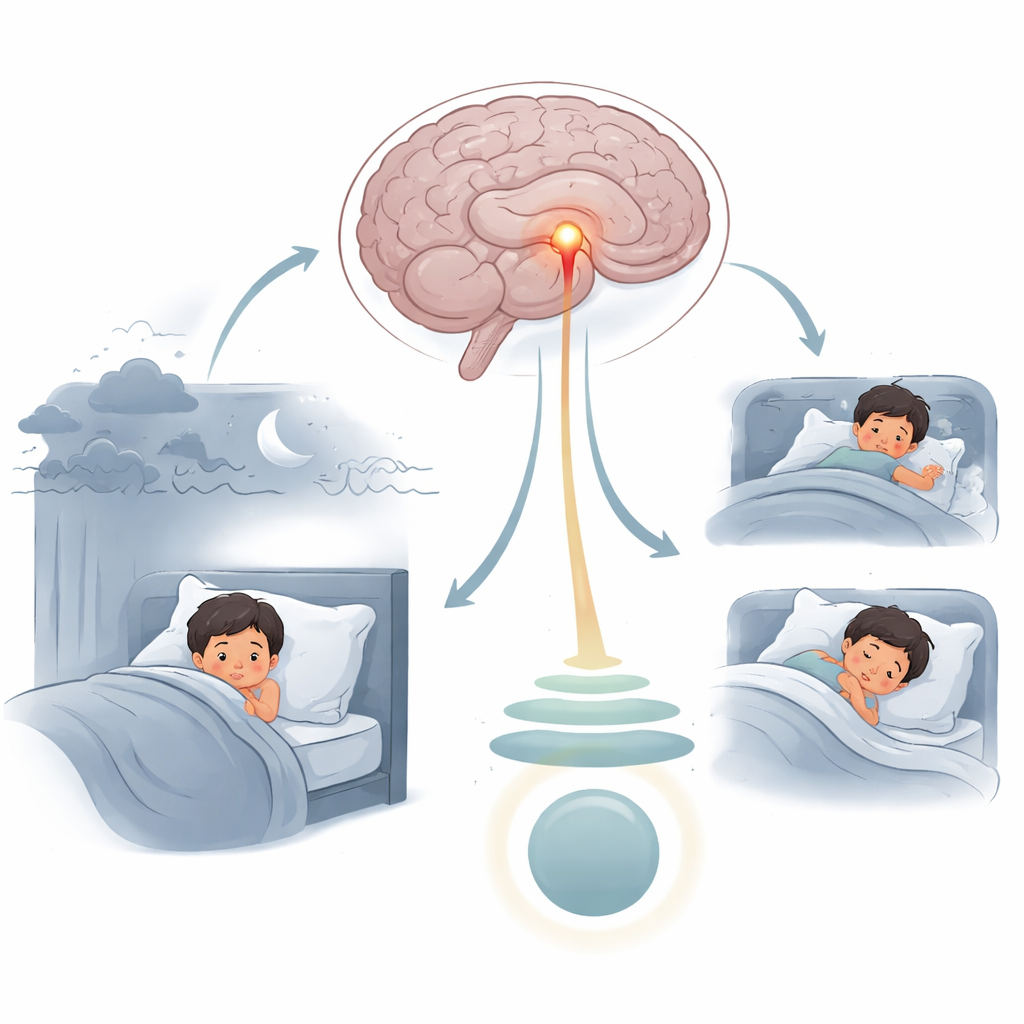
A tiny gland with a big job
The pineal gland makes melatonin, a hormone that signals when it is time to sleep and helps coordinate daily rhythms in the body. Melatonin levels change markedly around puberty, just as many children begin to experience more intense worries and shifting bedtimes. Previous research in adults has found that people with certain mental health conditions and sleep difficulties often have changes in pineal size. The authors wondered whether the shape and size of the working tissue inside the gland—the part that actually produces melatonin—might be linked to both anxiety and sleep in younger teens.
How the study was done
The researchers recruited 200 children aged 10 to 13 from clinics and the community, intentionally including youth with a wide range of anxiety—from very low to clinically high. A subset of 118 children completed both a brain scan and an overnight stay in a sleep lab. Using high‑resolution MRI images, scientists manually traced each child’s pineal gland and separated it into two parts: the active tissue (parenchyma) and any fluid‑filled pockets (cysts). They then recorded brain‑wave activity and other signals during sleep to measure how long it took children to fall asleep, how efficiently they slept, and how much time they spent in deeper, non‑dreaming sleep.
When worry changes what pineal size means
Contrary to expectations, the overall size of the pineal gland was not directly tied to how anxious a child was. But when the researchers looked at sleep, a more complex picture emerged. The key was an interaction between anxiety level and the volume of active pineal tissue. Among children with high anxiety, having a larger volume of this tissue went hand in hand with taking longer to fall asleep, sleeping less efficiently, and spending less time in deep, non‑rapid eye movement sleep. In contrast, among children with low anxiety, a larger active pineal volume was associated with shorter time to fall asleep, better sleep efficiency, and longer deep sleep—patterns more in line with what one might expect from a robust melatonin system.
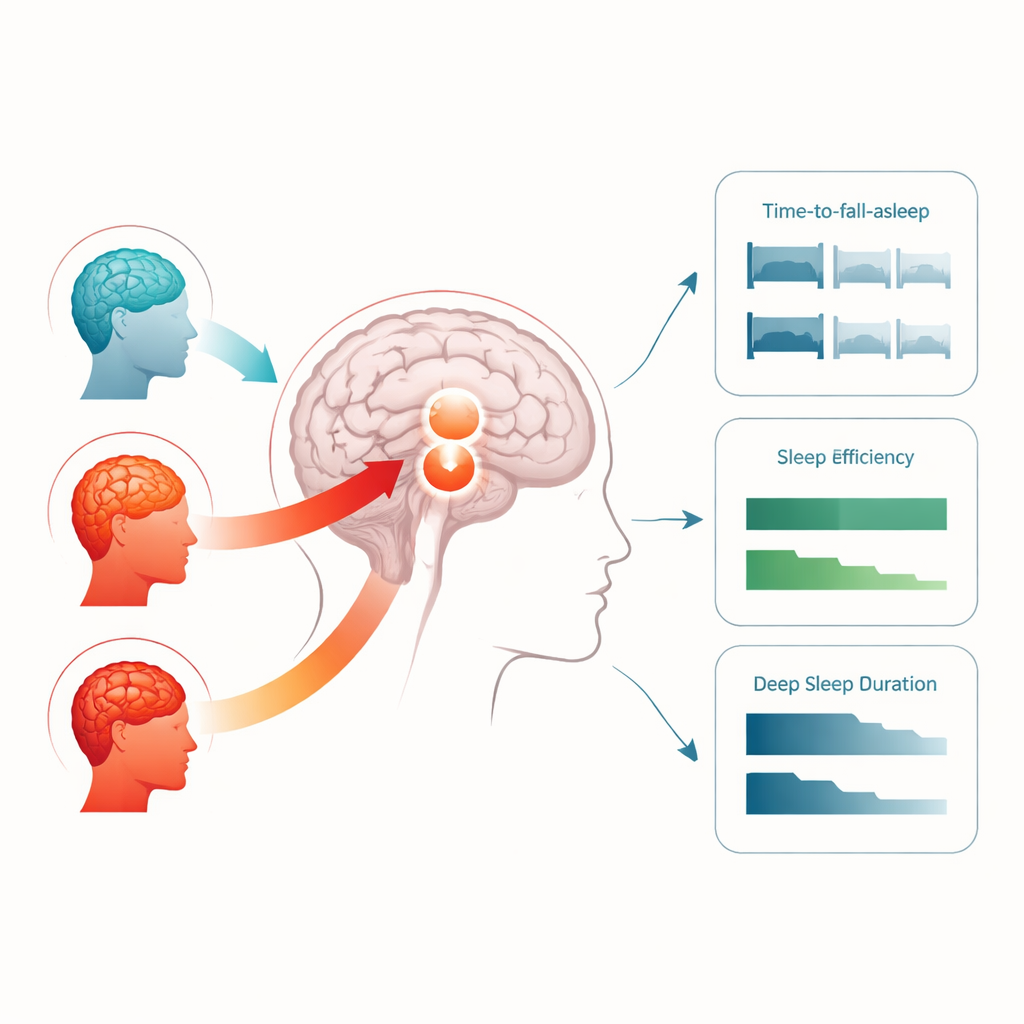
Possible explanations inside the brain
Why would more active tissue in the same gland point to better sleep in some children and worse sleep in others? The authors suggest that in highly anxious youth, the pineal gland may be trying—and struggling—to compensate for deeper chemical imbalances linked to stress and serotonin, a signaling molecule that serves as a building block for melatonin. Chronic stress can reshape the pineal gland, and disruptions in serotonin are common in anxiety disorders. One possibility is that, in anxious children, the gland grows or becomes denser in response to these pressures, yet still does not produce enough melatonin at the right times to support healthy sleep cycles. Because melatonin itself was not measured, this idea remains a hypothesis for future work.
What this means for anxious sleepers
For families dealing with both anxiety and sleep problems, these findings offer a biological clue: in peri‑adolescent youth, anxiety seems to change how pineal structure relates to sleep, turning what is usually a helpful feature into a marker of disrupted rest. The study does not suggest simple screening of pineal size or immediate new treatments. Instead, it highlights the pineal gland and melatonin system as important pieces of the puzzle linking worry and restless nights in young teens. Future studies that track melatonin levels directly and test how adjusting related brain chemicals affects sleep could open paths to more targeted interventions that calm both mind and body at bedtime.
Citation: Fuertes, F., Lalama, M., Dick, A.S. et al. Anxiety severity moderates the relation between pineal parenchymal volume and objective sleep problems in peri-adolescent youth. Sci Rep 16, 9036 (2026). https://doi.org/10.1038/s41598-026-39349-y
Keywords: anxiety, adolescent sleep, pineal gland, melatonin, brain development