Clear Sky Science · en
Experimental study on dynamic mechanical properties and damage mechanisms models of concrete under freeze-thaw cycles
Why winter is hard on concrete
In cold regions, bridges, dams, and waterways must endure years of water freezing and thawing inside their concrete. Each winter cycle can slowly widen hidden pores and cracks, threatening the safety and lifespan of massive hydraulic structures such as dams and spillways. This study looks closely at how repeated freeze–thaw cycles, combined with realistic loading conditions, gradually weaken concrete and change the way it fails, offering clues for designing structures that can better survive harsh climates.
Watching concrete weather a deep freeze
To mimic what happens in the field, the researchers made standard cylindrical concrete samples and exposed them to up to 75 controlled freeze–thaw cycles. In each four-hour cycle, water-saturated specimens were cooled to about −20 °C and then warmed back to 20 °C, just as would happen through winter days and nights. Between sets of cycles, they measured the mass, ultrasonic wave speed, and stiffness of the concrete. After the freezing treatment, the same samples were placed in a powerful testing machine and subjected to hundreds of repeated loads and then crushed at different loading speeds, representing slow loading, normal service, and rapid events like impacts or small earthquakes. 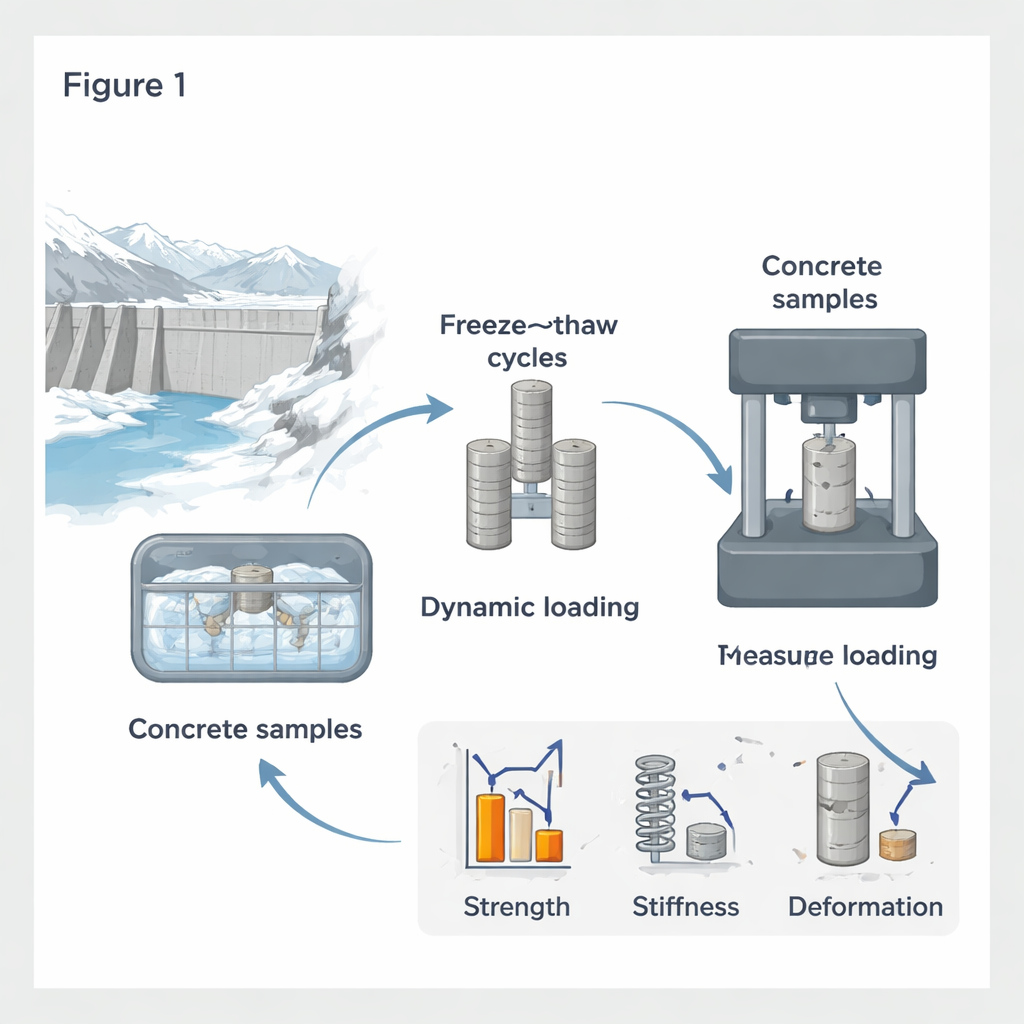
Strength fades, but deformation grows
The team found a clear pattern: as the number of freeze–thaw cycles increased, the concrete’s compressive strength and stiffness (its resistance to being squashed and its “springiness”) steadily declined. After 75 cycles, strength dropped by nearly one-fifth and stiffness by about half under the slowest loading. At the same time, the concrete’s residual strain and peak strain—how much it remained bent and how far it stretched before breaking—grew markedly. In simple terms, the material became softer and more deformable. Faster loading partly hid this damage: when compressed quickly, the concrete retained more of its apparent strength, showing that rapid loading can temporarily mask internal deterioration.
Hidden pores, growing cracks, and changing failure shapes
Imaging of the internal structure revealed how the damage accumulates. Initially, the concrete contained only scattered tiny pores. After 25 cycles, more pores appeared but were still mostly isolated. By 50 cycles, pores and microcracks had expanded and begun to link up, and by 75 cycles a dense network of large, connected cavities had formed. This microscopic evolution matched what was seen on the surface when the samples were crushed. Undamaged concrete tended to split along one or two sharp cracks, breaking into a few wedge-shaped pieces. After many freeze–thaw cycles, the specimens failed more gently but far more extensively, with a bulging shape, many fine fractures, and a lot of powder-like debris, indicating that the internal skeleton had lost its coherence. 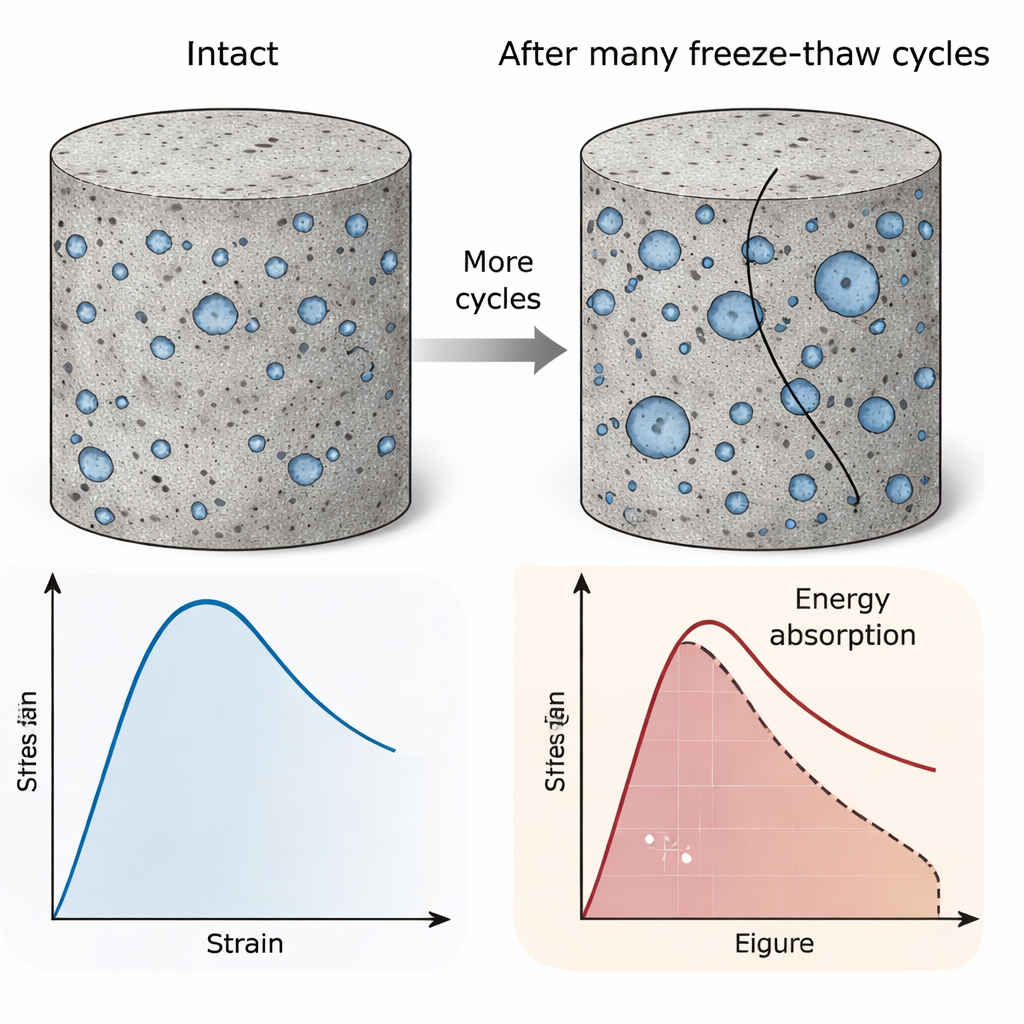
How loading speed and damage interact
By testing at several loading speeds, the researchers were able to quantify how sensitive the damaged concrete was to strain rate—the speed at which it was deformed. As freeze–thaw damage increased, the material’s response to loading speed became stronger. At high strain rates, the inertia of water trapped in pores and the limited time for cracks to grow slowed the spread of damage, so strength appeared relatively higher and stiffness loss was less severe than at slow loading. However, this was not a true recovery: the underlying pore network and crack density still worsened with each cycle, as shown by ultrasonic measurements and three-dimensional pore reconstructions. The stress–strain curves captured this shift: peaks moved downward and to the right, and the shaded area under the curve—representing the energy the concrete could absorb before failure—shrank, showing that the material became less able to dissipate loads.
What this means for real-world structures
For dams, spillways, and other hydraulic works in cold climates, these results highlight that repeated freezing and thawing quietly erode both strength and stiffness, even when the structure still appears sound. Over time, the concrete becomes more flexible but less able to absorb sudden loads without cracking. The study provides mathematical relationships that link the number of freeze–thaw cycles to changes in strength, stiffness, and deformation, giving engineers tools to estimate remaining life and plan maintenance. In plain language, the work shows that winter damage is not just a cosmetic problem: it reshapes the concrete from the inside out, and understanding this process is key to keeping critical water infrastructure safe for decades.
Citation: Cao, Y., Zhou, J., Shao, Y. et al. Experimental study on dynamic mechanical properties and damage mechanisms models of concrete under freeze-thaw cycles. Sci Rep 16, 7796 (2026). https://doi.org/10.1038/s41598-026-39345-2
Keywords: freeze–thaw damage, concrete durability, hydraulic structures, dynamic loading, cold regions